
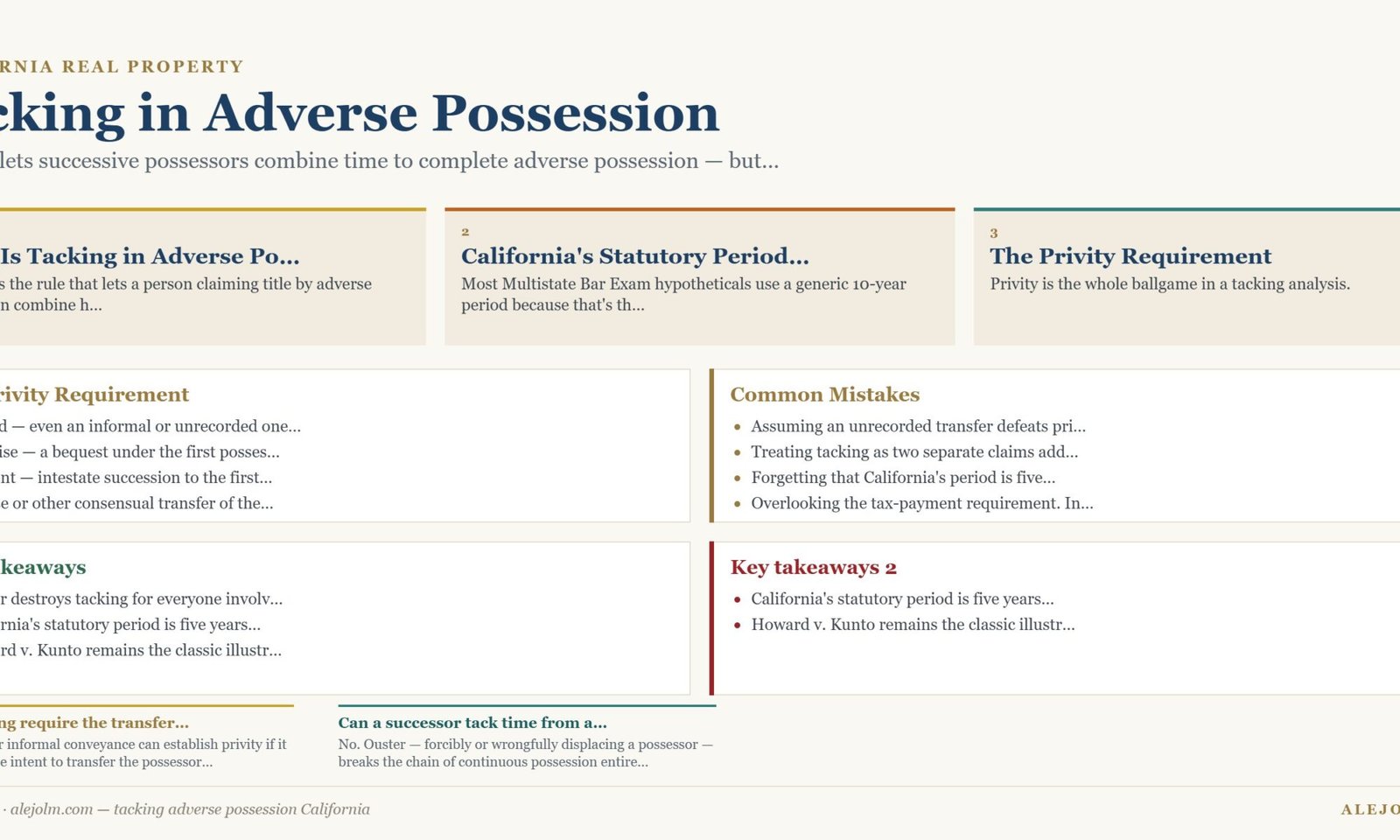
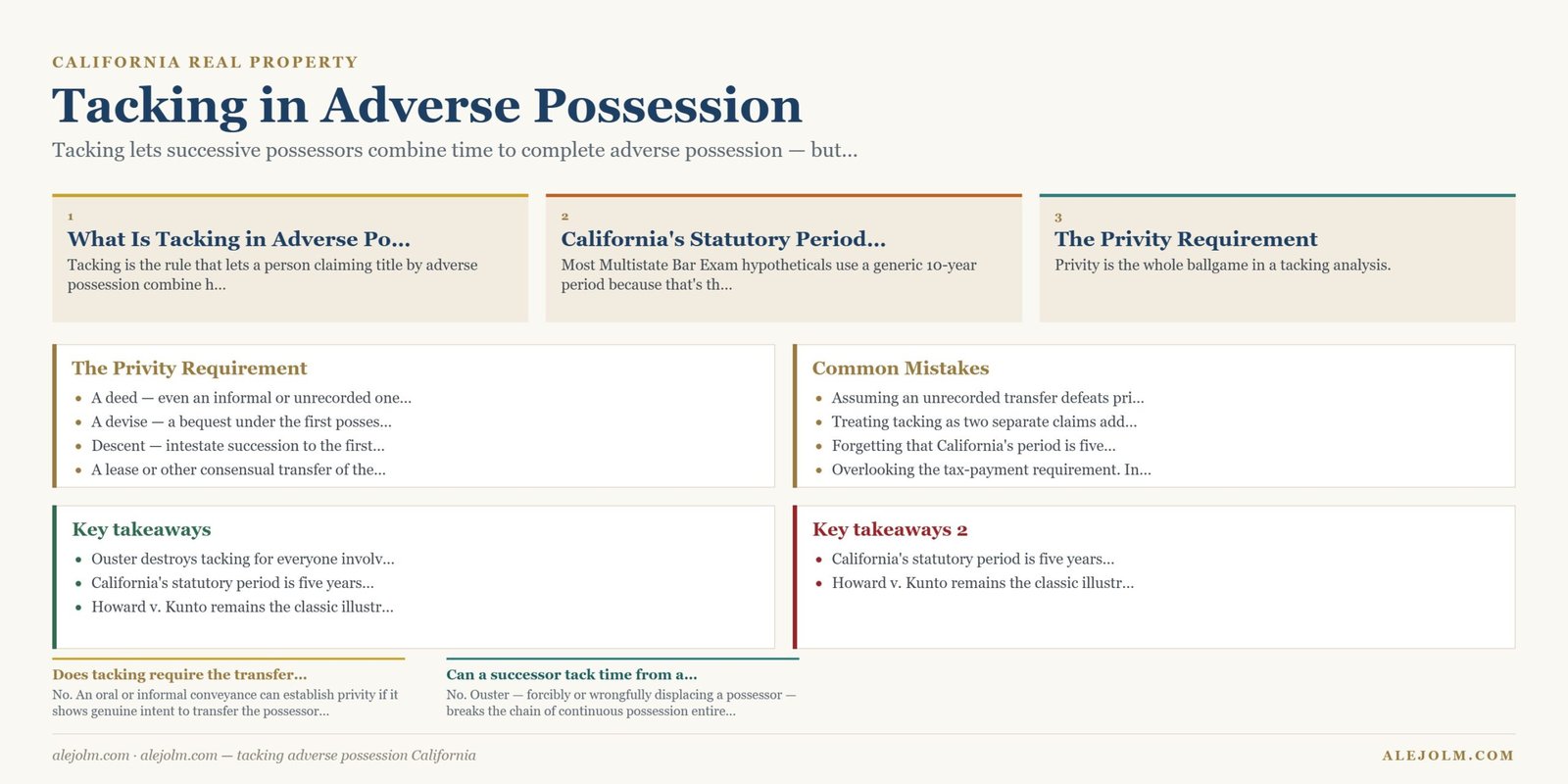
What Is Tacking in Adverse Possession?
Tacking is the rule that lets a person claiming title by adverse possession combine her own time on the land with a predecessor’s time, so the two periods together satisfy the statutory clock. It only works if the successive possessors are connected by privity — a deed, a will, intestate succession, or a lease. Without that legal nexus, each possessor starts from zero.
If you’re studying California real property for the bar, or you’re a landowner sorting out a boundary dispute with a neighbor whose family has occupied a strip of land for decades, tacking is the doctrine that decides whether decades of use actually add up to ownership.
Tacking, in one sentence: it’s the joining of successive periods of adverse possession by different claimants who are connected by privity, so that the second possessor’s time plus the first possessor’s time can together satisfy the jurisdiction’s statutory period.
California’s Statutory Period Is Shorter Than the MBE Default
Most Multistate Bar Exam hypotheticals use a generic 10-year period because that’s the most common default among U.S. states. California is not that state. Under Cal. Code Civ. Proc. § 318, an action to recover real property must be brought within five years of the dispossession. Critically, California also layers on a requirement most other states don’t have: under Cal. Code Civ. Proc. § 325, the possessor must have paid all property taxes levied on the land for the entire five-year period.
That means a California adverse possession (and tacking) analysis has two clocks running simultaneously — occupation and tax payment — and both must add up to five years. When you tack, you’re not just tacking the OCEAN elements (open, continuous, exclusive, actual, notorious/hostile); you’re also tacking, or verifying continuity of, the tax-payment requirement across the successive possessors.
The Privity Requirement
Privity is the whole ballgame in a tacking analysis. It means there’s a non-hostile, legally recognized transfer connecting the first possessor to the second. Courts recognize privity through:
- A deed — even an informal or unrecorded one, so long as it shows intent to transfer the possessory interest.
- A devise — a bequest under the first possessor’s will.
- Descent — intestate succession to the first possessor’s heirs.
- A lease or other consensual transfer of the possessory interest.
What privity is not: a stranger simply moving onto land after the first possessor leaves, dies, or is forced out. If there’s no legal nexus, the second possessor’s clock starts over, and any time the first possessor accumulated is lost for tacking purposes (though it may still support the first possessor’s own separate claim, if timely asserted).
When Tacking Fails: No Privity, or Ouster
Two fact patterns kill a tacking argument every time.
- No privity. A possessor dies without a will and without heirs, or simply abandons the land, and a completely unrelated person moves in. There’s no deed, devise, or descent connecting the two. The newcomer’s clock starts at zero.
- Ouster. The second possessor doesn’t take over peacefully — she forces the first possessor off the land, or takes it by intimidation. Ouster breaks the continuity requirement for both possessors. Neither can tack, and neither can rely on the other’s time.
Worked Example
Rosa occupies a vacant lot behind her house for four years, openly fencing it, mowing it, and paying the property taxes assessed on it each year. She then sells her interest in the lot to her neighbor, Denise, by an informal handwritten deed that says “I convey my interest in the back lot to Denise.” Denise moves the fence line slightly, continues paying the taxes, and occupies the lot openly for one more year.
At the five-year mark, does Denise own the lot by adverse possession?
Analysis: Rosa and Denise are connected by a deed — even though it’s informal and possibly never recorded, it shows Rosa’s intent to transfer her possessory interest and Denise’s intent to take it. That’s privity. Denise can tack Rosa’s four years onto her own one year, reaching the five-year period required under CCP § 318. Because both Rosa and Denise paid the taxes throughout, the CCP § 325 tax requirement is also satisfied continuously. Denise has a strong adverse possession claim.
Change one fact: Rosa simply abandons the lot, and a stranger, Marcus, wanders onto it a year later and starts using it. Marcus has no deed, no relationship to Rosa, and no knowledge of her prior use. Marcus cannot tack Rosa’s four years onto his own — there’s no privity — and his clock starts fresh.
Tacking: Allowed vs. Denied at a Glance
| Scenario | Privity? | Tacking Result |
|---|---|---|
| Seller deeds property to buyer, buyer continues possession | Yes (deed) | Allowed — periods combine |
| Possessor dies, heir inherits and continues possession | Yes (descent) | Allowed — periods combine |
| Possessor dies intestate with no heirs; stranger moves in | No | Denied — stranger’s clock resets |
| Second possessor forcibly evicts the first and takes over | No (ouster) | Denied — continuity broken for both |
| Possessor leases the parcel to a tenant who continues the use | Yes (lease) | Allowed — periods combine |
Common Mistakes
- Assuming an unrecorded transfer defeats privity. Recording isn’t required for privity; intent to transfer is what matters.
- Treating tacking as two separate claims added together. It isn’t. Each successor must be in privity with the immediately preceding possessor — you can’t skip a link in the chain.
- Forgetting that California’s period is five years, not the MBE’s common ten. Answer California-specific essay questions with CCP §§ 318 and 325, not the generic multistate default.
- Overlooking the tax-payment requirement. In California, continuous tax payment throughout the claimed period is not optional — it’s a separate element tacking must also satisfy.
FAQ
Does tacking require the transfer to be recorded?
No. An oral or informal conveyance can establish privity if it shows genuine intent to transfer the possessory interest. Recording affects notice to third parties under California’s recording statutes, not whether privity exists between the two possessors themselves.
Can a successor tack time from a possessor who ousted a prior owner?
No. Ouster — forcibly or wrongfully displacing a possessor — breaks the chain of continuous possession entirely. Neither the ousting party nor anyone claiming through that party can tack across the ouster.
Does California’s tax-payment rule apply during the tacked periods too?
Yes. Because Cal. Code Civ. Proc. § 325 requires continuous tax payment for the full five-year period, a successful tacking claim in California generally requires that taxes were paid (by one possessor or another) throughout the entire combined period, not just during the current possessor’s own portion.
Key Takeaways
- Tacking lets successive adverse possessors combine time, but only if connected by privity: a deed, devise, descent, or lease.
- A stranger who simply moves onto abandoned or vacated land cannot tack — the clock restarts.
- Ouster destroys tacking for everyone involved by breaking continuous possession.
- California’s statutory period is five years under CCP § 318, with a continuous tax-payment requirement under CCP § 325 — both must be satisfied across the tacked periods.
- Howard v. Kunto remains the classic illustration that privity can exist even when the paper description of the land is technically defective, so long as the parties intended to convey the parcel actually possessed.
This article is educational and is not legal advice. Consult a licensed California attorney about your situation.
Related guides
- adverse possession elements in California
- recording acts and priority disputes
- bona fide purchaser and notice rules