
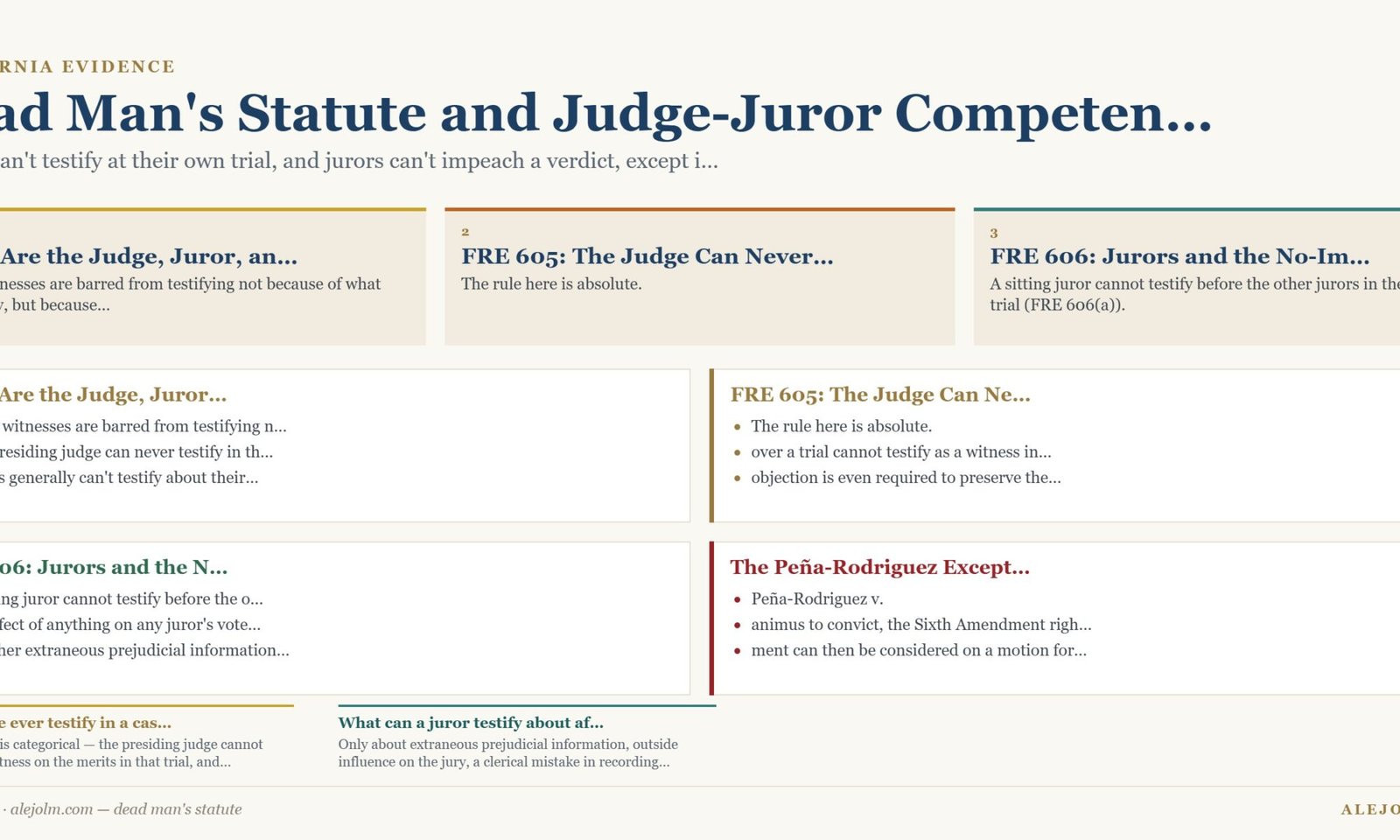

What Are the Judge, Juror, and Dead Man’s Statute Competency Rules?
Some witnesses are barred from testifying not because of what they’d say, but because of who they are. The presiding judge can never testify in the trial they’re conducting. Jurors generally can’t testify about their own deliberations. And in a shrinking minority of states, a Dead Man’s Statute bars an interested witness from testifying about a transaction with someone now deceased.
California Bar Exam questions on this cluster reward precision: know which rule applies to which person, and know that California has abolished one of the three doctrines entirely.
FRE 605 categorically bars the presiding judge from testifying in that trial; FRE 606 bars jurors from testifying about deliberations except for narrow misconduct exceptions; and the Dead Man’s Statute — where it survives — bars an interested party from testifying about dealings with a now-deceased person. California retains the first two rules but has abolished the third.
FRE 605: The Judge Can Never Testify
The rule here is absolute. A judge presiding over a trial cannot testify as a witness in that same trial — on the merits, not on routine procedural matters. No objection is even required to preserve the issue; the testimony is incompetent per se the moment it’s offered. The rationale is simple: judicial neutrality collapses the instant the judge becomes a fact witness in their own courtroom.
FRE 606: Jurors and the No-Impeachment Rule
A sitting juror cannot testify before the other jurors in the same trial (FRE 606(a)). After the trial, FRE 606(b) bars jurors from testifying about anything said or done during deliberations, the effect of anything on any juror’s vote, or any juror’s mental processes — with three textual exceptions:
- Whether extraneous prejudicial information reached the jury.
- Whether an outside influence was improperly brought to bear on any juror.
- Whether a mistake was made in entering the verdict on the verdict form.
The line that matters most: a juror can testify to the fact that misconduct occurred (“I researched the case online”), but not to its effect on their reasoning (“and it changed my vote”). Facts about exposure are testimonial; internal mental processes are protected.
The Peña-Rodriguez Exception for Racial Bias
Peña-Rodriguez v. Colorado carved out a fourth, constitutionally-compelled exception that sits outside FRE 606(b)’s text entirely: where a juror makes a clear statement relying on racial or similarly invidious stereotypes or animus to convict, the Sixth Amendment right to an impartial jury requires that the no-impeachment rule yield. That juror’s statement can then be considered on a motion for new trial, even though nothing in Rule 606(b) itself authorizes it.
The Dead Man’s Statute: Abolished in California
This is the clean CEC vs. FRE contrast in this cluster — except it isn’t really a contrast in rule text, it’s a contrast in survival. The FRE never codified a Dead Man’s Statute at all, and California affirmatively abolished its own version.
| Issue | Federal Rule | California Rule |
|---|---|---|
| Dead Man’s Statute exists? | No — not codified in the FRE | No — California has ABOLISHED its version |
| Where the doctrine survives | A minority of other states, often narrowed | Nowhere in California |
| Effect where it does survive | Bars an interested party-witness from testifying about transactions/communications with the deceased when the estate is a party | N/A in California |
| Exam relevance | Flag only if a non-federal, non-California jurisdiction is invoked | Never apply in a California-law essay |
Where the statute does survive elsewhere, it’s narrow: it disqualifies testimony only on the specific transaction with the deceased, not the witness’s testimony generally. On the California Bar Exam, the correct move is almost always to note that the doctrine doesn’t apply — full stop.
Worked Example: The Juror Who Googled the Case
During deliberations in a medical-malpractice trial, a juror who works as a nurse researches the disputed procedure online, finds articles contradicting the defense expert, and shares them with the rest of the jury. The jury returns a plaintiff’s verdict. Defense counsel moves for a new trial and seeks the juror’s testimony.
The juror may testify to the fact that extraneous information — the online research — reached the jury; that falls squarely within the FRE 606(b) exception for extraneous prejudicial information. The juror may not testify about whether that research actually changed anyone’s vote; that’s protected mental-process testimony. Whether the misconduct justifies a new trial then turns on whether the defense can show the extraneous information was prejudicial enough to make the trial unfair — a separate showing from the juror’s testimony itself.
Common Mistakes on the Bar Exam
- Merging FRE 605 and FRE 606. FRE 605 (judge) has no exceptions at all; FRE 606 (juror) has three textual exceptions plus the Peña-Rodriguez constitutional exception.
- Assuming jurors can testify freely about deliberations. They can’t — only about extraneous influence, outside contact, or a clerical verdict-form mistake.
- Forgetting the third FRE 606(b) exception. Students remember extraneous information and outside influence, but forget the clerical-mistake-on-the-verdict-form exception.
- Applying the Dead Man’s Statute in a California essay. It’s abolished in California; only raise it if the fact pattern explicitly invokes another state’s law.
Frequently Asked Questions
Can a judge ever testify in a case they’re presiding over?
No. FRE 605 is categorical — the presiding judge cannot testify as a witness on the merits in that trial, and no objection is even required to bar the attempt.
What can a juror testify about after a trial ends?
Only about extraneous prejudicial information, outside influence on the jury, a clerical mistake in recording the verdict, or — under Peña-Rodriguez — a clear statement of racial or similar bias during deliberations. Internal reasoning and how the juror voted remain off-limits.
Does California still have a Dead Man’s Statute?
No. California has abolished it entirely. It survives, narrowly, only in a minority of other states — never raise it in a California-law analysis.
Key Takeaways
- FRE 605 categorically bars the presiding judge from testifying in their own trial, with no exceptions.
- FRE 606(b) bars juror testimony about deliberations except for extraneous information, outside influence, and clerical verdict-form mistakes.
- Peña-Rodriguez v. Colorado adds a constitutional exception for clear statements of racial or similar bias during deliberations.
- California has abolished its Dead Man’s Statute; the FRE never codified one at all.
- Distinguish testimony about the fact of juror misconduct (allowed) from testimony about its effect on deliberations (protected).
This article is educational and is not legal advice. Consult a licensed California attorney about your situation.
Related guides
- witness sequestration rule
- presumptions and burdens in California evidence
- witness examination objections