
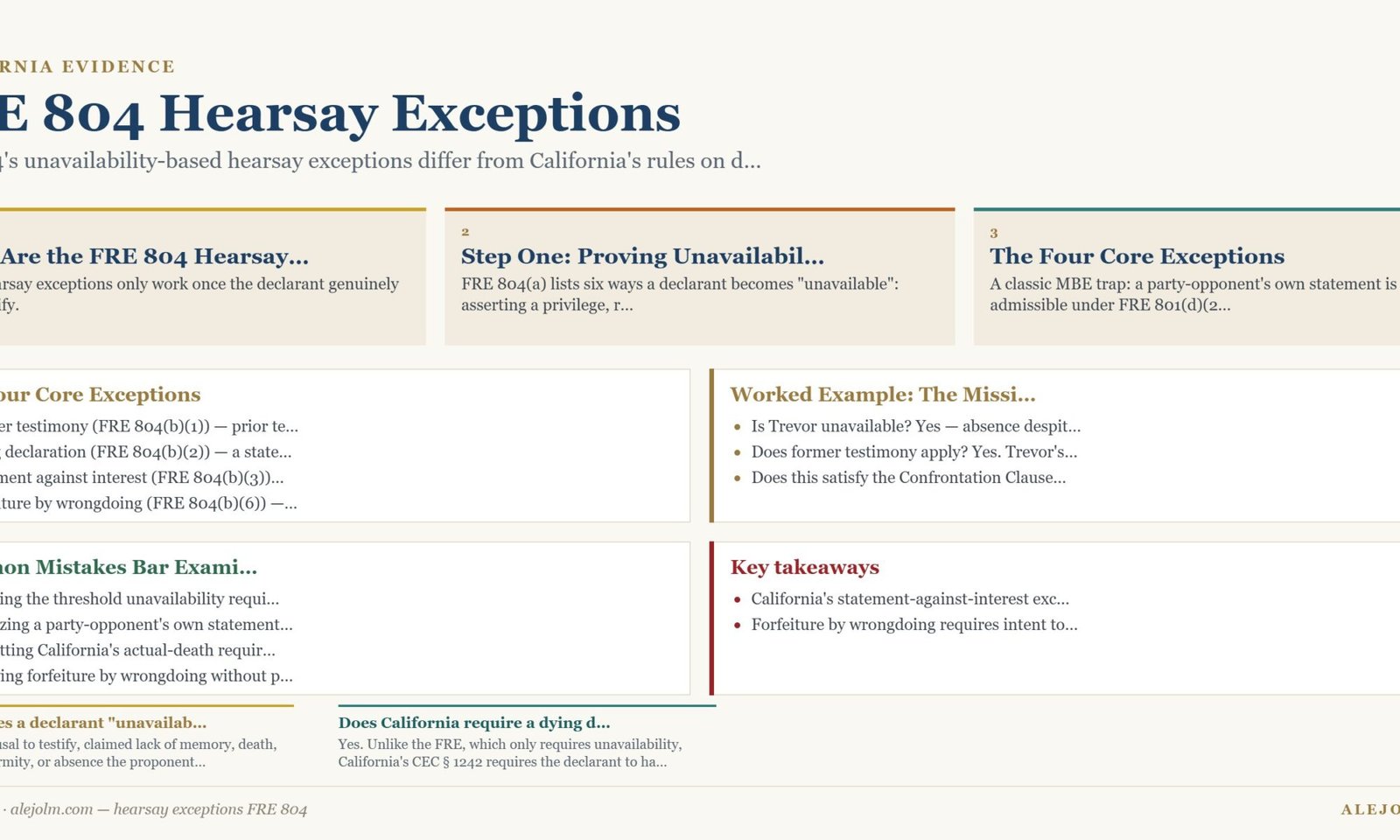
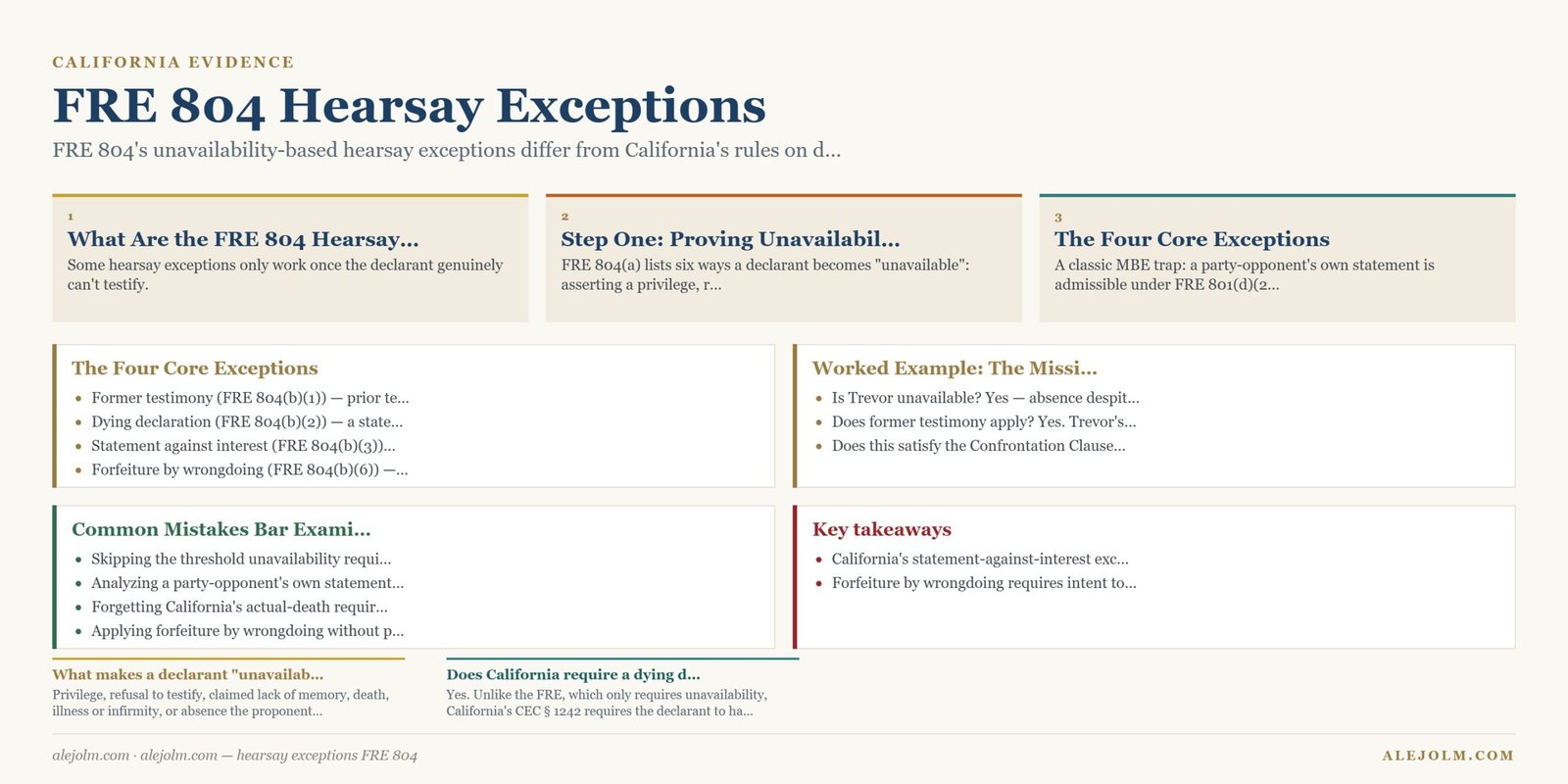
What Are the FRE 804 Hearsay Exceptions?
Some hearsay exceptions only work once the declarant genuinely can’t testify. FRE 804 covers exactly that scenario: former testimony, dying declarations, statements against interest, and forfeiture by wrongdoing — all of which require proving unavailability first. California’s version of these exceptions diverges from the FRE in ways that show up on the bar exam over and over.
FRE 804 hearsay exceptions, defined: hearsay exceptions — including dying declarations, statements against interest, former testimony, and forfeiture by wrongdoing — that apply only after the proponent establishes the declarant is unavailable to testify, whether due to privilege, memory loss, death, illness, or absence.
Step One: Proving Unavailability
FRE 804(a) lists six ways a declarant becomes “unavailable”: asserting a privilege, refusing to testify, claiming lack of memory, death, illness or infirmity, or absence the proponent can’t remedy. Under federal law, a flat refusal to testify is enough on its own.
California is stricter. A mere refusal doesn’t establish unavailability unless it stems from fear, and a claimed memory loss must be total as to the subject — selective or convenient amnesia doesn’t count. This gap matters tactically: a California litigant facing a reluctant witness may need to force actual testimony (or an on-the-record admission of total memory loss) before an exception can apply.
The Four Core Exceptions
- Former testimony (FRE 804(b)(1)) — prior testimony given under oath, where the party against whom it’s offered had an opportunity and similar motive to cross-examine.
- Dying declaration (FRE 804(b)(2)) — a statement made while believing death is imminent, about the cause or circumstances of the death, admissible only in civil cases and homicide prosecutions.
- Statement against interest (FRE 804(b)(3)) — a statement so contrary to the declarant’s pecuniary, proprietary, or penal interest that a reasonable person wouldn’t have made it unless it were true; if it’s used to exculpate a criminal defendant, it also needs corroborating circumstances.
- Forfeiture by wrongdoing (FRE 804(b)(6)) — a party can’t benefit from making a witness unavailable through wrongdoing intended to prevent testimony, per Giles v. California (2008).
A classic MBE trap: a party-opponent’s own statement is admissible under FRE 801(d)(2) regardless of unavailability, and regardless of whether it was against interest when made. Students who reach for FRE 804(b)(3) when the declarant is actually a party to the case are overcomplicating a simpler analysis — check 801(d)(2) first.
California’s Version: Four Major Differences
California’s Evidence Code recognizes the same four categories, but with distinct twists that bar examiners test heavily.
| Issue | FRE 804 (Federal) | CEC (California) |
|---|---|---|
| Refusal to testify | Sufficient on its own for unavailability | Only if refusal stems from fear |
| Memory loss | Any claimed lack of memory | Must be total as to the subject |
| Dying declaration scope | Civil cases and homicide prosecutions only; requires only unavailability | Applies in all civil and criminal cases, but requires the declarant to actually die (CEC § 1242) |
| Statement against interest | Pecuniary, proprietary, or penal interest | Broader — also covers statements against the declarant’s social interest (hatred, ridicule, disgrace) (CEC § 1230) |
| Former testimony | Requires a “predecessor in interest” in civil cases | Civil cases only; no predecessor requirement — a party with a similar interest and opportunity to examine suffices (CEC § 1292) |
| Forfeiture by wrongdoing standard | Preponderance of the evidence | Clear and convincing evidence (CEC § 1350) |
The dying declaration comparison is the one students most often get backward: federal law is broader on scope of proceedings (any civil case, plus homicide prosecutions) but only needs unavailability, while California applies the exception more broadly across all civil and criminal cases but demands the declarant actually die.
Forfeiture by Wrongdoing and the Confrontation Clause
Forfeiture by wrongdoing carries constitutional weight because it can defeat a defendant’s Confrontation Clause objection, not just a hearsay objection. Giles v. California requires that the wrongdoing be done with the intent to prevent the declarant from testifying — wrongdoing that merely happens to cause unavailability (with no such intent) doesn’t trigger forfeiture, for hearsay or constitutional purposes. California’s higher clear-and-convincing standard (versus the federal preponderance standard) makes forfeiture somewhat harder to establish in California courts, even though the underlying intent requirement is identical.
Worked Example: The Missing Witness
A witness, Trevor, testifies at a preliminary hearing that the defendant confessed to a robbery; defense counsel cross-examines him. By the time of trial, Trevor has vanished despite the prosecution’s diligent search.
- Is Trevor unavailable? Yes — absence despite diligent effort to procure him satisfies FRE 804(a)(6).
- Does former testimony apply? Yes. Trevor’s preliminary hearing testimony was given under oath, and the defendant had an opportunity and similar motive to cross-examine.
- Does this satisfy the Confrontation Clause too? Yes — the prior opportunity to cross-examine generally satisfies confrontation, so the testimony can come in even without Trevor live at trial.
Now change the facts: Trevor was murdered by the defendant specifically to keep him from testifying. Under Giles, this triggers forfeiture by wrongdoing — but in California, the prosecution must prove that intent by clear and convincing evidence, a notably higher bar than the federal preponderance standard.
Common Mistakes Bar Examiners Test
- Skipping the threshold unavailability requirement and jumping straight to the exception’s substantive elements.
- Analyzing a party-opponent’s own statement under FRE 804(b)(3) instead of the simpler FRE 801(d)(2), which requires no unavailability at all.
- Forgetting California’s actual-death requirement for dying declarations — a severely injured but surviving witness satisfies FRE 804(b)(2) but not CEC § 1242.
- Applying forfeiture by wrongdoing without proving the wrongdoer’s specific intent to prevent testimony, as Giles requires.
Frequently Asked Questions
What makes a declarant “unavailable” under FRE 804?
Privilege, refusal to testify, claimed lack of memory, death, illness or infirmity, or absence the proponent cannot remedy through reasonable means — any one of these six categories satisfies FRE 804(a).
Does California require a dying declarant to actually die?
Yes. Unlike the FRE, which only requires unavailability, California’s CEC § 1242 requires the declarant to have actually died for the dying declaration exception to apply.
What does forfeiture by wrongdoing require?
Proof that a party caused the declarant’s unavailability through wrongdoing specifically intended to prevent the declarant from testifying, per Giles v. California — mere causation without that intent isn’t enough, and California requires clear and convincing evidence of it.
Key Takeaways
- FRE 804 exceptions require proving unavailability first, under one of six defined categories.
- California’s unavailability standard is stricter for refusals (must stem from fear) and memory loss (must be total).
- California requires actual death for a dying declaration but applies the exception across all civil and criminal cases, unlike the FRE’s narrower scope.
- California’s statement-against-interest exception reaches social interest, broader than the federal pecuniary/proprietary/penal categories.
- Forfeiture by wrongdoing requires intent to prevent testimony under both systems, but California demands clear and convincing evidence, not mere preponderance.
Related guides
- hearsay exceptions under FRE 803
- hearsay rule basics
- non-hearsay statements not offered for truth
- witness impeachment methods
Sources and further reading
This article is educational and is not legal advice. Consult a licensed California attorney about your situation.