

What Is Rule 3.6 in California Legal Ethics?
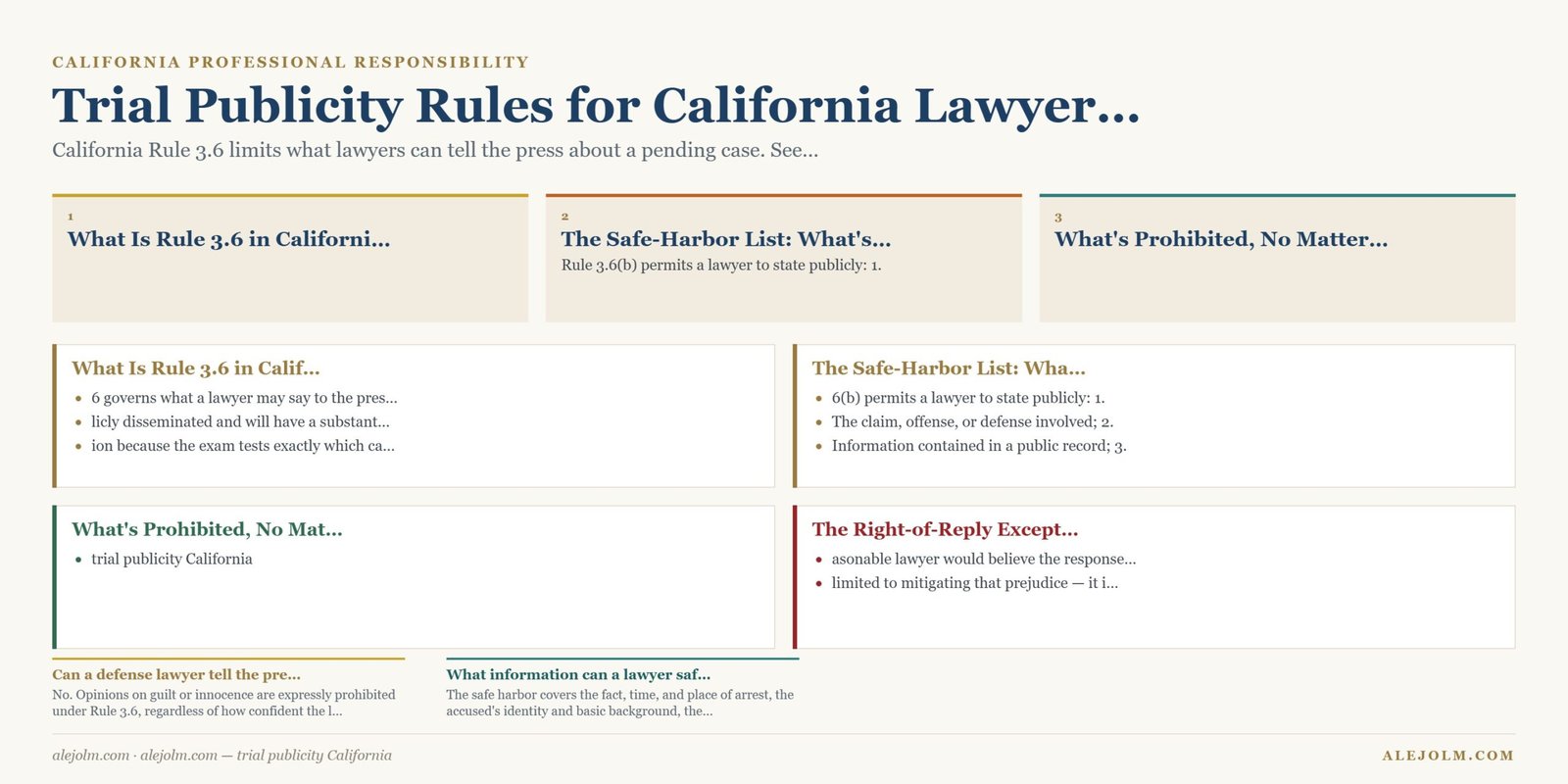
Rule 3.6 governs what a lawyer may say to the press or public about a pending matter. In one sentence: a lawyer must not make an extrajudicial statement she knows or reasonably should know will be publicly disseminated and will have a substantial likelihood of materially prejudicing an adjudicative proceeding. California and the ABA Model Rule share the same basic safe-harbor structure, but the rule rewards careful memorization because the exam tests exactly which categories of statement are permitted and which are flatly prohibited.
The Safe-Harbor List: What’s Permitted
Rule 3.6(b) permits a lawyer to state publicly:
- The claim, offense, or defense involved;
- Information contained in a public record;
- The general scope or status of an ongoing investigation;
- Scheduling or the result of any step in litigation;
- A request for assistance in obtaining evidence;
- A warning of danger to a person or the public; and, in criminal cases only:
- The accused’s identity, residence, occupation, and family status;
- Information needed for apprehension of a suspect;
- The fact, time, and place of an arrest; and
- The identity of investigating or arresting officers and the length of the investigation.
What’s Prohibited, No Matter How Truthful
| Category | Status |
|---|---|
| Character, credibility, or reputation of a party or witness | Prohibited |
| Possibility of a guilty plea or contents of a defendant’s statement | Prohibited |
| Opinion on guilt or innocence | Prohibited |
| Test results | Prohibited |
| Evidence likely to be inadmissible | Prohibited |
| Safe-harbor facts (claim, public record, scheduling, arrest basics) | Permitted |
| Limited right-of-reply to unprompted negative publicity | Permitted |
The Right-of-Reply Exception
Rule 3.6(c) lets a lawyer respond to recent publicity not initiated by the lawyer or client, if a reasonable lawyer would believe the response is necessary to protect the client from substantial undue prejudice. The reply must be strictly limited to mitigating that prejudice — it is not a license to launch an affirmative campaign about the merits.
Worked Example: The Prohibited Guilt Opinion
Defense counsel for a client charged with a high-profile violent crime holds a press conference and tells reporters: “Any intelligent jury will find my client did not commit this crime. This is a witch-hunt by a prosecutor bolstering his political ambitions.” This violates Rule 3.6. “Any intelligent jury will find my client did not commit this crime” is a direct opinion on guilt or innocence — flatly prohibited — and it also pressures the jury pool by implying that acquittal equals intelligence. The attack on the prosecutor’s motives isn’t a safe-harbor statement either, and no right-of-reply exception applies because there was no prior publicity prompting it. Discipline follows.
Worked Example: Safe Harbor, Then a Misstep
A prosecutor’s office announces: “John Doe, 42, was arrested yesterday at 2:15 p.m. at his residence on charges of wire fraud and conspiracy. Detective Maria Smith, known for her ability to apprehend guilty criminals, led the investigation.” The first half — identity, charge, time, place, date of arrest, name of the investigating officer — falls squarely within the criminal-case safe harbor and is permitted. But “known for her ability to apprehend guilty criminals” implies the defendant is guilty because a capable detective caught him. That crosses into a prohibited opinion on guilt, and it can also trigger Rule 3.8(f)’s heightened prosecutor-specific publicity duties.
Worked Example: A Proper Right-of-Reply
Defense counsel in an accident case gives an inflammatory, inaccurate press interview about the facts before trial. In response, plaintiff’s counsel issues a carefully worded statement limited to correcting the specific factual mischaracterizations. This is a proper right-of-reply under Rule 3.6(c): there was prior publicity not initiated by plaintiff’s counsel, the reply is narrowly tailored to mitigating the prejudice, and it isn’t an affirmative campaign about the merits.
Why the Rule Exists
Lawyers have real First Amendment interests in public speech, but statements about pending cases can taint the jury pool and undermine a fair proceeding. The safe-harbor categories let lawyers share objective, largely uncontroversial information, while the prohibited categories — guilt opinions, character attacks, test results — are precisely the statements most likely to prejudice a jury before it hears any evidence.
Common Mistakes on Rule 3.6 Questions
- Confusing safe-harbor facts with commentary layered on top. Stating an arrest’s time and place is fine; adding a characterization (“known for catching guilty criminals”) is not.
- Assuming right-of-reply covers any response to bad press. It only covers publicity not initiated by the lawyer or client, and only to the extent necessary to mitigate the prejudice.
- Overlooking prosecutors’ extra duties. Rule 3.8(f) layers additional trial-publicity obligations onto prosecutors specifically.
- Treating “vigorous advocacy” as an excuse for guilt opinions. No amount of conviction in the client’s innocence makes a public guilt/innocence opinion permissible.
FAQ
Can a defense lawyer tell the press the client is innocent?
No. Opinions on guilt or innocence are expressly prohibited under Rule 3.6, regardless of how confident the lawyer is or how sympathetic the client’s situation.
What information can a lawyer safely share about an arrest?
The safe harbor covers the fact, time, and place of arrest, the accused’s identity and basic background, the charges, and the identity of investigating or arresting officers — but not commentary implying guilt.
When is a right-of-reply statement permitted?
Only when responding to recent publicity the lawyer or client did not initiate, and only to the extent a reasonable lawyer believes is necessary to protect the client from substantial undue prejudice — not as a platform for broader commentary.
Key Takeaways
- Rule 3.6 bars extrajudicial statements with a substantial likelihood of materially prejudicing a proceeding.
- A specific safe-harbor list permits objective facts like scheduling, arrest basics, and public-record information.
- Opinions on guilt or innocence, character attacks, and test results are always prohibited.
- The right-of-reply exception is narrow — limited to mitigating unprompted, prejudicial publicity.
- Trial publicity is a recurring topic on the California Bar Exam, especially paired with prosecutor-specific duties.
This article is educational and is not legal advice. Consult a licensed California attorney about your situation.
Related guides
- bar admission honesty rules
- abuse of the legal system under Rule 4.4(a)
- truthfulness to third parties under Rule 4.1
- California’s lawyer non-compete rule