
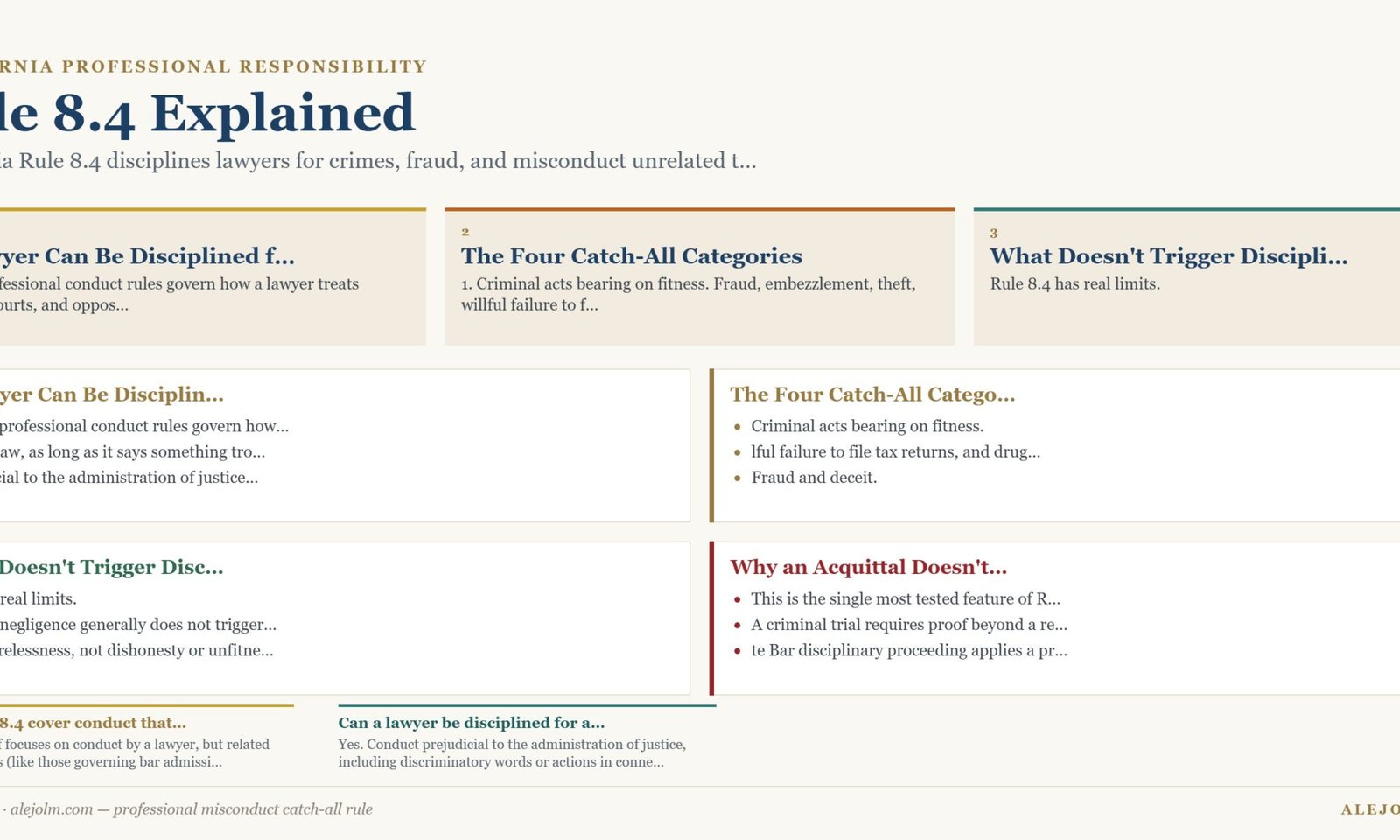
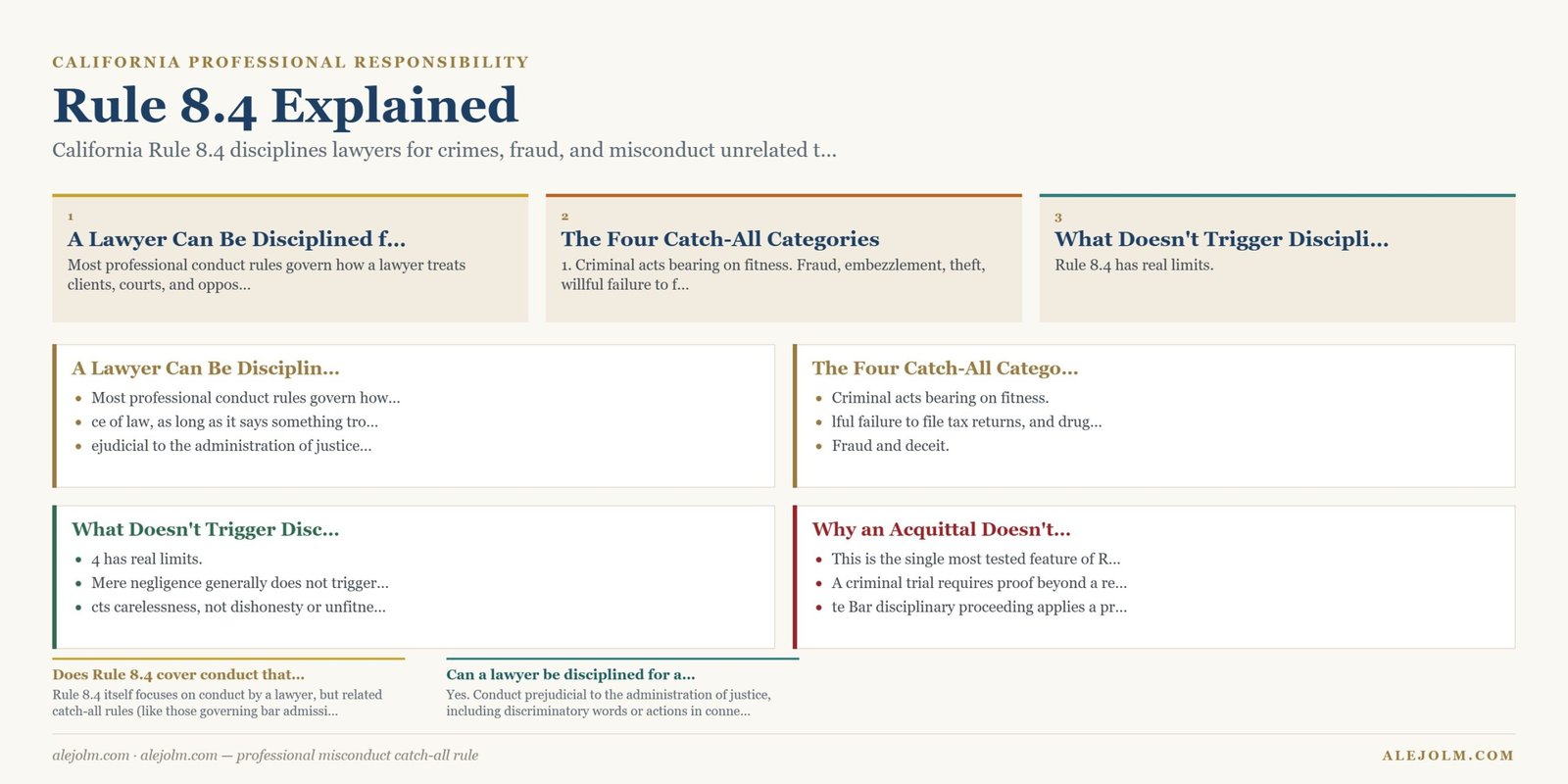
A Lawyer Can Be Disciplined for Conduct That Has Nothing to Do With Practicing Law
Most professional conduct rules govern how a lawyer treats clients, courts, and opposing counsel. Rule 8.4 is different — it’s a catch-all that reaches conduct completely outside the practice of law, as long as it says something troubling about whether the person is fit to hold a law license at all.
Rule 8.4 authorizes discipline for four broad categories of conduct: criminal acts reflecting adversely on honesty, trustworthiness, or fitness to practice; fraud and deceit even outside a criminal context; conduct prejudicial to the administration of justice; and suggesting improper influence over a government decision-maker. None of these require the misconduct to be connected to the lawyer’s law practice, and a criminal acquittal does not automatically shield a lawyer from Bar discipline for the same underlying conduct.
The Four Catch-All Categories
- Criminal acts bearing on fitness. Fraud, embezzlement, theft, willful failure to file tax returns, and drug offenses all qualify — even when entirely unconnected to legal work.
- Fraud and deceit. Civil, noncriminal dishonesty — for example, selling a house while knowingly concealing a mold problem — falls within the rule too.
- Conduct prejudicial to the administration of justice. This includes discrimination or bias that undermines confidence in the legal system.
- Suggesting improper influence. Implying the ability to improperly sway a judge or government official, or facilitating judicial misconduct.
What Doesn’t Trigger Discipline
Rule 8.4 has real limits. Mere negligence generally does not trigger discipline. A speeding ticket or an ordinary traffic accident reflects carelessness, not dishonesty or unfitness — it doesn’t implicate the character traits the rule cares about.
| Conduct | Discipline Under Rule 8.4? | Why |
|---|---|---|
| Embezzling from a non-client trust fund | Yes | Criminal act reflecting on honesty, even though unrelated to law practice |
| Ordinary speeding ticket | No | Mere negligence, not dishonesty or unfitness |
| Concealing known defects in a personal real-estate sale | Yes | Fraud and deceit, even though noncriminal |
| Acquittal on tax evasion charges | Discipline still possible | Bar applies its own, lower evidentiary standard |
| Advising a witness to fabricate a police report | Yes | Fraud and deceit, plus likely other rule violations |
Why an Acquittal Doesn’t End the Inquiry
This is the single most tested feature of Rule 8.4. A criminal trial requires proof beyond a reasonable doubt. A State Bar disciplinary proceeding applies a preponderance of the evidence standard — a meaningfully lower bar. Because the two proceedings are independent, with different burdens and different fact-finders, an acquittal in criminal court doesn’t preclude the Bar from separately concluding that the conduct occurred and imposing discipline.
Worked Example: The Bank Embezzler
Attorney Robert works a side job at a bank and is convicted of embezzling $500,000 from a family trust account entirely unconnected to any of his legal clients. He falsified records, concealed withdrawals, and lied to the trust’s beneficiaries. None of this touched his law practice in any way.
Robert is still subject to Rule 8.4 discipline. The rule doesn’t require a connection to legal work — it asks whether the criminal act reflects adversely on honesty, trustworthiness, or fitness to practice. Deliberately falsifying records and stealing half a million dollars answers that question clearly: someone willing to do that with a trust account raises real doubts about whether they can be trusted with client funds, confidential information, or the integrity of legal proceedings generally.
Contrast that with a lawyer who gets a routine speeding ticket for driving 55 in a 45 zone. That’s a legal violation, but it’s ordinary negligence — a momentary lapse, not a character flaw bearing on honesty or trustworthiness. Rule 8.4 doesn’t reach it.
Now suppose a different lawyer is prosecuted for tax evasion and acquitted because the prosecution couldn’t prove intent beyond a reasonable doubt. The State Bar, reviewing the same underlying evidence under its own preponderance standard, independently concludes the lawyer did conceal income and acted dishonestly toward the IRS. Discipline can still follow. The criminal acquittal resolved only the criminal case; it says nothing about what the Bar, applying a different and lower standard, is entitled to conclude.
Common Mistakes
- Assuming misconduct must relate to the practice of law. Personal criminal conduct or civil fraud entirely outside legal work can still trigger discipline.
- Treating a criminal acquittal as dispositive. The Bar applies its own independent standard and isn’t bound by a criminal court’s outcome.
- Overlooking Rule 8.4 as a backup theory. When a lawyer violates a specific rule through dishonest conduct, Rule 8.4 often provides an independent, additional basis for discipline.
- Lumping all criminal conduct together. Negligence-based offenses like traffic violations are treated differently from crimes involving dishonesty, theft, or fraud.
- Underestimating the reach of “prejudicial to the administration of justice.” Discriminatory conduct or bias can trigger discipline under this category even without a specific victim complaint.
FAQ
Does Rule 8.4 cover conduct that occurred before the lawyer was admitted to the Bar?
Rule 8.4 itself focuses on conduct by a lawyer, but related catch-all rules (like those governing bar admission statements) address pre-admission honesty. Ongoing conduct reflecting on fitness, discovered after admission, can still be evaluated under Rule 8.4.
Can a lawyer be disciplined for a single act of bias or discrimination?
Yes. Conduct prejudicial to the administration of justice, including discriminatory words or actions in connection with legal practice, falls within Rule 8.4’s fourth catch-all category.
Is intent required for every category under Rule 8.4?
Not necessarily. While criminal acts and fraud typically involve some level of intent or recklessness, the rule’s overall reach extends to conduct reflecting on fitness broadly, which can include reckless behavior in addition to purely intentional acts.
Key Takeaways
- Rule 8.4 disciplines conduct bearing on honesty, trustworthiness, or fitness to practice, even when entirely unconnected to legal work.
- Mere negligence, like an ordinary traffic ticket, does not trigger discipline under this rule.
- A criminal acquittal does not prevent Bar discipline because the Bar applies a lower, independent evidentiary standard.
- The rule covers four categories: criminal acts, fraud and deceit, conduct prejudicial to justice, and suggesting improper influence.
- Rule 8.4 often serves as a backup basis for discipline layered on top of violations of more specific rules.
Related guides
- California’s duty to accept court appointments
- California Rule 4.4(b) on inadvertent privileged documents
- conflicts of interest
Sources and further reading
This article is educational and is not legal advice. Consult a licensed California attorney about your situation.