
Lawyers Aren’t Required to Take Every Client — Except When a Court Says So
Despite holding a legal monopoly on providing legal services, a lawyer has no general obligation to accept any particular client. You can decline a case for almost any reason. That freedom disappears the moment a court appoints you — at that point, the default flips, and you must accept unless you can show good cause to decline.
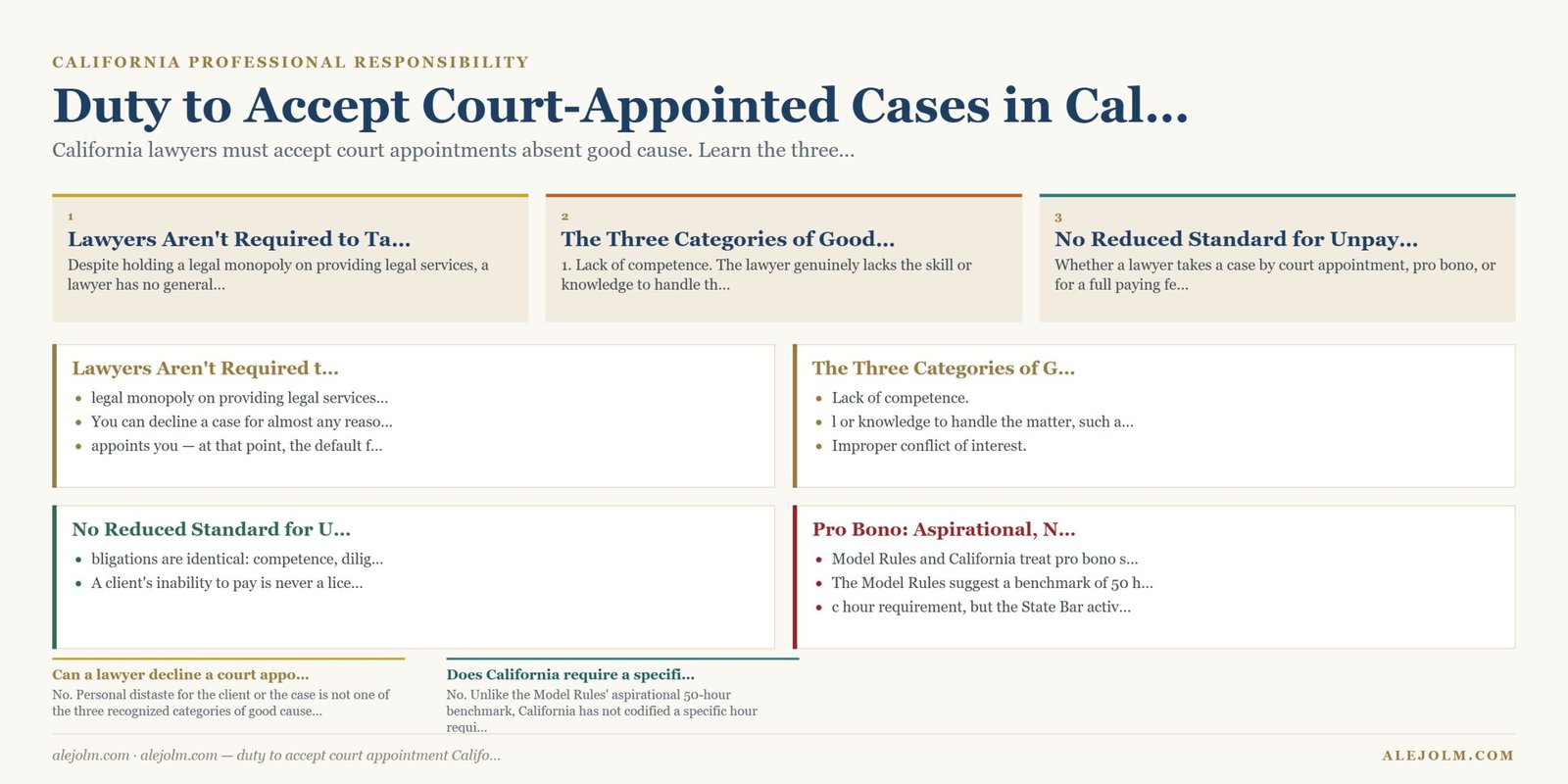
As a general rule, California lawyers have no duty to accept a client, but Rules 6.1 and 6.2 require a lawyer to accept a court appointment — such as representing an indigent criminal defendant — unless good cause exists to decline. Good cause falls into three categories: lack of competence, an improper conflict of interest, or an unjust financial burden. Once accepted, court-appointed and pro bono clients receive exactly the same standard of representation as paying clients.
The Three Categories of Good Cause
- Lack of competence. The lawyer genuinely lacks the skill or knowledge to handle the matter, such as a traffic-ticket practitioner appointed to a capital murder trial.
- Improper conflict of interest. The lawyer already represents someone with adverse interests in the same matter, such as a co-defendant.
- Unjust financial burden. Accepting would threaten the lawyer’s ability to sustain a practice or earn a livelihood — not merely reduce income for a while.
Courts apply the financial-burden category narrowly. Mere inconvenience or a temporary income dip typically isn’t enough; the burden has to be disproportionate and threaten the lawyer’s practice itself.
No Reduced Standard for Unpaying Clients
Whether a lawyer takes a case by court appointment, pro bono, or for a full paying fee, the professional obligations are identical: competence, diligence, communication, and confidentiality all apply at full strength. A client’s inability to pay is never a license to cut corners.
| Category | Applies To | Standard |
|---|---|---|
| Competence | Paying, court-appointed, and pro bono clients | Identical |
| Diligence | Paying, court-appointed, and pro bono clients | Identical |
| Confidentiality | Paying, court-appointed, and pro bono clients | Identical |
| Duty to accept the representation in the first place | Only court-appointed matters | No duty for ordinary retained matters |
Pro Bono: Aspirational, Not Mandatory
Both the Model Rules and California treat pro bono service as an ethical aspiration rather than a mandatory obligation. The Model Rules suggest a benchmark of 50 hours per year of pro bono service to people of limited means. California has not codified a specific hour requirement, but the State Bar actively encourages pro bono work through its own programs and reporting.
Worked Example: The Overmatched Solo Practitioner
Priya has run a solo criminal-defense practice for five years, handling traffic tickets and misdemeanor drug cases almost exclusively. A California court appoints her to defend a client facing a capital murder charge involving DNA evidence, ballistics experts, and the possibility of a death sentence — a case entirely outside anything Priya has ever handled.
Good cause to decline clearly exists under the lack-of-competence category, and the court should appoint someone with actual capital-defense experience instead. But if Priya accepts the appointment anyway — voluntarily taking on a case she was entitled to decline — declining the responsibility upfront does not excuse inadequate representation once she’s in. She now owes the client the same competence a capital-defense specialist would provide: retaining forensic and ballistics experts, studying capital procedure quickly, and building an adequate defense, or she faces both discipline and civil malpractice exposure for underperforming.
Now compare a different scenario: Priya already represents Co-Defendant A in a multi-defendant case, and the court appoints her to also represent Co-Defendant B in the same prosecution. Here, good cause exists under the conflict-of-interest category — A and B’s interests are likely to diverge (one might want a plea, the other might want trial; each might implicate the other). The court needs to appoint separate counsel for B rather than allow Priya to represent both.
Common Mistakes
- Accepting a specialized appointment without honestly assessing competence. Taking on capital defense, securities litigation, or patent work without the underlying skill set.
- Ignoring an unaddressed conflict and hoping it won’t matter. Representing two parties with divergent interests in the same appointed matter.
- Cutting corners for unpaying clients. Investigating less, preparing less, or strategizing less for a court-appointed or pro bono client than for a paying one.
- Confusing “no duty to accept” with permissible discrimination. Declining a retained client based on race, ethnicity, or personal disapproval is not legitimate good cause — that’s a different problem entirely, distinct from the court-appointment context.
- Overstating financial hardship. Claiming “good cause” over a modest, temporary income reduction rather than a genuine threat to the practice’s survival.
FAQ
Can a lawyer decline a court appointment simply because the client is unlikeable or the case is unpopular?
No. Personal distaste for the client or the case is not one of the three recognized categories of good cause. Declining on that basis is itself problematic and unrelated to the legitimate exceptions.
Does California require a specific number of pro bono hours per year?
No. Unlike the Model Rules’ aspirational 50-hour benchmark, California has not codified a specific hour requirement, though the State Bar actively promotes and tracks pro bono participation.
If a lawyer successfully declines a court appointment for good cause, are they off the hook entirely?
Yes for that particular appointment — the court simply appoints different counsel. But declining doesn’t excuse a lawyer who accepted a similar appointment in the past from having provided competent representation at the time.
Key Takeaways
- Lawyers have no general duty to accept a client, but court appointments must be accepted absent good cause.
- Good cause falls into three categories: lack of competence, improper conflict of interest, and unjust financial burden.
- Once accepted, court-appointed and pro bono clients receive identical competence, diligence, and confidentiality protections as paying clients.
- Pro bono service is aspirational — around 50 hours a year under the Model Rules — not a mandatory quota.
- Financial-burden good cause is applied narrowly; mere reduced income rarely qualifies.
This article is educational and is not legal advice. Consult a licensed California attorney about your situation.
Related guides
- California’s advocate-witness consent exception
- conflicts of interest
- California Rule 8.4’s professional misconduct catch-all