
What Is Supervisory Liability Under California Rules 5.1–5.3?
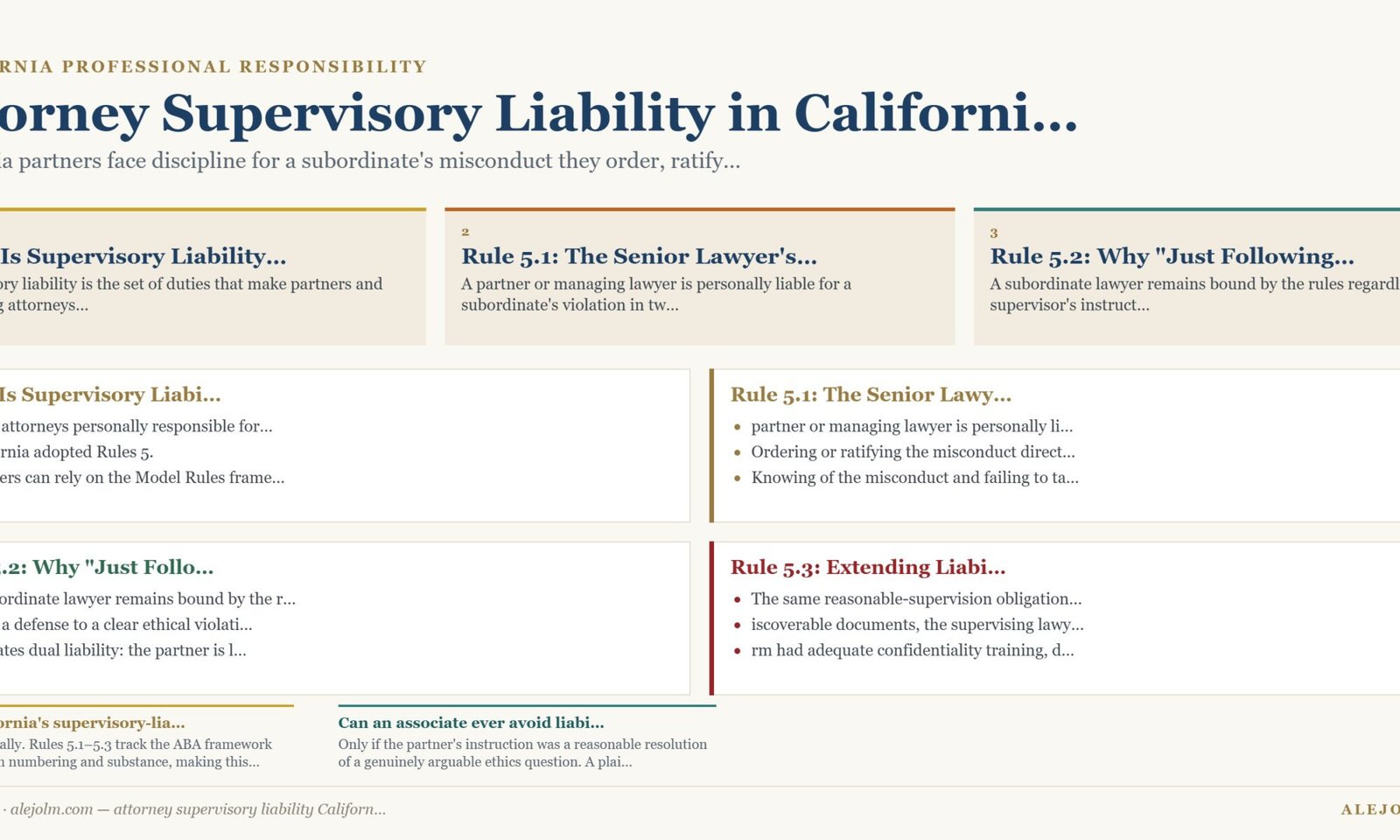
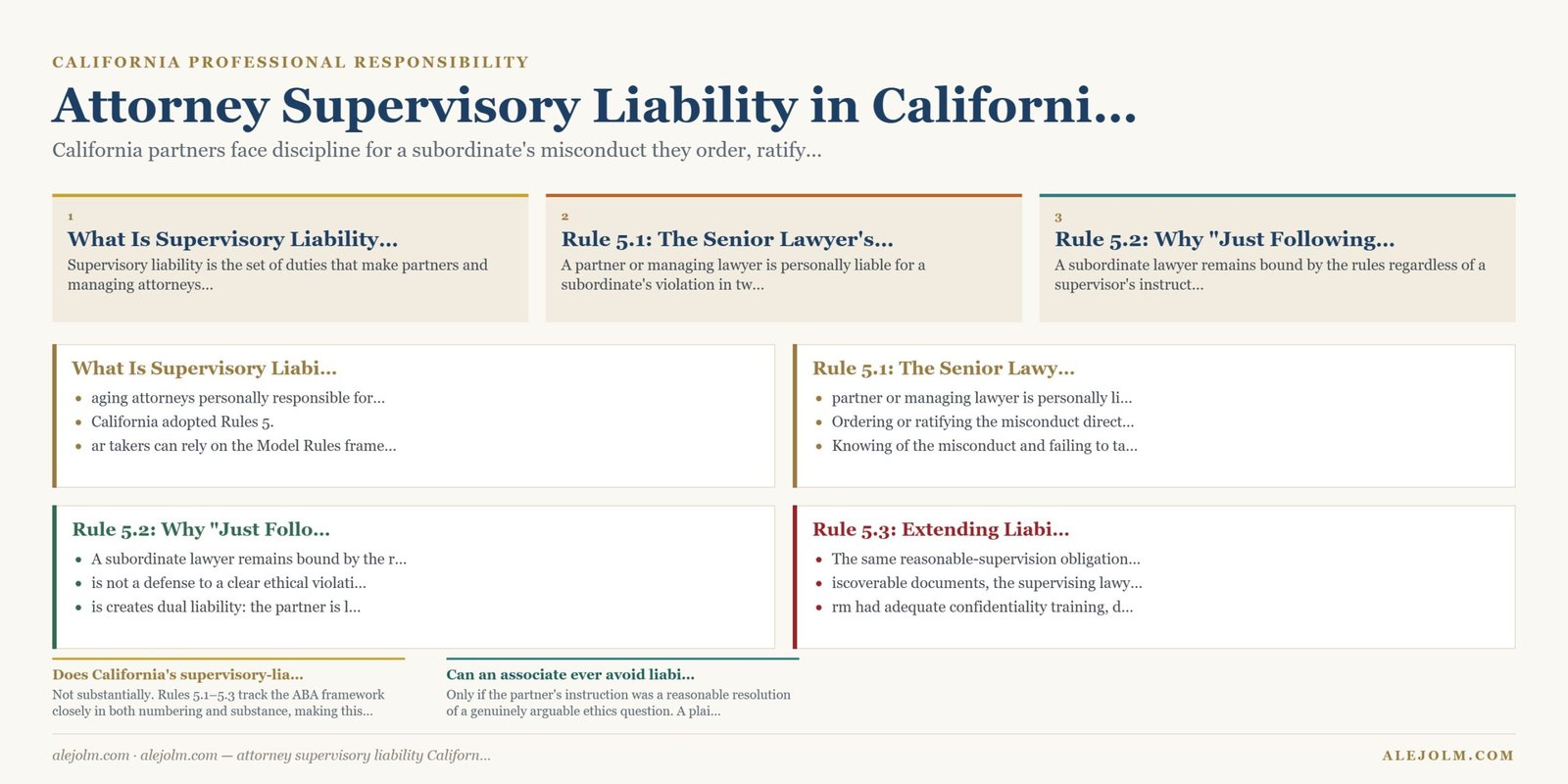
Supervisory liability is the set of duties that make partners and managing attorneys personally responsible for a subordinate’s ethical violations — not just for their own conduct. California adopted Rules 5.1, 5.2, and 5.3 with the same numbering and largely the same substance as the ABA Model Rules, which is itself worth noting: this is one of the rare corners of professional responsibility where California and the ABA move almost in lockstep, so bar takers can rely on the Model Rules framework here with fewer hidden traps than in confidentiality or candor.
That doesn’t make the topic easy — it makes it a pure application exercise, and bar examiners love layering multiple people’s liability into a single fact pattern.
Rule 5.1: The Senior Lawyer’s Two Tracks of Liability
A partner or managing lawyer is personally liable for a subordinate’s violation in two independent situations:
- Ordering or ratifying the misconduct directly.
- Knowing of the misconduct and failing to take reasonable remedial action.
| Liability track | What triggers it | Example |
|---|---|---|
| Ordering/ratifying | Partner directs or approves the violation | Partner instructs an associate to bill for time never worked |
| Failure to remediate | Partner learns of misconduct and does nothing reasonable about it | Partner overhears plans for a frivolous motion and stays silent |
| Systemic failure | Firm never implemented reasonable compliance systems | No conflict-check process exists at all |
Beyond individual incidents, Rule 5.1 also imposes a proactive, firm-wide duty: reasonable policies and procedures for conflict checks, deadline tracking, billing audits, and trust-account controls. A written policy that’s never enforced doesn’t satisfy this standard — the bar requires actual implementation and monitoring, scaled to the firm’s size.
Rule 5.2: Why “Just Following Orders” Doesn’t Work
A subordinate lawyer remains bound by the rules regardless of a supervisor’s instructions. “The partner told me to” is not a defense to a clear ethical violation — the junior lawyer is independently liable for executing it. This creates dual liability: the partner is liable for ordering, and the associate is liable for carrying it out.
There’s exactly one safe harbor: a subordinate is not liable when acting on the supervisor’s reasonable resolution of a genuinely arguable ethical question. If a partner gives a thoughtful, good-faith answer to a debatable ethics question — say, whether a particular fee structure satisfies Rule 1.8.1 — and it later turns out to be wrong, the associate who relied on that answer is protected. But a partner cannot manufacture that protection by mislabeling a plainly unethical instruction as “arguable.” Backdating a document to dodge a statute of limitations isn’t a close call.
Rule 5.3: Extending Liability to Non-Lawyer Staff
The same reasonable-supervision obligation extends to paralegals, office managers, and legal secretaries. If an office manager leaves confidential files where opposing counsel can see them, or a paralegal deletes discoverable documents, the supervising lawyer is liable if the firm lacked reasonable procedures to prevent it. The standard isn’t perfection — it’s whether the firm had adequate confidentiality training, document-handling protocols, and oversight proportionate to its size.
Analyzing a Supervisory Liability Fact Pattern: Two Separate Questions
Bar examiners typically bury two or three people in a single supervisory-liability hypo — a partner, an associate, and sometimes a paralegal — and expect you to analyze each one separately rather than treat the group as a single unit. Always ask two independent questions for every fact pattern: (1) did a supervising lawyer order, ratify, or knowingly fail to remediate the misconduct, and (2) did the subordinate who actually carried out the conduct have a reasonable basis to believe it was a genuinely arguable ethics question rather than a clear violation. A supervisor can be liable even if the subordinate is protected by the safe harbor, and a subordinate can be liable even if the supervisor never gave an explicit order — for instance, if the subordinate independently commits misconduct the supervisor never authorized, only the subordinate is liable, since Rule 5.1 doesn’t make partners strictly liable for everything that happens at the firm. Keeping these two liability tracks analytically separate, rather than assuming one person’s liability determines the other’s, is what separates a strong bar answer from a superficial one.
Worked Example: The Backdated Document
Partner tells Associate to backdate a document to meet a statute-of-limitations deadline. Uncertain, Associate asks whether this is ethical. Partner says, “Just do it — it’s business as usual here.” Associate complies.
Analysis:
- Partner: Clearly liable. Partner ordered a violation involving dishonesty toward the tribunal.
- Associate: Also liable. “Just following orders” isn’t a defense, and backdating a document to defeat a limitations period isn’t a genuinely arguable ethical question — it’s fraud. The Rule 5.2 safe harbor never applies here because there was nothing reasonably debatable about Partner’s instruction.
Both face discipline independently; neither can point at the other to avoid it.
FAQ
Does California’s supervisory-liability rule differ much from the ABA’s?
Not substantially. Rules 5.1–5.3 track the ABA framework closely in both numbering and substance, making this one of the more predictable areas of California professional responsibility for exam purposes.
Can an associate ever avoid liability by following a partner’s instructions?
Only if the partner’s instruction was a reasonable resolution of a genuinely arguable ethics question. A plainly unethical order never qualifies, no matter how senior the person giving it.
Is a lawyer liable for a paralegal’s ethics breach if the lawyer didn’t know about it?
Potentially yes, if the firm lacked reasonable procedures to prevent it. The duty is to institute and enforce reasonable systems, not merely to react after the fact.
Key Takeaways
- California Rules 5.1–5.3 largely mirror the ABA Model Rules, both in numbering and substance.
- Rule 5.1 liability arises from ordering/ratifying misconduct or knowingly failing to remediate it.
- Rule 5.2’s “just following orders” defense never works against a plainly unethical instruction.
- The Rule 5.2 safe harbor protects only reasonable resolutions of genuinely arguable ethics questions.
- Rule 5.3 extends the same reasonable-supervision duty to non-lawyer staff like paralegals and office managers.
This article is educational and is not legal advice. Consult a licensed California attorney about your situation.
Related guides
- California Attorney Fee Agreements
- Frivolous Claims in California
- Attorney Withdrawal Rules in California