
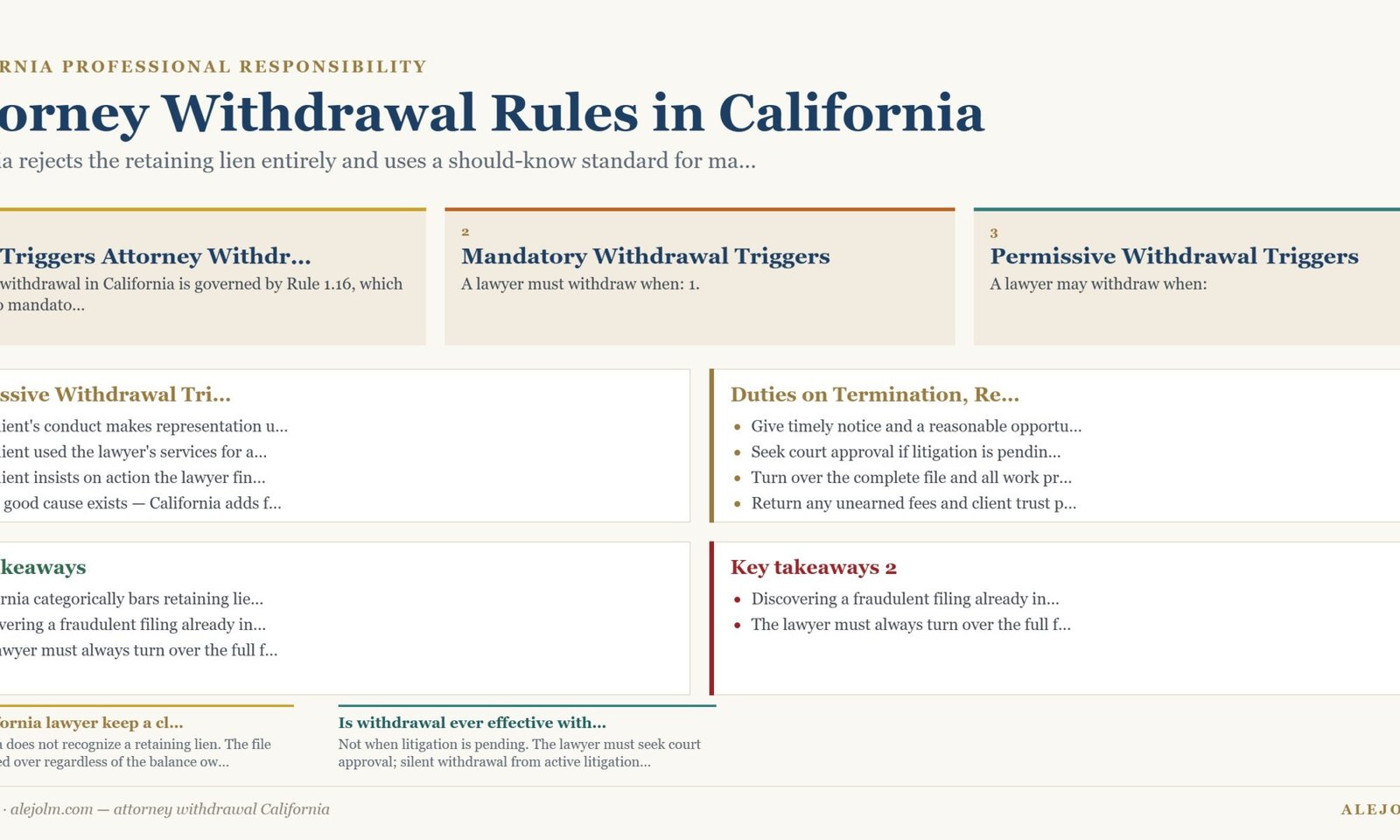

What Triggers Attorney Withdrawal in California?
Attorney withdrawal in California is governed by Rule 1.16, which splits into mandatory triggers (the lawyer must withdraw) and permissive triggers (the lawyer may withdraw). Get the category wrong on the bar exam and you’ll misdiagnose the entire fact pattern — mandatory withdrawal is non-discretionary, while permissive withdrawal leaves room for the lawyer’s judgment.
California’s version of this rule contains three specific departures from the ABA Model Rules that show up constantly in exam questions: a broader knowledge standard, no retaining lien, and an added mandatory ground tied to harassing litigation.
Mandatory Withdrawal Triggers
A lawyer must withdraw when:
- Continued representation would violate a rule of professional conduct.
- The lawyer’s mental or physical condition makes representation unreasonably difficult.
- The client discharges (fires) the lawyer.
- A court orders withdrawal.
- (California only) The client is pursuing a claim without probable cause, for the purpose of harassing or maliciously injuring someone.
Permissive Withdrawal Triggers
A lawyer may withdraw when:
- The client’s conduct makes representation unreasonably difficult, after a warning.
- The client used the lawyer’s services for a past crime or fraud.
- The client insists on action the lawyer finds repugnant.
- Other good cause exists — California adds frivolous claims and illegal client conduct here too.
- (ABA only) Unreasonable financial burden on the lawyer — California does not recognize this as a stand-alone ground.
The Knowledge Standard Split
| Issue | ABA Model Rule 1.16 | California Rule 1.16 |
|---|---|---|
| Mandatory-withdrawal knowledge standard | Actual knowledge | “Knows or reasonably should know“ |
| Unreasonable financial burden | Recognized permissive ground | Not a stand-alone ground |
| Retaining lien over the client file | Permitted in some jurisdictions | Never permitted |
| Only lien available | Retaining or charging lien | Charging lien only, and it must satisfy Rule 1.8.1 |
California’s broader “reasonably should know” standard means a lawyer can’t claim willful blindness to avoid a mandatory-withdrawal obligation the way an ABA-jurisdiction lawyer arguably could under a pure actual-knowledge test.
California’s Ban on the Retaining Lien
This is the split most bar takers get wrong. In some ABA jurisdictions, a lawyer can withhold the client’s file as leverage to collect unpaid fees — a “retaining lien.” California categorically rejects this. Regardless of how much a client owes, the lawyer must turn over the entire file upon termination. The only lien California permits is a negotiated charging lien against future case proceeds, and even that must independently satisfy the Rule 1.8.1 business-transaction safeguards (fair terms, written disclosure, advice to seek independent counsel, informed written consent).
If a client owes $50,000 in unpaid fees, the lawyer’s remedy is mandatory fee arbitration under § 6200 or a separate collection action — never file retention.
Mandatory Withdrawal Plus the “Noisy Withdrawal”
When a client discloses that a pleading already filed contains a fabricated fact, mere withdrawal isn’t enough. The lawyer must also make a noisy withdrawal — filing a notice disaffirming the prior filings to the extent they relied on information now known to be false, without breaching confidentiality about the specifics. Slinking away silently leaves the fraud standing uncorrected in front of the court.
Duties on Termination, Regardless of Who Initiated It
Whether the lawyer withdraws, the client fires the lawyer, or the matter simply concludes, the lawyer must:
- Give timely notice and a reasonable opportunity for the client to find new counsel.
- Seek court approval if litigation is pending — silent withdrawal from an active case is a separate violation.
- Turn over the complete file and all work product, unpaid fees notwithstanding.
- Return any unearned fees and client trust property.
- Maintain confidentiality indefinitely, even after the relationship ends.
Worked Example: The Fabricated Allegation
Lawyer represents Client in a real-estate dispute. After filing the complaint, Client admits the key factual allegation is false — invented to gain settlement leverage. Lawyer believes this is fraud on the tribunal.
Analysis: This is an ongoing use of Lawyer’s services to perpetrate fraud, triggering mandatory withdrawal. Lawyer must attempt to withdraw and must also file a noisy withdrawal disaffirming the fraudulent complaint. If the court denies withdrawal — rare, but possible where it would unduly delay trial — Lawyer must continue the representation while refusing to advance or rely on the false allegation, disaffirming it on the record to the extent confidentiality allows.
FAQ
Can a California lawyer keep a client’s file until unpaid fees are paid?
No. California does not recognize a retaining lien. The file must be turned over regardless of the balance owed; unpaid fees go through fee arbitration or a collection action instead.
Is withdrawal ever effective without court approval?
Not when litigation is pending. The lawyer must seek court approval; silent withdrawal from active litigation is itself a violation.
What is a “noisy withdrawal” and when is it required?
It’s a notice disaffirming prior filings tainted by fraud, required when a lawyer discovers a pleading already submitted rests on information now known to be false. Simple, silent withdrawal isn’t enough in that scenario.
Key Takeaways
- Mandatory withdrawal is non-discretionary; permissive withdrawal leaves room for lawyer judgment.
- California uses a “knows or reasonably should know” standard for mandatory withdrawal — broader than the ABA’s actual-knowledge standard.
- California categorically bars retaining liens; only a Rule 1.8.1-compliant charging lien is available.
- Discovering a fraudulent filing already in the record requires a noisy withdrawal, not just quiet departure.
- The lawyer must always turn over the full file, return unearned fees, and preserve confidentiality after termination.
This article is educational and is not legal advice. Consult a licensed California attorney about your situation.
Related guides
- California Attorney Fee Agreements
- Counseling Crime or Fraud: California Attorney Rule
- Candor to the Tribunal: California’s Rule 3.3 Split