
What Are the Fairness-in-Litigation Rules?
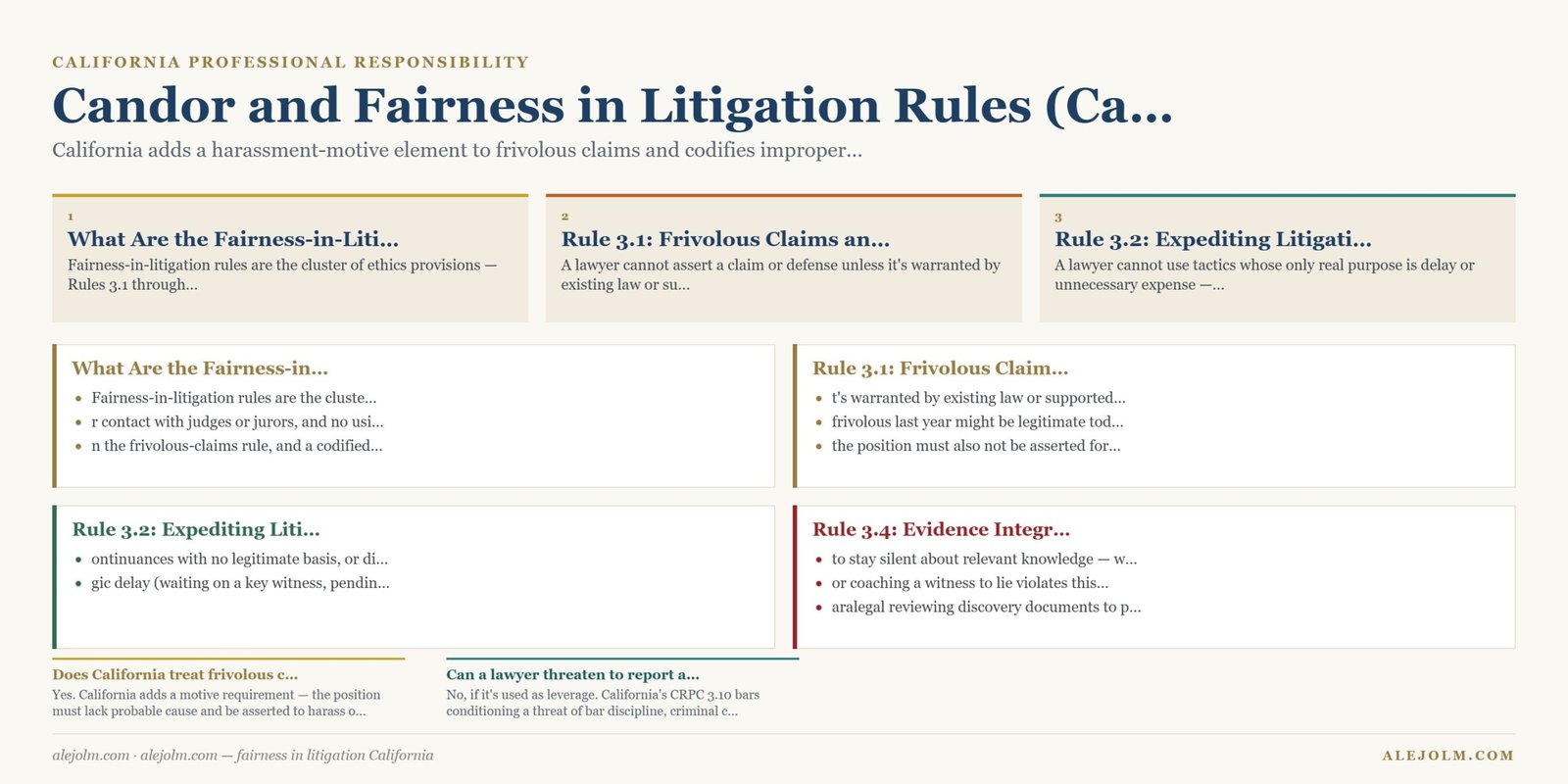
Fairness-in-litigation rules are the cluster of ethics provisions — Rules 3.1 through 3.5 — that govern how a lawyer advocates once a case is filed: no frivolous claims, no unnecessary delay, no tampering with evidence, no improper contact with judges or jurors, and no using threats of criminal or disciplinary charges as a bargaining chip.
On the California Bar Exam, these rules matter less for their individual prohibitions — which largely track the ABA Model Rules — and more for two California-specific additions: a motive element in the frivolous-claims rule, and a codified rule against improper threats that the ABA handles only indirectly.
Rule 3.1: Frivolous Claims and the Good-Faith Standard
A lawyer cannot assert a claim or defense unless it’s warranted by existing law or supported by a good-faith argument to extend, modify, or reverse existing law. This is an objective test tied to the state of the law at the time the claim is filed — a challenge that looked frivolous last year might be legitimate today if scholarly criticism or shifting precedent has opened the door.
California’s addition: the position must also not be asserted for the purpose of harassing or maliciously injuring another person. Even a technically defensible claim can violate CRPC 3.1 if the lawyer’s real motive is to inflict cost and burden rather than pursue the claim on its merits.
Rule 3.2: Expediting Litigation
A lawyer cannot use tactics whose only real purpose is delay or unnecessary expense — think serial continuances with no legitimate basis, or discovery requests sized purely to exhaust the other side’s resources. Legitimate strategic delay (waiting on a key witness, pending legal developments) is not a violation; delay for delay’s sake is.
Rule 3.4: Evidence Integrity and Witness Instructions
Rule 3.4 prohibits altering, destroying, or obstructing access to evidence, or counseling anyone else to do so, and it bars instructing a witness to stay silent about relevant knowledge — with a narrow carve-out for a client’s relative, employee, or agent. Fabricating a document or coaching a witness to lie violates this rule and typically overlaps with the duty of candor to the tribunal.
Rule 3.5: Keeping the Tribunal Impartial
A lawyer cannot discuss the merits of a case with a judge outside opposing counsel’s presence unless authorized by law or court order, cannot give gifts to judges or court staff, and cannot communicate with jurors about the case while trial is ongoing. Post-trial juror contact is generally fine unless the juror objects or the contact turns harassing.
California’s Improper-Threats Rule: CRPC 3.10
This is the clearest California-vs-ABA split in this cluster.
| Issue | ABA Model Rules | California (CRPC 3.10) |
|---|---|---|
| Threatening criminal/disciplinary charges to gain civil leverage | No dedicated rule — reached indirectly through Rules 4.4 and 8.4 | Directly and explicitly prohibited |
| Genuine ethics violation exists | Still handled indirectly | Reporting is fine; conditioning it on settlement is not |
| Codification | Scattered across general-conduct rules | Single, dedicated rule (3.10) |
Example: a lawyer emails opposing counsel, “Settle for $100K or I’m reporting you to the bar.” That’s an improper threat under CRPC 3.10, even if the underlying ethics violation the lawyer is threatening to report is completely real. The lawyer can still report it — just not as a negotiating chip.
The Spaulding Problem: Silence vs. Evidence Tampering
Spaulding v. Zimmerman is the classic fact pattern for this cluster: defense counsel learns through a defense medical exam that the plaintiff has an undisclosed, life-threatening condition, and says nothing. California treats this as a hard case — disclosure of a non-client’s undiscovered medical condition is permitted only where it would prevent a criminal act threatening death or substantial bodily injury, and staying silent about a medical finding is not itself a criminal act. So under California’s framework, the lawyer’s silence in Spaulding does not, by itself, violate the fairness rules.
Worked Example: The Baseless Misconduct Accusation
Lawyer represents a defendant in a criminal trial and suspects — without any actual evidence — that the prosecutor is withholding favorable evidence. During closing argument, Lawyer accuses the prosecutor of misconduct in front of the jury, hoping only to inflame the jury against the prosecution.
Analysis: This violates the fairness and civility rules. An accusation of opposing-counsel misconduct made without a good-faith factual basis, aimed at prejudicing the jury rather than genuinely challenging the evidence, functions like a frivolous assertion applied to trial tactics. Zealous advocacy never extends to baseless attacks on opposing counsel’s integrity, regardless of the client’s stakes.
FAQ
Does California treat frivolous claims differently from the ABA?
Yes. California adds a motive requirement — the position must lack probable cause and be asserted to harass or maliciously injure someone — beyond the ABA’s pure good-faith-legal-basis test.
Can a lawyer threaten to report an opposing lawyer to the State Bar during settlement talks?
No, if it’s used as leverage. California’s CRPC 3.10 bars conditioning a threat of bar discipline, criminal charges, or administrative complaints on a civil settlement, even if the underlying violation is real.
Is post-trial contact with a juror always allowed in California?
Generally yes, unless the juror objects or the lawyer’s contact becomes harassing or coercive.
Key Takeaways
- Rule 3.1 bars frivolous claims; California adds a separate harassment/malice motive requirement.
- Rule 3.4 bars evidence tampering and witness-silencing instructions, with a narrow family/employee exception.
- Rule 3.5 bars ex parte judicial contact, gifts to judges, and mid-trial juror communication.
- CRPC 3.10 is a California-specific, dedicated ban on using criminal or disciplinary threats as civil leverage.
- Silence about an opposing party’s undiscovered medical condition is not automatically a fairness violation in California.
This article is educational and is not legal advice. Consult a licensed California attorney about your situation.
Related guides
- Candor to the Tribunal: California’s Rule 3.3 Split
- Frivolous Claims in California
- Prosecutor Ethical Duties in California