
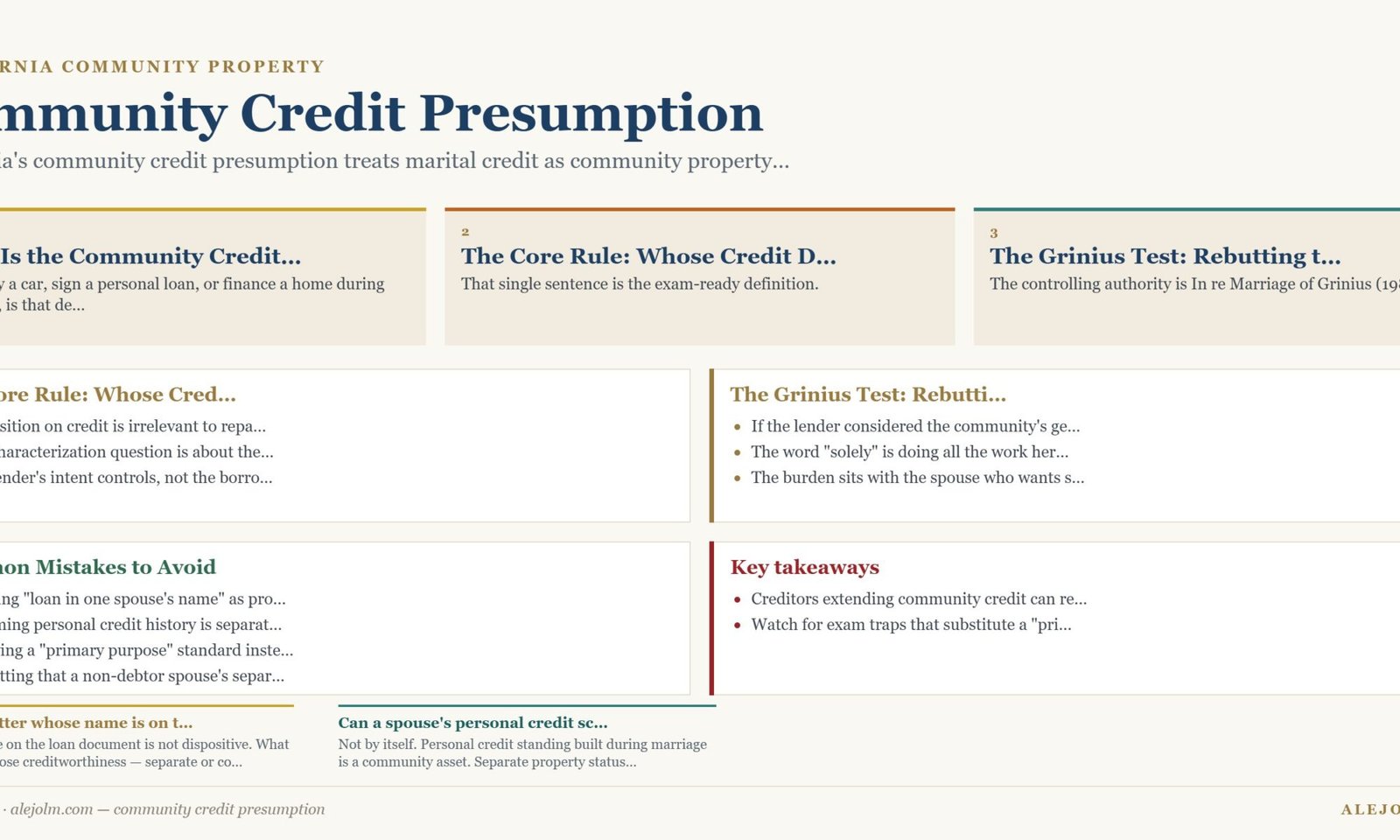
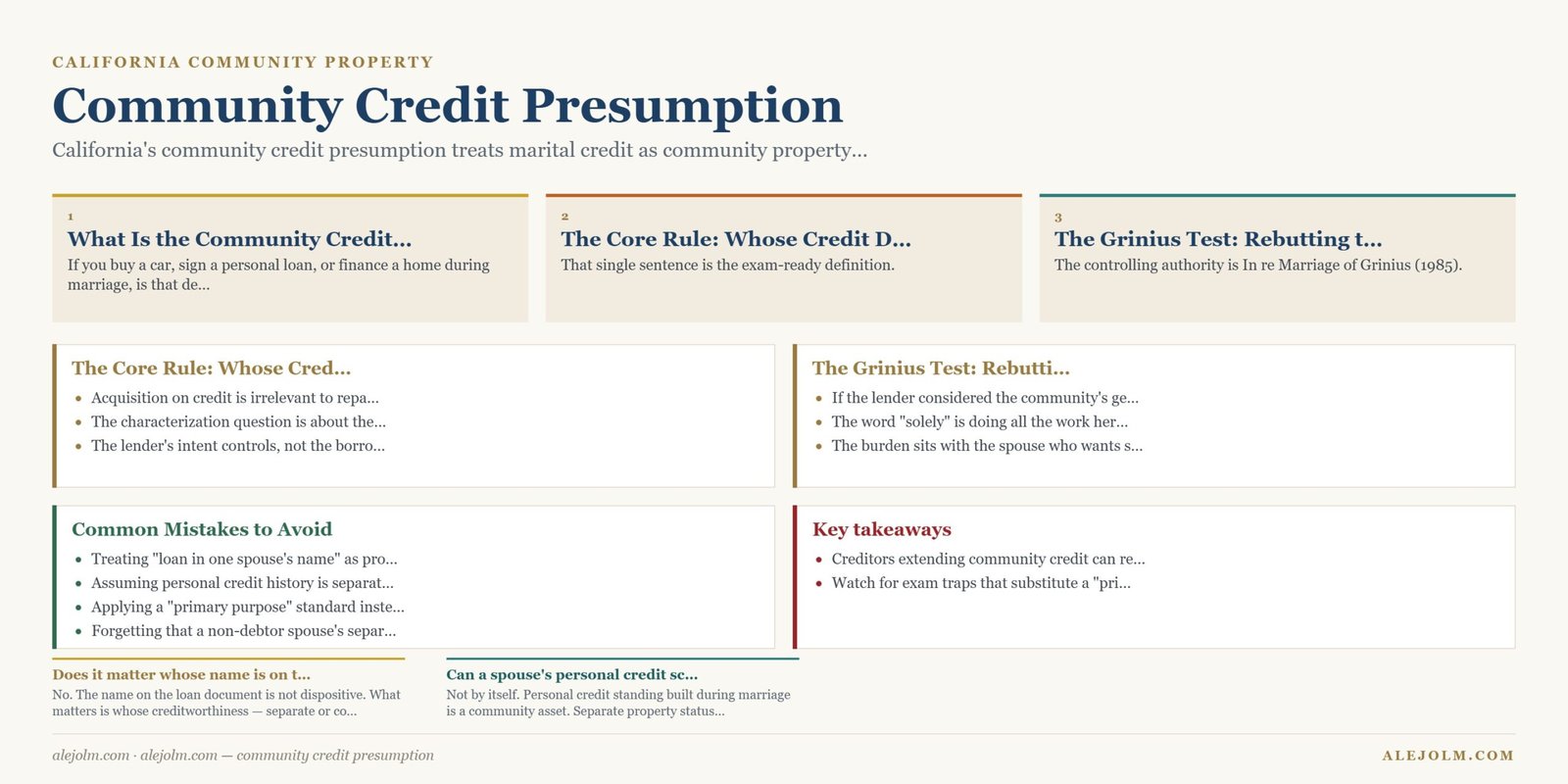
What Is the Community Credit Presumption in California?
If you buy a car, sign a personal loan, or finance a home during marriage, is that debt — and the property it buys — community or separate? California answers this with the community credit presumption: property acquired on credit during marriage is presumed community property, and the real question is never who signed the paperwork but whose creditworthiness the lender actually relied on. This distinction trips up law students and California Bar Exam takers constantly, because it feels counterintuitive that a loan in one spouse’s name alone can still be fully community.
Understanding this presumption matters far beyond the exam. Divorcing spouses, creditors, and estate planners all need to know whether a financed asset belongs to the marital estate or to one spouse individually.
The Core Rule: Whose Credit Did the Lender Rely On?
Community Credit Presumption, defined: when property is acquired on credit during marriage, it is presumed community property regardless of who repays the debt or whose name is on the loan; the character of the property turns on whether the lender relied on the couple’s community credit reputation or exclusively on one spouse’s separate financial capacity.
That single sentence is the exam-ready definition. Now break it into its working parts.
- Acquisition on credit is irrelevant to repayment. Property bought with borrowed money belongs to the buyer at the moment of purchase, whether or not the loan is ever paid off.
- The characterization question is about the loan, not the asset. You characterize the debt first, then the property acquired with it follows the same characterization.
- The lender’s intent controls, not the borrower’s intent. Courts look at underwriting records, applications, and what the lender actually considered when deciding to extend credit.
The Grinius Test: Rebutting the Presumption
The controlling authority is In re Marriage of Grinius (1985). Under Grinius, a spouse asserting that credit-acquired property is separate carries the burden of proving the lender relied solely on that spouse’s separate property or separate financial capacity — not merely primarily, not merely mostly, but exclusively.
- If the lender considered the community’s general credit reputation at all, even as one factor among several, the community credit presumption survives.
- The word “solely” is doing all the work here. Many students mistakenly treat this as a “primary purpose” or “predominant factor” test. It is not. Any reliance on community credit defeats the separate property claim.
- The burden sits with the spouse who wants separate property treatment, not with the spouse (or the community) defending the presumption.
This is a demanding standard by design. California’s community property system favors characterizing marital-era acquisitions as shared, and Grinius makes separate-property rebuttal genuinely hard to prove.
Personal Credit Is Still Community Credit
One of the most heavily tested traps in this area: a spouse’s personal credit standing — their individual credit score, employment history, and payment record — is not separate property. It is treated as a community asset.
That means a loan extended in one spouse’s name, based entirely on that spouse’s personal credit history, is still presumptively community. The fact that only one spouse signed, and that the lender pulled only that spouse’s credit report, does not establish separate property. You need something more: proof the lender relied on actual separate property or separate financial capacity, not just an individual’s general creditworthiness.
Worked Example: Applying Grinius
Facts: Maria and David marry in 2018. In 2021, Maria buys a car and finances it through a dealer. The dealer’s underwriting file shows the loan was approved based on Maria’s income from her job and her personal credit score — nothing else was reviewed.
Analysis: Maria’s job income and credit score are community assets earned and built during marriage. The dealer did not rely on any separate property Maria owned before marriage or received by gift or inheritance. Because the lender relied on Maria’s personal (community) credit standing, the car is community property — even though David never signed anything and the loan is in Maria’s name alone.
Contrast: Suppose instead the dealer’s file showed Maria pledged a rental duplex she inherited before the marriage as collateral, and the underwriter’s notes state the loan was approved “based solely on borrower’s separate real estate holding, without regard to borrower’s income or marital credit history.” That record could support a separate property finding under Grinius — but only because the lender’s reliance was documented as exclusive.
Creditor Reach: Who Can Be Sued on the Debt
The flip side of characterization is enforcement. Once a debt is characterized as community credit, a creditor’s reach is defined by that characterization.
| Scenario | Creditor can reach | Creditor cannot reach |
|---|---|---|
| Community credit debt, during marriage | Community property; debtor spouse’s separate property | Non-debtor spouse’s separate property |
| Separate credit debt (Grinius-proven) | Debtor spouse’s separate property | Community property (in most cases); non-debtor spouse’s separate property |
| Post-divorce enforcement | Property awarded to the debtor spouse | Property awarded to the non-debtor spouse who did not incur the debt |
This table matters because bar exam fact patterns frequently combine a credit characterization question with a creditor’s rights question. Get the characterization right first — the enforcement analysis follows automatically.
Common Mistakes to Avoid
- Treating “loan in one spouse’s name” as proof of separate property. The name on the paperwork is not the test. The lender’s actual reliance is the test.
- Assuming personal credit history is separate property. It isn’t. Personal creditworthiness built during marriage is a community asset.
- Applying a “primary purpose” standard instead of “sole reliance.” Grinius requires exclusivity, not predominance. This is the single most commonly missed distinction on exams.
- Forgetting that a non-debtor spouse’s separate property is protected. Creditors extending community credit cannot reach the separate property of the spouse who did not incur the debt.
Why This Matters for the California Bar Exam
Community credit presumption questions almost always appear alongside characterization and tracing issues. When you see a financed purchase in a fact pattern, immediately ask: (1) when was the credit extended — before or during marriage; (2) what did the lender’s file show about reliance; and (3) does any evidence show exclusive reliance on separate property. If the facts are silent on lender intent, default to the presumption: it’s community.
FAQ
Does it matter whose name is on the loan?
No. The name on the loan document is not dispositive. What matters is whose creditworthiness — separate or community — the lender actually relied upon when approving the credit.
Can a spouse’s personal credit score ever make an asset separate property?
Not by itself. Personal credit standing built during marriage is a community asset. Separate property status requires proof the lender relied exclusively on actual separate property or separate financial capacity, not general creditworthiness.
Can a creditor go after my separate bank account for my spouse’s community debt?
Generally no, if you did not personally incur the debt. A creditor extending community credit can reach the community estate and the debtor spouse’s separate property, but not the non-debtor spouse’s separate property.
Key Takeaways
- Property acquired on credit during marriage is presumed community property; the analysis turns on the lender’s reliance, not on repayment or whose name appears on the loan.
- Under In re Marriage of Grinius, the spouse claiming separate property must prove the lender relied solely on separate property or separate financial capacity — any community reliance defeats the claim.
- A spouse’s personal credit history and score are community assets, not separate property.
- Creditors extending community credit can reach community property and the debtor spouse’s separate property, but never the non-debtor spouse’s separate property.
- Watch for exam traps that substitute a “primary purpose” test for the correct “sole reliance” standard.
This article is educational and is not legal advice. Consult a licensed California attorney about your situation.
Related guides
- community property presumptions
- spousal fiduciary duty
- premarital agreements
- Moore-Marsden apportionment