
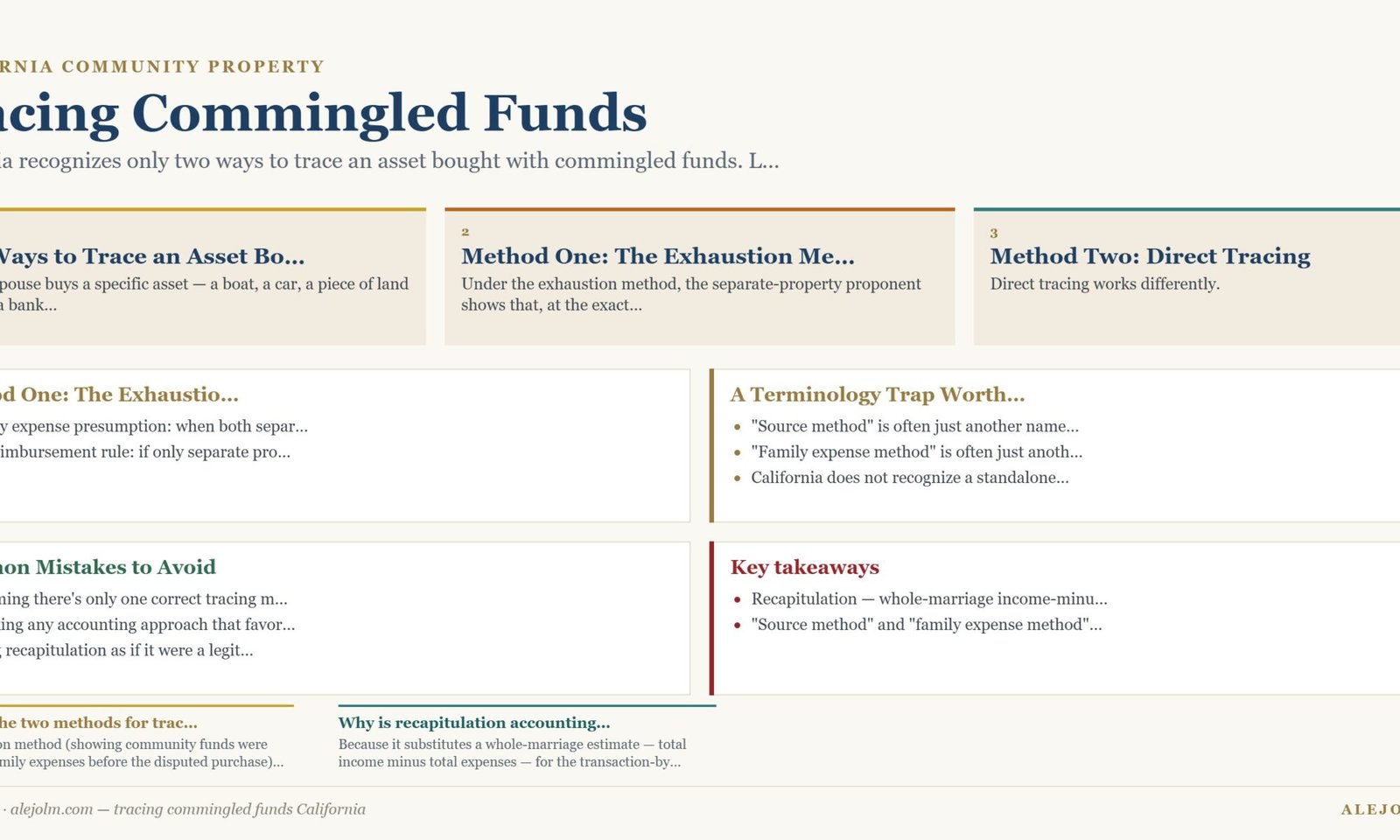
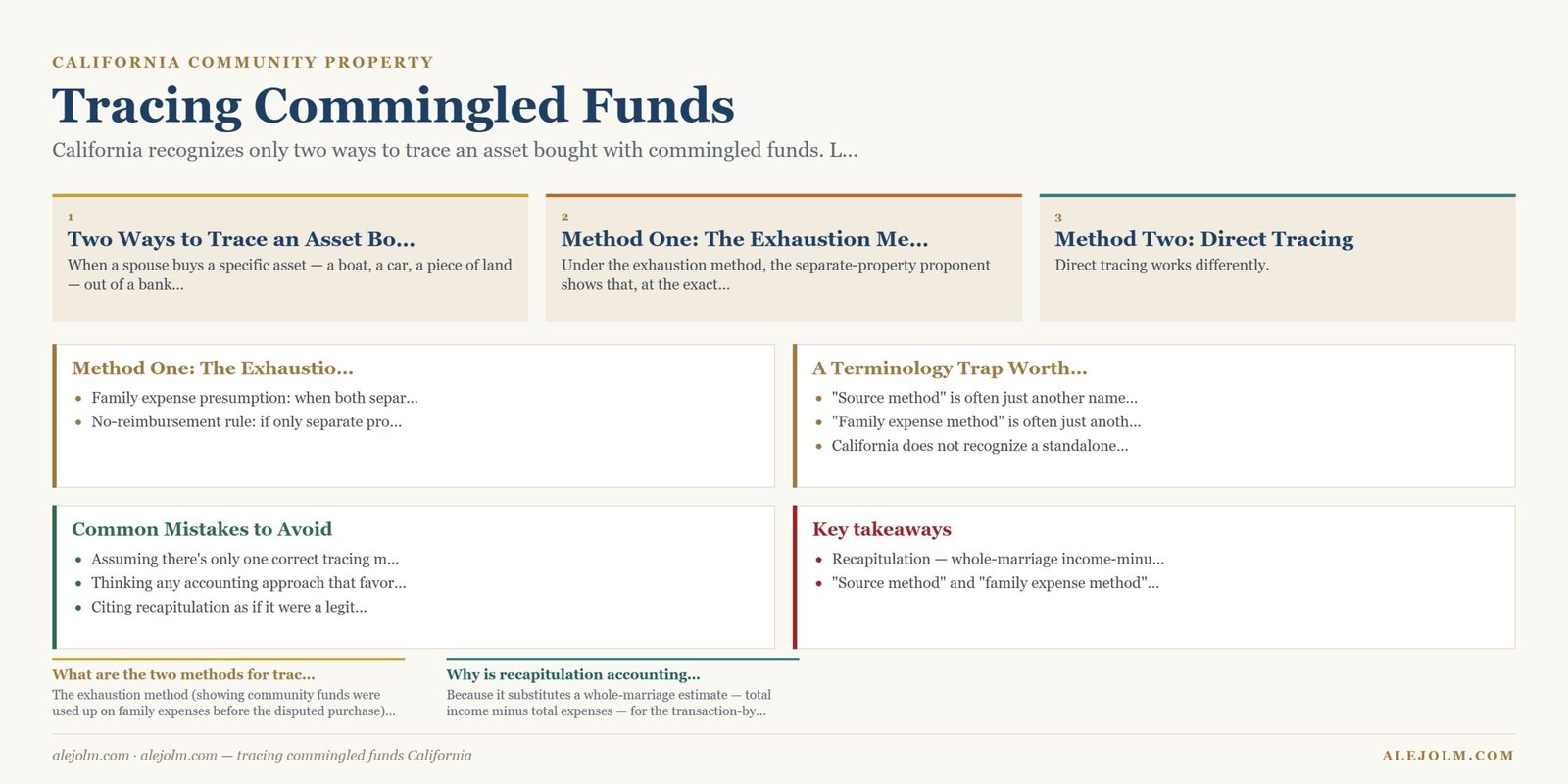
Two Ways to Trace an Asset Bought With Commingled Funds
When a spouse buys a specific asset — a boat, a car, a piece of land — out of a bank account that mixes separate and community money, California doesn’t let just any accounting theory carry the day. Courts recognize exactly two valid methods of proof, and both demand a transaction-by-transaction historical record, not a big-picture estimate.
Tracing commingled funds means proving that a specific purchase drew on identifiable separate-property money rather than community money, using either the exhaustion method or direct tracing. Both methods require contemporaneous, transaction-level evidence; a retrospective summary of the whole marriage — called recapitulation — is prohibited because it distorts the actual timing of each transaction.
Method One: The Exhaustion Method
Under the exhaustion method, the separate-property proponent shows that, at the exact moment the disputed asset was purchased, all community property in the account had already been used up on family expenses — leaving only separate funds available for the purchase.
This method rests on two sub-doctrines:
- Family expense presumption: when both separate and community funds were available at the moment a family expense was paid, community property is presumed to have been used first.
- No-reimbursement rule: if only separate property was available to pay a family expense, the separate-property spouse gets no reimbursement for that expense — spouses owe each other mutual support, and ordinary family expenses aren’t a debt the community owes back. This is distinct from § 2640, which does reimburse separate contributions to the acquisition of community property, not to ordinary family expenses.
Method Two: Direct Tracing
Direct tracing works differently. Even where both community and separate funds were present in the account at the time of purchase, the purchasing spouse can prevail by showing a specific intent to use identifiable separate funds for that particular purchase.
Direct tracing tends to be more useful in divorce litigation, where the proponent can testify to their own intent at the time. It’s far more problematic at death, when the decedent’s intent can no longer be established through testimony — which can make the community-property presumption nearly impossible to rebut in a probate context.
Recapitulation Is Prohibited
A tempting but forbidden shortcut is “recapitulation” — arguing, in effect, that total community income over the whole marriage minus total family expenses proves a given asset must be separate property. California courts reject this outright. Tracing must happen at the precise moment of each transaction, using a historical, transaction-by-transaction record — not an aggregate calculation performed after the fact.
There’s one narrow exception worth knowing for exam purposes: retrospective, recapitulation-style accounting is permitted for reverse Pereira or reverse Van Camp apportionment of a community-property business after separation, because labor and capital contributions there genuinely cannot be disentangled on a transaction-by-transaction basis. That exception does not extend to ordinary commingled bank account tracing.
| Method | What it proves | Best used |
|---|---|---|
| Exhaustion method | CP was exhausted by family expenses before the purchase | When detailed family-expense records exist |
| Direct tracing | Specific intent to use identifiable SP funds still on hand | Divorce (proponent can testify to intent) |
| Recapitulation | Prohibited — not a valid method for commingled accounts | Never (except reverse Pereira/Van Camp business apportionment) |
A Terminology Trap Worth Knowing
Some study aids use looser labels that map onto these two methods but can mislead if taken too literally:
- “Source method” is often just another name for direct tracing — tracing an asset back to its original separate source.
- “Family expense method” is often just another name for the exhaustion method — relying on the family expense presumption.
- California does not recognize a standalone “deposit method” or FIFO (first-in-first-out) assumption as an independent way to prove separate-property character in a commingled account. A FIFO-style assumption about withdrawal order, by itself, is not sufficient proof under See v. See or Estate of Neilson. FIFO-style reasoning does appear in the lowest intermediate balance rule, but that’s a limiting cap on tracing claims, not an affirmative method for proving separate character.
Worked Example: Exhaustion vs. Direct Tracing on the Same Facts
Facts: Husband deposits a $50,000 separate-property inheritance into the family checking account. Over the next five years, he also deposits his CP salary into the same account, and the couple pays ordinary living expenses from it. He then writes a check from that account to buy a boat.
Analysis under exhaustion: To win under the exhaustion method, Husband needs a historical record showing that at the precise moment he bought the boat, every dollar of community money that had ever gone into the account had already been spent on family expenses — meaning only separate funds remained available for the boat purchase. Without contemporaneous records establishing that timeline, Husband loses, and the boat is treated as community property.
Analysis under direct tracing: Alternatively, if Husband has contemporaneous bank records and can testify that when he wrote the check, he specifically intended to draw down the remaining, still-identifiable inheritance funds — which had not yet been exhausted — that satisfies direct tracing, even though community funds were also sitting in the account at the same time.
What fails: If Husband instead argues, “Over our five years together, my CP income was roughly equal to our family expenses, so this boat must have come from my inheritance,” that’s recapitulation — a whole-period estimate rather than a transaction-specific showing — and California courts will reject it outright.
Common Mistakes to Avoid
- Assuming there’s only one correct tracing method. California recognizes two valid methods — exhaustion and direct tracing — and a party can plead both in the alternative depending on the facts and available records.
- Thinking any accounting approach that favors the claimant will work. Courts require the actual evidentiary showing under exhaustion or direct tracing; a spouse can’t just pick a favorable label and skip the underlying transaction-by-transaction proof.
- Citing recapitulation as if it were a legitimate third method. It’s expressly prohibited for commingled bank account tracing, with the narrow exception of reverse Pereira/Van Camp business apportionment after separation.
FAQ
What are the two methods for tracing commingled funds in California?
The exhaustion method (showing community funds were used up on family expenses before the disputed purchase) and direct tracing (showing specific intent to use identifiable separate funds still on hand at the time of purchase).
Why is recapitulation accounting prohibited for tracing commingled funds?
Because it substitutes a whole-marriage estimate — total income minus total expenses — for the transaction-by-transaction historical record California courts require, distorting exactly when and how a specific purchase was funded.
Is direct tracing harder to use after a spouse has died?
Yes. Direct tracing depends on proving the purchasing spouse’s specific intent at the time of the transaction, and that intent is much harder to establish once the spouse who could testify to it is no longer available.
Key Takeaways
- California recognizes exactly two tracing methods for commingled accounts: exhaustion and direct tracing.
- Exhaustion relies on the family expense presumption (CP spent first) plus the no-reimbursement rule for family expenses paid with SP alone.
- Direct tracing requires proof of specific intent to use identifiable separate funds, and works better at divorce than at death.
- Recapitulation — whole-marriage income-minus-expenses accounting — is prohibited for ordinary commingled account tracing.
- “Source method” and “family expense method” are informal names for direct tracing and exhaustion; California does not recognize a standalone FIFO/deposit method.
This article is educational and is not legal advice. Consult a licensed California attorney about your situation.
Related guides
- separate property and commingling
- community property reimbursement and tracing
- community property presumptions