
What Is Claim Preclusion (Res Judicata)?
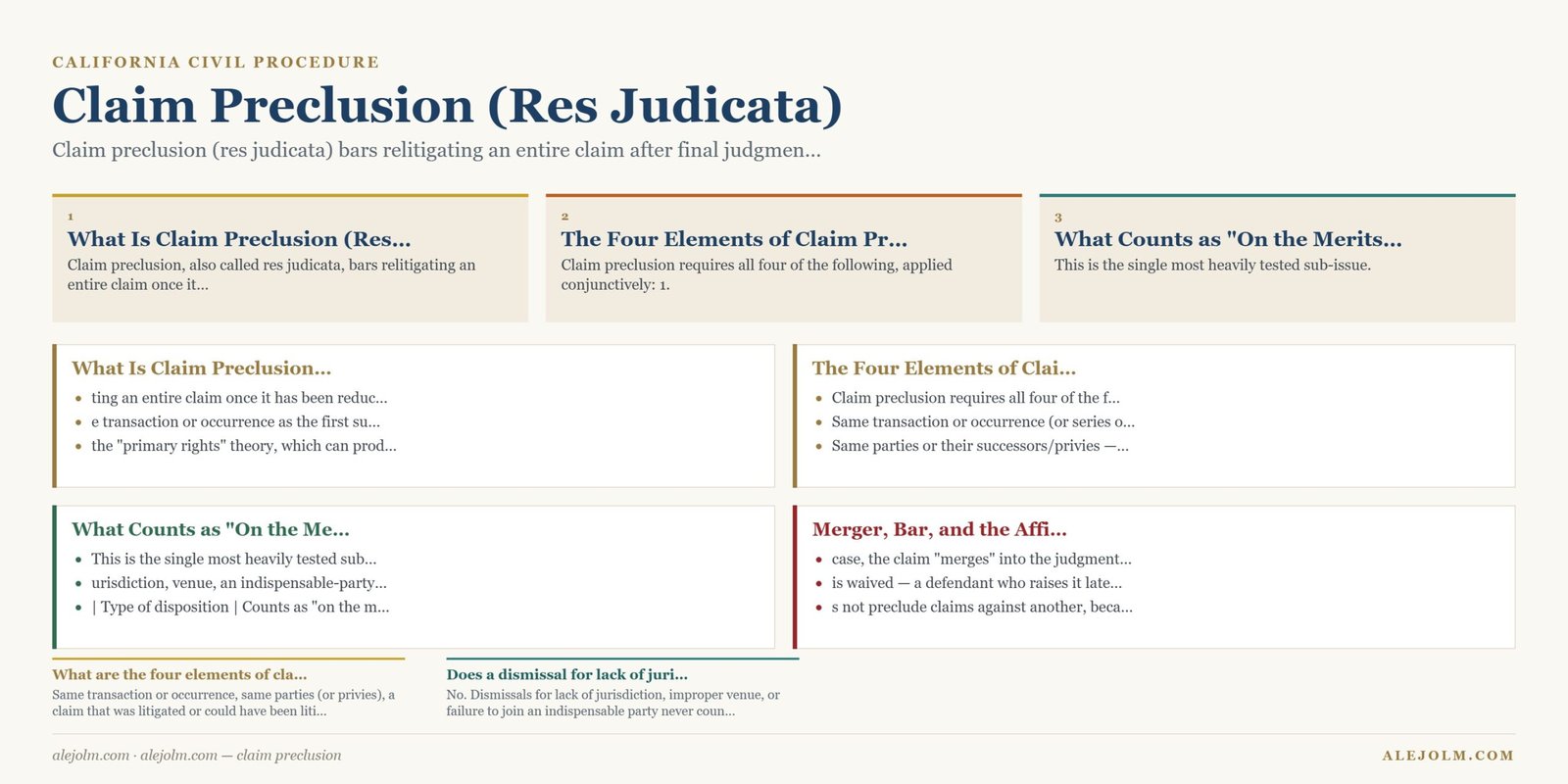
Claim preclusion, also called res judicata, bars relitigating an entire claim once it has been reduced to a valid final judgment on the merits between the same parties. Under the federal transactional test, any claim arising from the same transaction or occurrence as the first suit is barred — whether or not it was actually raised the first time.
California reaches a similar practical result through a different doctrinal path: the “primary rights” theory, which can produce a different outcome than the federal test in some fact patterns. That split is one of the highest-yield state-specific distinctions on the California Bar Exam.
The Four Elements of Claim Preclusion
Claim preclusion requires all four of the following, applied conjunctively:
- Same transaction or occurrence (or series of related transactions) as the first claim.
- Same parties or their successors/privies — the same plaintiff against the same defendant.
- The claim was litigated, or could have been litigated — every theory that could have been raised within that transaction is barred, even if never actually asserted and even if the plaintiff didn’t know about it at the time.
- A valid final judgment on the merits.
Lawyers sometimes call this the “meat-cleaver” doctrine: it decapitates the entire cause of action and everything that could have been litigated within it, in contrast to the “scalpel” of issue preclusion, which excises only a single previously-litigated issue.
What Counts as “On the Merits”?
This is the single most heavily tested sub-issue. Every judgment is presumed to be on the merits unless it was based on jurisdiction, venue, an indispensable-party defect, or a statute-of-limitations dismissal — none of those count.
| Type of disposition | Counts as “on the merits”? |
|---|---|
| 12(b)(6) dismissal for failure to state a claim | Yes |
| Summary judgment or trial verdict | Yes |
| Default judgment (if court had proper SMJ and PJ) | Yes |
| Dismissal for lack of jurisdiction | No |
| Dismissal for improper venue | No |
| Dismissal for statute of limitations | No |
A first-year mistake is assuming any dismissal triggers preclusion. It doesn’t — always check whether the dismissal fell into a jurisdictional, venue, or timeliness carve-out first.
Merger, Bar, and the Affirmative Defense Requirement
If the plaintiff won the first case, the claim “merges” into the judgment; if the defendant won, the plaintiff is “barred” from relitigating. Either way, claim preclusion must be pleaded as an affirmative defense in the answer, or it is waived — a defendant who raises it late has lost the defense, no matter how obviously the elements are met.
Joint tortfeasors get a narrow carve-out worth remembering: a judgment against one joint tortfeasor does not preclude claims against another, because their liability is typically several rather than derivative.
Which Court’s Preclusion Law Applies?
The preclusion law of the court that rendered the first judgment governs, even in a later action filed elsewhere. If the first judgment was federal, federal preclusion law applies even if the second suit lands in California state court — a rule rooted in 28 U.S.C. § 1738’s Full Faith and Credit Act.
That choice matters enormously, because federal and California law diverge sharply on pending appeals: under federal law, a judgment has immediate preclusive effect even while an appeal is pending. Under California law, a judgment is not final for preclusion purposes until the appeal is resolved or the time to appeal has expired.
California’s Primary Rights Theory
California defines a “claim” by the plaintiff’s primary right violated and the defendant’s corresponding duty — not by the federal transactional test. Multiple legal theories vindicating the same primary right count as one claim and can’t be split into separate suits, but distinct primary rights support independent causes of action even from the same event.
The classic illustration: personal injury is one primary right (you can’t split negligence and strict liability claims from the same accident into separate suits), but property damage from that same accident is a different primary right — so California permits separate lawsuits for personal injury and property damage arising from a single accident, something the federal transactional test would likely bar as a single claim.
Worked Example
Plaintiff sued Defendant in federal court for negligence arising from a car accident and lost after a full trial on the merits. While Plaintiff’s appeal of that judgment is still pending, Plaintiff files a new lawsuit against Defendant in California state court, again alleging negligence based on the same accident. Defendant moves to dismiss based on res judicata.
Analysis: The motion should be granted. Because the first judgment was rendered by a federal court, federal preclusion law governs even though the second suit is in California state court. Under federal law, a judgment has immediate preclusive effect even while an appeal is pending. All four elements are met — same transaction, same parties, actually litigated to a full trial verdict, and a valid final judgment. The pending appeal does not defeat preclusion under the federal rule. Had the first judgment instead come from a California state court, California’s own rule — no preclusion until the appeal is resolved — would flip the outcome.
Common Mistakes to Avoid
- Assuming any dismissal counts as “on the merits” for res judicata purposes.
- Applying the federal transactional test in a California-flagged fact pattern instead of the primary rights theory.
- Forgetting the federal-versus-California split on pending appeals.
- Treating joint tortfeasors as mutually preclusive when liability is several, not derivative.
- Failing to plead claim preclusion as an affirmative defense in the answer.
FAQ
What are the four elements of claim preclusion?
Same transaction or occurrence, same parties (or privies), a claim that was litigated or could have been litigated, and a valid final judgment on the merits.
Does a dismissal for lack of jurisdiction trigger res judicata?
No. Dismissals for lack of jurisdiction, improper venue, or failure to join an indispensable party never count as “on the merits” and do not trigger claim preclusion on the substantive claim.
How is California’s approach to res judicata different from the federal rule?
California uses the primary rights theory instead of the federal transactional test, and it withholds preclusive effect until a judgment is final on appeal — federal law gives immediate preclusive effect even while an appeal is pending.
Key Takeaways
- Claim preclusion requires the same transaction, same parties, a claim that was or could have been litigated, and a final judgment on the merits.
- Jurisdictional, venue, and statute-of-limitations dismissals do not count as “on the merits.”
- The preclusion law of the court that entered the first judgment governs, even in a later suit elsewhere.
- California’s primary rights theory can allow separate suits the federal transactional test would bar as one claim.
- Claim preclusion must be pleaded as an affirmative defense or it is waived.
This article is educational and is not legal advice. Consult a licensed California attorney about your situation.
Related guides
- issue preclusion (collateral estoppel)
- full faith and credit
- Rooker-Feldman doctrine
- dismissal of civil actions