
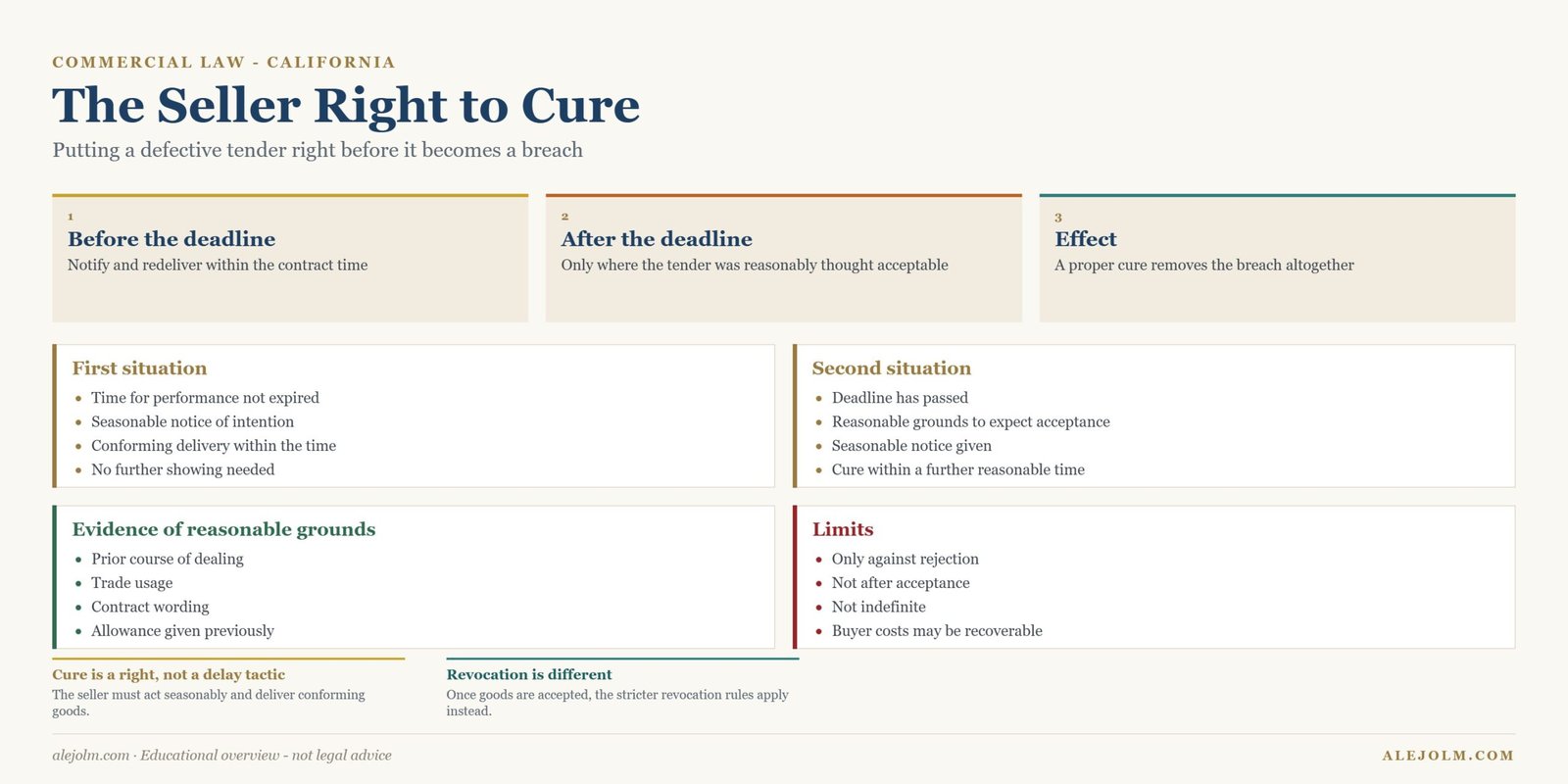
The right to cure is what stops the perfect tender rule from being unworkable. Where a buyer rejects goods because the tender did not conform, the California Commercial Code allows the seller in defined circumstances to notify the buyer and substitute a conforming delivery, and a proper cure removes the breach rather than merely reducing the damages.
There are two situations, and they are governed by different tests. If the time for performance has not expired, cure is straightforward. If the deadline has passed, the seller must additionally show that it had reasonable grounds to believe the original tender would be acceptable. This guide explains both, the notice requirement, and why cure has nothing to offer once the buyer has accepted.
Situation one: the deadline has not passed
Where the contract time for performance still has room in it, the seller need only give seasonable notice of its intention to cure and make a conforming delivery within that time. No further showing is required. A seller that delivers early and discovers a problem is therefore in a strong position, which is one practical argument for delivering ahead of the date.
Situation two: the deadline has passed
Once the contract time has expired, the seller may still have a further reasonable time to substitute a conforming tender, but only if it had reasonable grounds to believe that the original tender would be acceptable. That test is objective and is usually established by evidence of what has happened between these parties before or of what is normal in the trade.
- Prior course of dealing. The buyer has previously accepted similar deviations without complaint.
- Trade usage. Small variations of this kind are customary in the market.
- Contract wording. The agreement itself contemplates tolerances or substitutions.
- A money allowance. The seller offered a price adjustment along with the tender.
- Communications before delivery. The buyer indicated flexibility.
- Seasonable notice. The seller told the buyer promptly that it intended to cure.
The limits of the right
Cure operates against rejection only. Once the buyer has accepted the goods, whether by saying so, by failing to reject within a reasonable time or by acting inconsistently with the seller ownership, the seller can no longer invoke it. At that point the buyer position is governed by the stricter rules on revocation of acceptance, which require the nonconformity to substantially impair the value of the goods to that buyer.
The right is also not a licence to delay. The seller must notify seasonably and complete the cure within a reasonable further time, and a buyer that has incurred additional expense because of the defective first tender can generally recover it.
| Circumstance | Cure available | What the seller must show |
|---|---|---|
| Delivery early, defect found, time remains | Yes | Notice and timely conforming delivery |
| Deadline passed, prior acceptances of similar goods | Yes | Reasonable grounds plus notice |
| Deadline passed, no history or usage | No | Rejection stands |
| Buyer has accepted the goods | No | Revocation rules apply |
| Seller delays without notice | No | Right lost |
A worked example
A supplier delivers a consignment of custom printed garments to a Los Angeles retailer three days before the contract date, and a small proportion carry a printing fault. The retailer rejects the whole delivery. Because the deadline has not passed, the supplier simply notifies the retailer and delivers corrected items in time. The cure is effective, the tender now conforms, and the rejection falls away.
Change the timing. Suppose the faulty delivery arrives on the final day. The supplier can still cure only if it can point to something showing it reasonably expected the faulty items to be accepted, such as previous consignments in which the retailer tolerated the same fault. Without that, the rejection stands and the retailer may buy elsewhere.
The right to cure in California and Los Angeles County in 2026
For manufacturers and distributors operating through the ports and warehouses of Los Angeles County, the cure right is the most useful defensive tool against opportunistic rejections in a falling market. The practical requirement is documentary: a seller needs records of previous deliveries, allowances and communications to establish reasonable grounds once a deadline has passed.
Buyers, for their part, should be precise about the nonconformity when rejecting and should say clearly whether a cure would be accepted. Ambiguity helps the seller, because a court asked to decide whether the seller reasonably expected acceptance will look at everything the buyer said and did.
- Deliver early where you can. It preserves the simpler cure route.
- Give notice at once. Seasonable notice is a requirement, not a courtesy.
- Keep the dealing history. It is the usual proof of reasonable grounds.
- Offer an allowance. A price adjustment supports the reasonableness of the original tender.
- Reject with particulars. Buyers should specify the defect to preserve their position.
- Watch acceptance. Cure disappears once the goods are accepted.
For 2026, confirm the current California authority on cure, seasonable notice and reasonable grounds directly with current authority, since these continue to develop.
Common mistakes to avoid
- Assuming cure is always available. After the deadline it requires a positive showing.
- Skipping the notice. An unannounced second delivery may not qualify.
- Treating reasonable grounds as subjective. The test looks at objective evidence.
- Invoking cure after acceptance. The revocation rules apply instead.
- Taking too long. A further reasonable time is not an open ended one.
- Ignoring the buyer costs. Additional expense caused by the first tender is recoverable.
Frequently asked questions
Can a seller always fix a defective delivery?
No. Where the contract time has expired the seller must show that it had reasonable grounds to believe the original tender would be acceptable.
What is seasonable notice?
Notice given within the time agreed or, if no time is agreed, within a reasonable time in the circumstances. In practice it means promptly.
Does a cure remove the breach entirely?
Yes, as to that tender. A proper cure means the tender conforms, rather than merely reducing the damages the seller must pay.
Can the seller cure after I have accepted the goods?
No. Cure operates against rejection. Once you have accepted, your position depends on the rules for revocation of acceptance and on warranty claims.
Can I recover the extra costs the first delivery caused me?
Generally yes. A buyer can usually recover reasonable expenses incurred as a result of the defective tender even where the seller then cures.
Related guides
- The perfect tender rule
- Revocation of acceptance
- Installment contracts
- Risk of loss and delivery terms
- Implied warranties
- Substantial performance
- Material breach
- Damages for breach of contract
Next steps
If a delivery has been rejected, work out first whether the contract date has passed, because that single fact decides which test applies. Our guides to the perfect tender rule and revocation of acceptance cover the position on either side of acceptance.
For primary sources, read California Commercial Code section 2508 and the civil jury instructions published by the Judicial Council of California.