
Supplemental jurisdiction answers a practical problem. A plaintiff has one claim that belongs in federal court and three that do not, all arising from the same events. Splitting them across two courthouses would waste everyone’s time. Section 1367 of title 28 lets the federal court take the whole dispute — with important limits that exist to stop the statute from swallowing the complete diversity rule.
This guide covers the common nucleus test, the claims that section 1367(b) excludes, the four discretionary grounds for declining, and the tolling rule that keeps a dismissed state claim alive. It closes with how the doctrine works when a Los Angeles case straddles state and federal law.
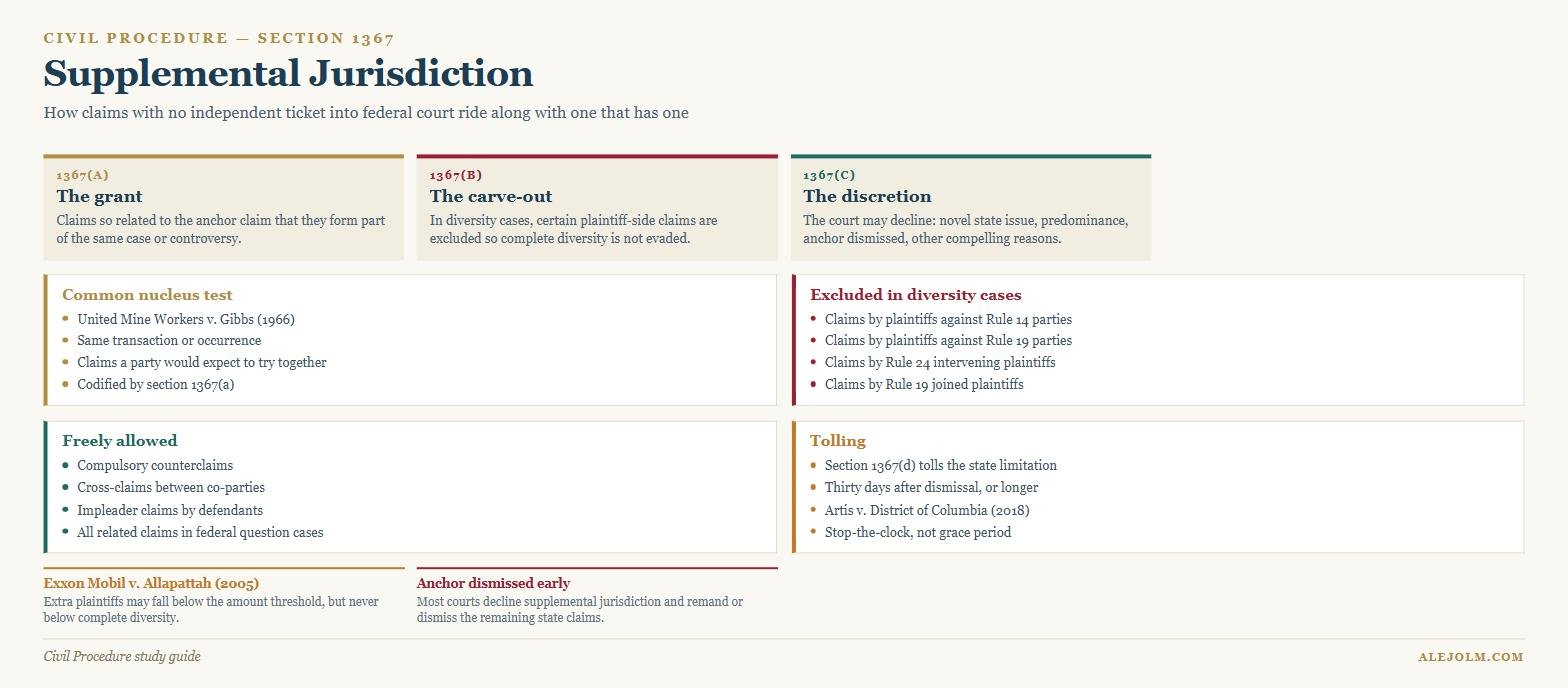
The grant: section 1367(a)
Once a district court has original jurisdiction over any claim, it also has jurisdiction over all other claims that are so related that they form part of the same case or controversy under Article III. The statute codifies United Mine Workers v. Gibbs (1966), which asked whether the claims derive from a common nucleus of operative fact such that a plaintiff would ordinarily be expected to try them all in one proceeding.
Two features are easy to miss. First, the grant is claim-specific, not case-specific: each additional claim is tested separately. Second, section 1367(a) expressly reaches claims that involve the joinder or intervention of additional parties, so supplemental jurisdiction is not confined to new claims between existing litigants.
The carve-out: section 1367(b)
If — and only if — the anchor claim rests on diversity, subsection (b) withdraws supplemental jurisdiction over certain claims. The purpose is narrow and specific: to prevent a plaintiff from doing indirectly what Strawbridge forbids directly. The excluded categories are claims by plaintiffs against persons made parties under Rules 14, 19, 20 or 24, and claims by persons proposed to be joined as plaintiffs under Rule 19 or seeking to intervene as plaintiffs under Rule 24, where exercising jurisdiction would be inconsistent with section 1332.
Notice who is missing. Defendants are not restricted, so a defendant’s impleader claim, cross-claim or compulsory counterclaim travels under section 1367(a) even in a diversity case. And in a federal question case subsection (b) does not apply at all.
The Exxon Mobil gloss
Exxon Mobil Corp. v. Allapattah Services (2005) drew a sharp line between the two section 1332 requirements. Where one plaintiff satisfies the amount in controversy, additional plaintiffs joined under Rule 20 or certified in a Rule 23 class may ride along on smaller claims. Incomplete diversity is different: it is a defect in original jurisdiction over the action itself, and supplemental jurisdiction cannot repair it.
The discretion: section 1367(c)
| Ground | Text of § 1367(c) |
|---|---|
| Novel state issue | Claim raises a novel or complex issue of state law |
| Predominance | Claim substantially predominates over the anchor |
| Anchor dismissed | All claims with original jurisdiction dismissed |
| Exceptional circumstances | Other compelling reasons for declining |
Where the court declines, section 1367(d) tolls the applicable state limitation period while the claim was pending and for at least thirty days after dismissal. Artis v. District of Columbia (2018) held this is a genuine stop-the-clock rule rather than a thirty-day grace period, which can matter enormously when a case has been in federal court for years.
A worked example
An employee sues her employer in federal court under Title VII and adds California Labor Code and defamation claims arising from the same termination. The employer impleads a staffing agency for indemnity. Midway through discovery the court grants summary judgment on the Title VII claim.
Up to that point everything was proper: the Title VII claim was the anchor, the state claims shared a common nucleus, and section 1367(b) was irrelevant because the anchor rested on federal question jurisdiction rather than diversity. After the Title VII claim falls, the court may decline under section 1367(c)(3). Whether it does turns on how much has been invested — a dismissal on the pleadings almost always leads to declining, while a dismissal on the eve of trial usually does not.
Supplemental jurisdiction in California and Los Angeles County in 2026
Los Angeles cases are unusually likely to mix federal and California claims in a single complaint, because the California statutory landscape is so much broader than the federal one. A wrongful termination case can combine Title VII with the Fair Employment and Housing Act, Labor Code section 1102.5, wage and hour claims and a Private Attorneys General Act representative claim. A civil rights case can combine section 1983 with the Bane Act and the Unruh Civil Rights Act. Every one of those state claims reaches federal court only through section 1367.
That creates a recurring pattern in the Central District. The federal claim anchors the case, the California claims dominate it in volume and value, and the parties eventually argue about predominance under section 1367(c)(2) or about what happens when the anchor is dismissed. PAGA claims are especially awkward because they are representative actions brought on the state’s behalf, and district judges have repeatedly declined supplemental jurisdiction over them while sending them back to the Los Angeles Superior Court.
Practical points for a Los Angeles filing in 2026:
- Expect the anchor to be attacked first. Defendants often move against the single federal claim precisely to trigger section 1367(c)(3) and send the California claims home.
- Plead PAGA with care. Consider whether a representative claim belongs in the same pleading at all, and check the current administrative notice requirements with the California Labor and Workforce Development Agency before filing.
- Rely on section 1367(d) tolling rather than protective filings. Under Artis the state clock stops, but confirm the interaction with the California Government Claims Act deadlines where a public entity is involved.
- Remember the Government Claims Act. A claim against the County of Los Angeles or the City requires a timely administrative claim; supplemental jurisdiction does not excuse that step.
- Do not assume remand and dismissal are the same. A removed case with declined supplemental claims is remanded to the superior court; an originally filed case is dismissed, and the plaintiff must file anew.
- Consider filing everything in state court instead. California courts have concurrent jurisdiction over most federal claims, and a single superior court action avoids the whole problem.
For 2026, the strategic question in Los Angeles is not whether section 1367 permits the state claims to be joined — it usually does — but whether you want them there when the federal anchor is vulnerable. Continue with subject matter jurisdiction, removal and remand and claim and issue preclusion.
Common mistakes to avoid
- Applying section 1367(b) in a federal question case. The carve-out operates only where original jurisdiction rests solely on diversity.
- Restricting defendants. Subsection (b) limits plaintiff-side claims. Impleader and cross-claims by defendants are unaffected.
- Treating decline as automatic. Section 1367(c) is discretionary, and a court deep into a case will often keep the state claims.
- Confusing supplemental jurisdiction with joinder. Rules 13, 14, 18, 19, 20 and 24 decide whether a claim may be asserted; section 1367 decides whether the court has power over it.
- Ignoring the tolling rule. Counsel who assume a state claim died with the federal case often abandon a claim that section 1367(d) preserved.
Frequently asked questions
What is the common nucleus of operative fact test?
It asks whether the supplemental claim shares enough factual overlap with the anchor claim that a litigant would ordinarily expect to try them in one proceeding. It comes from United Mine Workers v. Gibbs and is codified in section 1367(a).
Can supplemental jurisdiction cure a lack of complete diversity?
No. Exxon Mobil allows extra plaintiffs to fall below the amount in controversy, but a non-diverse party destroys original jurisdiction over the action and cannot be saved.
Does a compulsory counterclaim need its own jurisdictional basis?
No. A compulsory counterclaim arises from the same transaction and therefore satisfies the common nucleus test, and the section 1367(b) carve-out does not reach defendants.
What happens to state claims when the federal claim is dismissed?
The court may decline jurisdiction under section 1367(c)(3). Removed claims are remanded to state court; originally filed claims are dismissed, with the state limitation period tolled under section 1367(d).
Is supplemental jurisdiction the same as pendent and ancillary jurisdiction?
It replaced them. Congress consolidated the judge-made pendent claim, pendent party and ancillary doctrines into a single statute in 1990.
Related guides
- Subject Matter Jurisdiction in Federal Court Explained
- Federal Question Jurisdiction and the Well-Pleaded Rule
- Diversity Jurisdiction: Citizenship and Amount Rules
- Removal and Remand: Moving a Case to Federal Court
- The Erie Doctrine Explained: A 4-Step Bar Exam Guide
- Res Judicata vs Collateral Estoppel: Bar Exam Guide
- Abstention Doctrine: 4 Ways Federal Courts Step Aside
- Personal Jurisdiction: The 3-Step Bar Exam Framework
- Full Faith and Credit: Recognising Sister-State Judgments
- Standing in Federal Court: The 3-Part Article III Test
- The IRAC Method: How to Structure a Bar Exam Answer
Next steps
Supplemental jurisdiction usually becomes an issue after a case has already moved between court systems. Read removal and remand next to see how a case gets to federal court in the first place, and how the same discretionary grounds send parts of it back.