
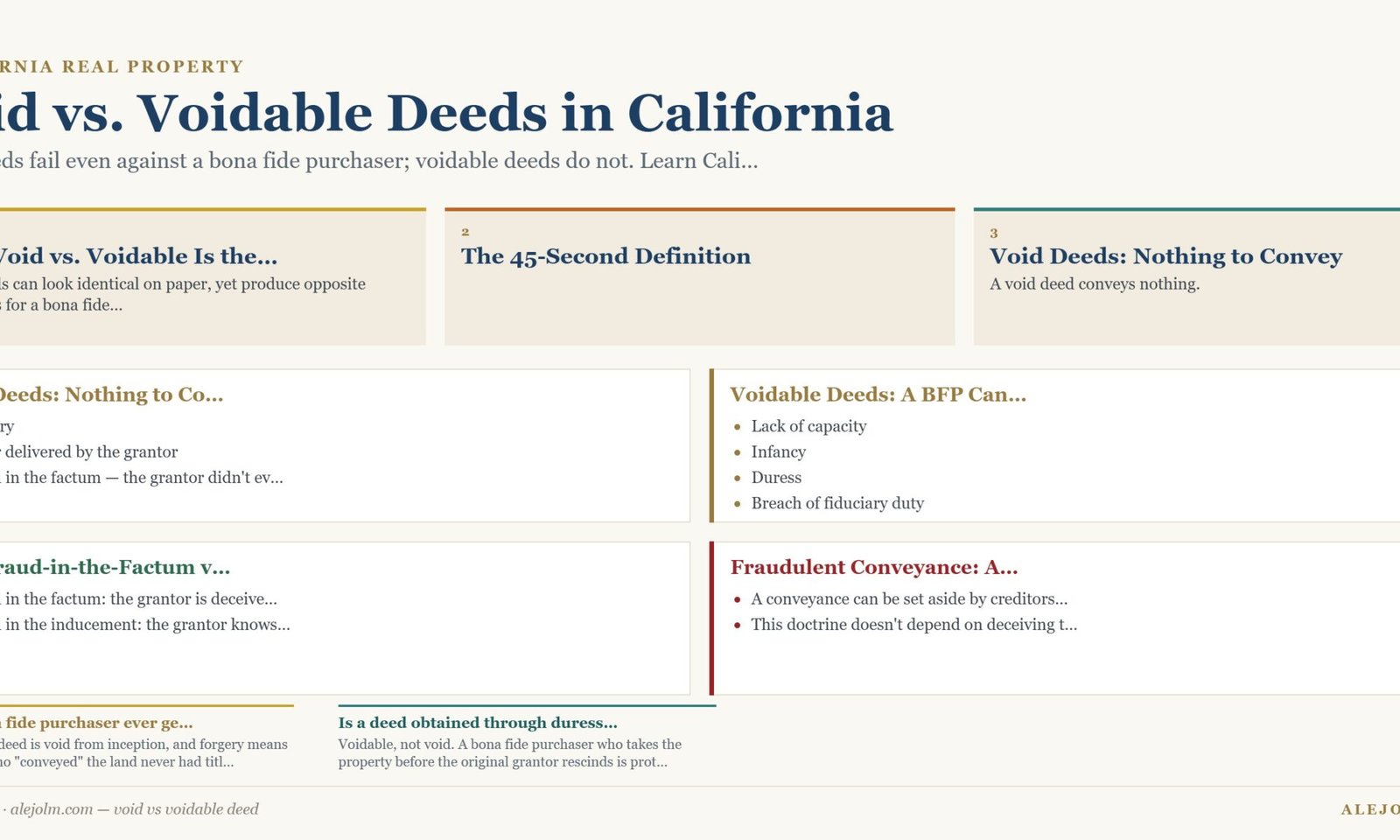
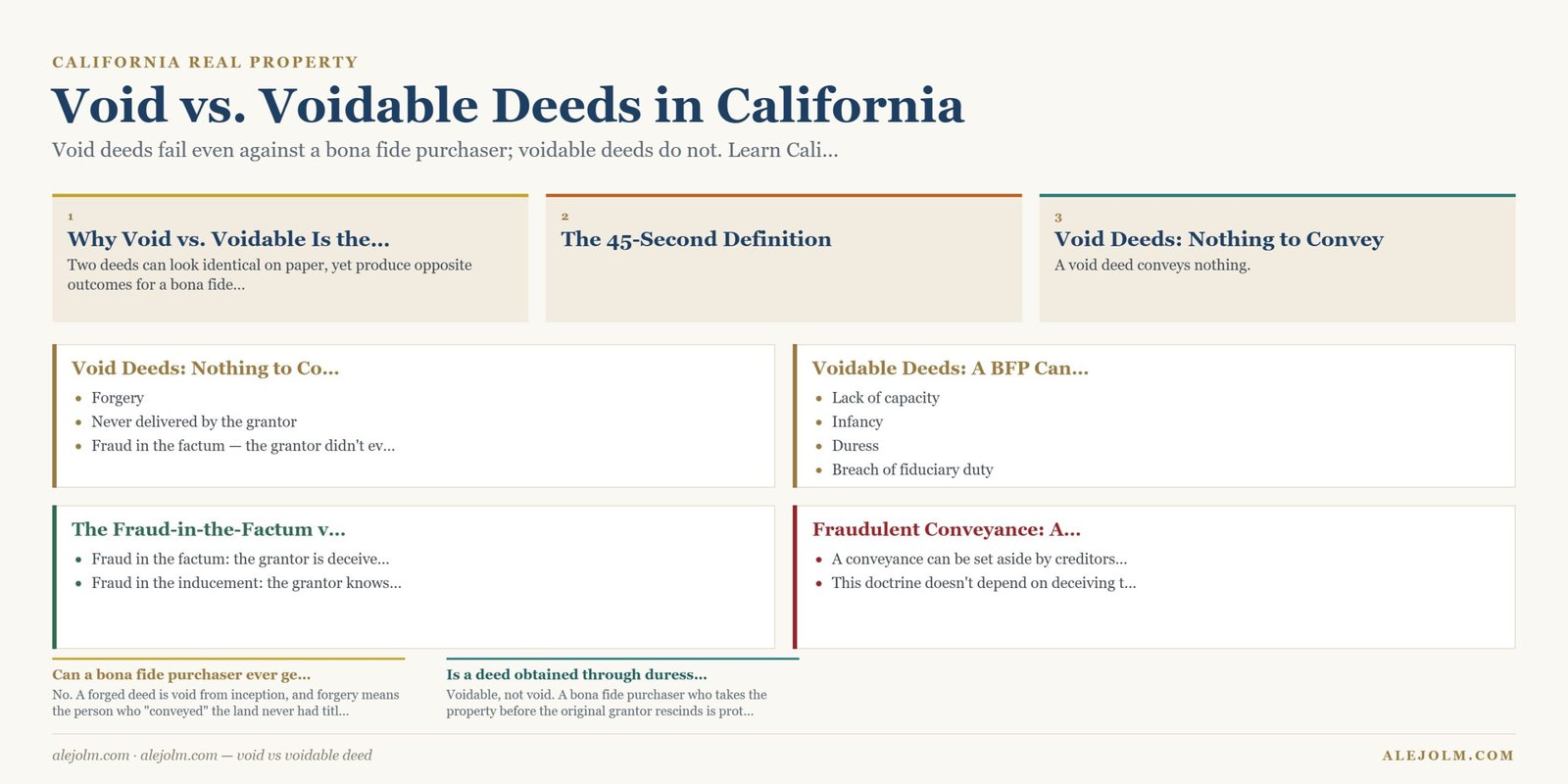
Why Void vs. Voidable Is the Whole Ballgame
Two deeds can look identical on paper, yet produce opposite outcomes for a bona fide purchaser three transactions later. On the California Bar Exam, and in real title disputes, everything turns on one classification question: is the defective deed void, or merely voidable?
Get that label right, and the rest of the analysis writes itself. Get it wrong, and you’ll hand the property to the wrong party.
The 45-Second Definition
Void deed: a nullity from inception — set aside even against a later bona fide purchaser — caused by forgery, lack of delivery, or fraud in the factum. Voidable deed: effective until rescinded, and set aside only if no bona fide purchaser has already taken — caused by lack of capacity, duress, undue influence, or fraud in the inducement.
Void Deeds: Nothing to Convey
A void deed conveys nothing. The grantor never had title to give, so no one down the chain — however innocent — can end up with good title through it.
Causes of a void deed:
- Forgery
- Never delivered by the grantor
- Fraud in the factum — the grantor didn’t even know she was signing a deed
Worked example. A forger fabricates a deed purporting to transfer Ohanian’s land to himself, then sells the land to Bell, a bona fide purchaser who pays full value with no notice of the forgery. Does Bell get good title? No. Bell gets nothing — the forged deed is void from inception, and even an innocent, paying BFP cannot take good title through a void instrument. Ohanian can recover the property directly from Bell. The forger never had title, so there was never anything to pass along.
Voidable Deeds: A BFP Can Cut Off the Original Owner’s Claim
A voidable deed is different in kind. It’s fully effective until rescinded, and a bona fide purchaser who takes before rescission wins outright.
Causes of a voidable deed:
- Lack of capacity
- Infancy
- Duress
- Breach of fiduciary duty
- Undue influence
- Mistake
- Fraud in the inducement — the grantor knew she was signing a deed, but was lied to about terms or value
Worked example. Grantor Reyes is fraudulently induced by Vance’s material lies to convey land to Vance. Vance then sells to Kessler, a bona fide purchaser without notice of the fraud. Can Reyes recover the land from Kessler? No. Vance’s deed from Reyes is only voidable — because Kessler is a BFP who took before Reyes rescinded, Kessler prevails. Reyes’s only remedy is a damages action against Vance, not recovery of the land itself.
| Defect | Void or voidable? | BFP protected? |
|---|---|---|
| Forgery | Void | No — BFP takes nothing |
| Never delivered | Void | No — BFP takes nothing |
| Fraud in the factum | Void | No — BFP takes nothing |
| Lack of capacity / infancy | Voidable | Yes, if BFP takes before rescission |
| Duress / undue influence | Voidable | Yes, if BFP takes before rescission |
| Fraud in the inducement | Voidable | Yes, if BFP takes before rescission |
The Fraud-in-the-Factum vs. Fraud-in-the-Inducement Line
This distinction alone accounts for a large share of missed points in the deeds unit.
- Fraud in the factum: the grantor is deceived about the very nature of the document — told she’s signing a contract or a receipt when it’s actually a deed. This voids the deed.
- Fraud in the inducement: the grantor knows she’s signing a deed but is lied to about the property’s value, condition, or the buyer’s identity or intentions. This only makes the deed voidable.
Worked example. An elderly grantor with diminished capacity is coerced by her caretaker into signing a deed under duress; the caretaker then sells to an innocent bona fide purchaser. Can the grantor recover the property from the BFP? No. Duress renders a deed merely voidable, not void. Because the BFP intervened before the grantor rescinded, the BFP prevails, and the grantor’s only remedy is a damages action against the wrongdoing caretaker.
Fraudulent Conveyance: A Separate Creditor Remedy
Don’t confuse the void/voidable framework with fraudulent conveyance law, which lets a grantor’s creditors unwind a transfer.
- A conveyance can be set aside by creditors if made with actual intent to hinder, delay, or defraud them, or without receiving reasonably equivalent value while insolvent.
- This doctrine doesn’t depend on deceiving the grantee — it protects creditors, not the grantor or a defrauded buyer.
Worked example. Facing bankruptcy, Ortiz conveys land to her adult son for no consideration. Ortiz’s creditors challenge the transfer. Under fraudulent-conveyance law, the creditors can set the conveyance aside and reach the property, because Ortiz transferred it without reasonably equivalent value while insolvent — regardless of her capacity or any duress, and regardless of whether the son knew anything was wrong.
Common Mistakes on Bar Exam Fact Patterns
- Assuming a BFP always wins. A BFP only defeats voidable defects, never a void deed.
- Treating all fraud identically. Fraud in the factum voids the deed; fraud in the inducement merely makes it voidable. Memorize this pairing.
- Missing that lack of capacity is only voidable. Capacity, duress, and undue influence protect the grantor but don’t void the deed from inception.
- Confusing fraudulent conveyance with void/voidable deeds. Fraudulent conveyance is a distinct creditor remedy, unrelated to whether the grantee deceived the grantor.
FAQ
Can a bona fide purchaser ever get good title from a forged deed?
No. A forged deed is void from inception, and forgery means the person who “conveyed” the land never had title to give. A BFP cannot take good title through a void instrument, no matter how much was paid or how innocent the purchaser was.
Is a deed obtained through duress void or voidable?
Voidable, not void. A bona fide purchaser who takes the property before the original grantor rescinds is protected, leaving the grantor with only a damages claim against the wrongdoer.
What is the difference between fraud in the factum and fraud in the inducement?
Fraud in the factum means the grantor didn’t know she was signing a deed at all, which voids it. Fraud in the inducement means the grantor knew she was signing a deed but was lied to about its terms, which only makes it voidable.
Key Takeaways
- Void deeds (forgery, no delivery, fraud in the factum) are set aside even against a bona fide purchaser.
- Voidable deeds (capacity, duress, undue influence, fraud in the inducement) are protected once a BFP intervenes before rescission.
- Fraud in the factum voids; fraud in the inducement only makes voidable — this distinction is the most frequently tested pairing in the deeds unit.
- Fraudulent conveyance is a separate doctrine that lets creditors unwind transfers made without fair value while insolvent.
This article is educational and is not legal advice. Consult a licensed California attorney about your situation.
Related guides
- Deed delivery and escrow rules in California
- Estoppel by deed: California’s after-acquired title rule
- Bona fide purchaser and notice
- Deed types and covenants in California