
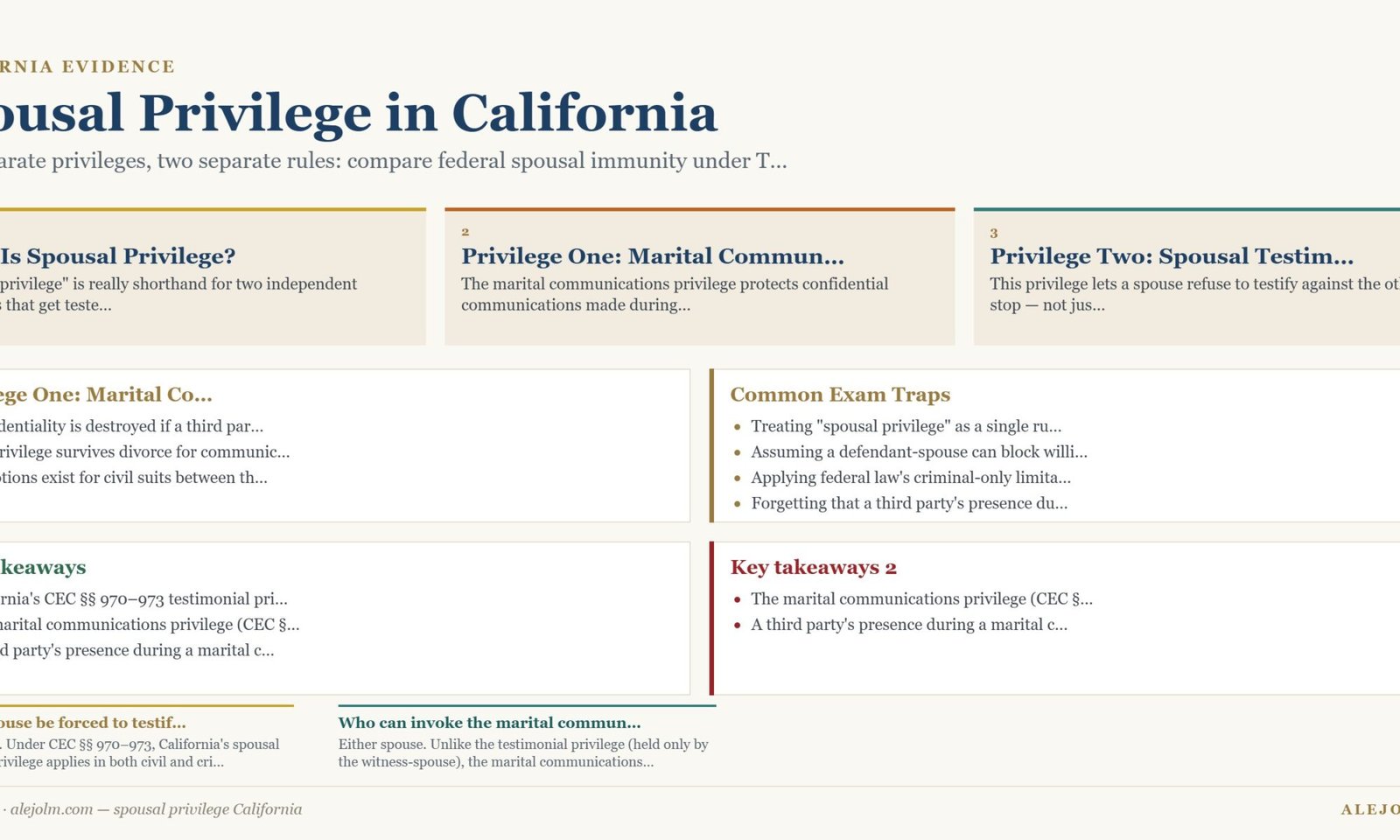
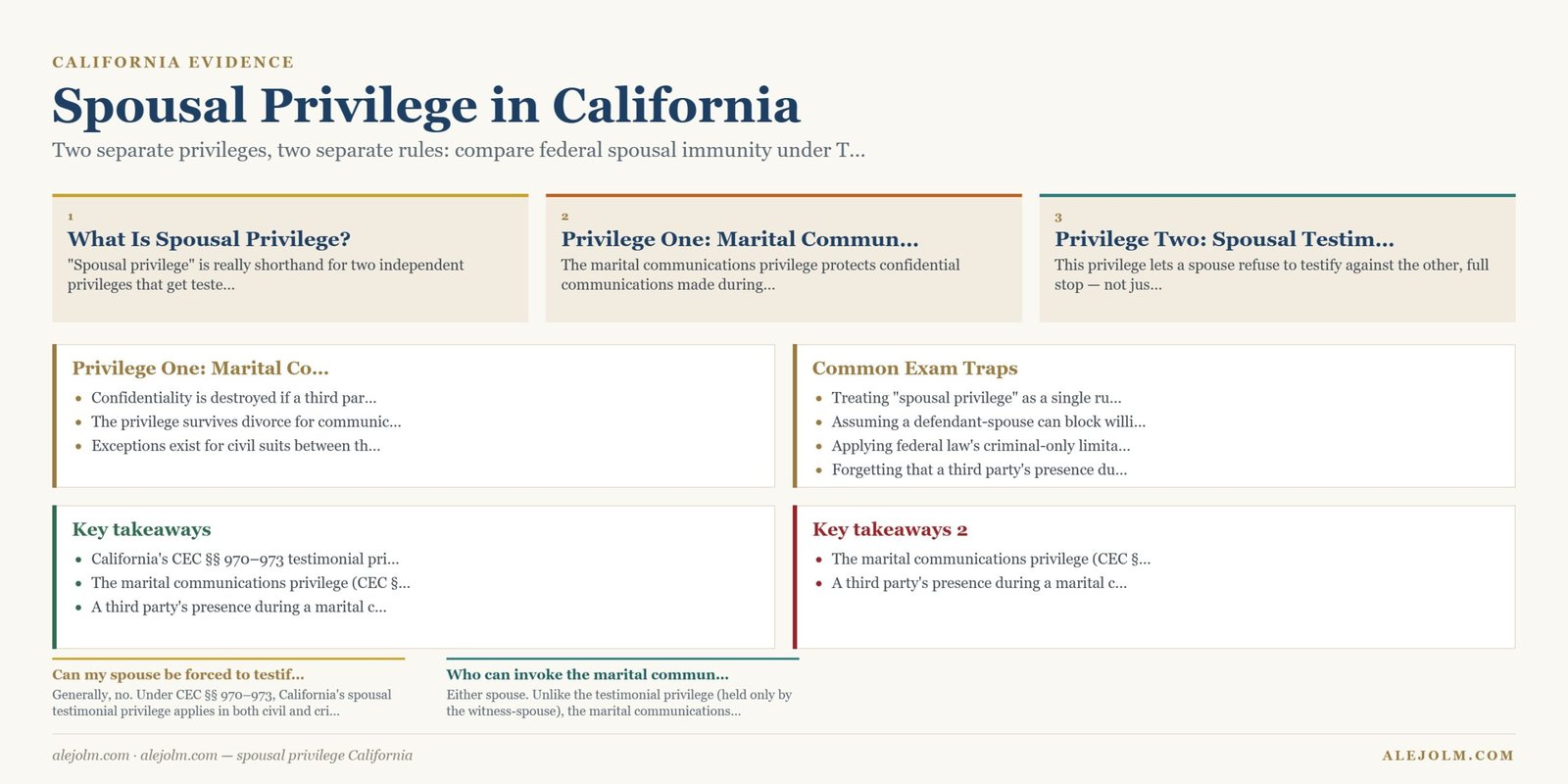
What Is Spousal Privilege?
“Spousal privilege” is really shorthand for two independent privileges that get tested separately: the marital communications privilege and the spousal testimonial privilege (sometimes called spousal immunity). Treating them as one rule is the single most common mistake on this topic.
California expands both of these well beyond what federal common law provides, and the gap between the two systems is a favorite California Bar Exam distinction — one that shows up in criminal, family, and civil fact patterns alike.
Spousal privilege refers to two distinct evidentiary protections: the marital communications privilege, which shields confidential statements made during marriage, and the spousal testimonial privilege, which lets a spouse refuse to testify against the other.
Privilege One: Marital Communications
The marital communications privilege protects confidential communications made during a valid marriage, in both civil and criminal cases. It’s held by both spouses — either one can invoke it to block the communication’s disclosure, even if the other spouse is on the stand and willing to talk.
Key features:
- Confidentiality is destroyed if a third party overhears or is present for a business (not marital-support) purpose.
- The privilege survives divorce for communications made during the marriage.
- Exceptions exist for civil suits between the spouses, criminal prosecutions for crimes against the other spouse or their children, and joint criminal participation.
Privilege Two: Spousal Testimonial Immunity
This privilege lets a spouse refuse to testify against the other, full stop — not just about communications, but about anything, including pre-marriage conduct. Under federal common law, Trammel v. United States (1980) holds that only the witness-spouse holds this privilege. A defendant-spouse cannot block a willing spouse from testifying against them.
Federal spousal testimonial immunity applies only in criminal cases (including grand jury proceedings), and it requires a valid marriage at the time of trial — divorce kills it prospectively.
CEC vs. FRE: Where California Goes Much Further
| Issue | Federal Rule (Common Law) | California Rule (CEC) |
|---|---|---|
| Marital communications privilege | Applies in civil and criminal cases; held by both spouses | Same scope, CEC §§ 980–987, held by both spouses |
| Testimonial privilege — case types | Criminal cases only (incl. grand jury) | Both civil and criminal cases (CEC §§ 970–973) |
| Testimonial privilege — scope | Refuse to testify against the other spouse | Refuse to testify altogether, “about any subject matter” (CEC § 971) |
| Who holds testimonial privilege | Witness-spouse only (Trammel) | Witness-spouse (CEC § 970), similar to Trammel |
| Effect of divorce | Terminates testimonial privilege prospectively | Same, though marital communications made during marriage remain protected |
| Unique exceptions | None equivalent to CEC § 972 | § 972 — marriage entered to evade privilege, or crimes against children, may defeat the privilege |
The headline difference: California’s testimonial privilege isn’t limited to criminal cases and isn’t limited to adverse testimony — it lets a witness-spouse refuse to discuss any subject matter in any proceeding, civil or criminal.
Why the Two-Privilege Structure Matters in Practice
Because the two privileges have different holders, a single fact pattern can produce two different outcomes depending on which privilege applies. If a defendant confessed to his wife in a private conversation, the marital communications privilege belongs to both spouses — the defendant can block his wife’s testimony about that specific conversation even if she’s willing to share it. But if the prosecution instead asks the wife to describe the defendant’s general demeanor or unrelated conduct she personally observed (not the content of a confidential statement), that’s not protected by marital communications privilege at all, and under Trammel, the defendant can’t use the separate testimonial privilege to stop her from testifying generally, because only the witness-spouse holds that one.
Worked Hypothetical
Facts: Diego is married to Wendy. Alone in their kitchen with no one else present, Diego tells Wendy he embezzled money from his employer. Diego is later prosecuted in California state court, and the prosecution calls Wendy, who is willing to testify about the confession.
Analysis: Two privileges are in play, and they cut opposite directions. First, the marital communications privilege (CEC §§ 980–987) protects Diego’s confession because it was made in confidence during a valid marriage. Diego — as one of the two holders — can assert it to block Wendy from disclosing the confession’s content, even though Wendy is willing to testify and even though she, not Diego, is the one on the stand. Second, if instead the prosecution asked Wendy only to describe Diego’s demeanor that evening — not the confession’s content — that testimony isn’t privileged communication at all. Third, contrast the testimonial privilege: if Wendy simply wanted to testify generally against Diego (not about a confidential communication), CEC § 971 gives her, as the witness-spouse, the choice — Diego cannot invoke a privilege he doesn’t hold to silence her. The two analyses are independent, and the confidential confession is protected regardless of Wendy’s willingness to talk.
Common Exam Traps
- Treating “spousal privilege” as a single rule instead of analyzing marital communications and testimonial immunity separately.
- Assuming a defendant-spouse can block willing spousal testimony under federal law — only the witness-spouse holds that privilege after Trammel.
- Applying federal law’s criminal-only limitation on testimonial privilege to a California civil case, where CEC § 971 applies in both.
- Forgetting that a third party’s presence during a marital conversation destroys the communications privilege.
FAQ
Can my spouse be forced to testify against me in a California civil case?
Generally, no. Under CEC §§ 970–973, California’s spousal testimonial privilege applies in both civil and criminal cases, and the witness-spouse can refuse to testify about any subject matter — broader than the federal rule, which limits testimonial immunity to criminal proceedings.
Who can invoke the marital communications privilege?
Either spouse. Unlike the testimonial privilege (held only by the witness-spouse), the marital communications privilege under CEC §§ 980–987 is held by both spouses, and either one can block disclosure of a qualifying confidential communication.
Does divorce end spousal privilege?
It depends which one. The testimonial privilege ends prospectively upon divorce. The marital communications privilege survives divorce for communications made while the couple was validly married.
Key Takeaways
- Always analyze marital communications privilege and spousal testimonial privilege as two separate doctrines with different holders and scopes.
- Federal testimonial immunity under Trammel applies only in criminal cases and is held solely by the witness-spouse.
- California’s CEC §§ 970–973 testimonial privilege is far broader: it covers civil and criminal cases and any subject matter.
- The marital communications privilege (CEC §§ 980–987) is held by both spouses and survives divorce for in-marriage communications.
- A third party’s presence during a marital conversation generally destroys the communications privilege’s confidentiality requirement.
This article is educational and is not legal advice. Consult a licensed California attorney about your situation.
Related guides
- attorney-client privilege under California’s Evidence Code
- Fifth Amendment privilege against self-incrimination
- rape shield law in California