
What Is a Spendthrift Trust in California?
If you’ve ever heard of a wealthy family “protecting” an inheritance from a beneficiary’s creditors—or from the beneficiary’s own bad spending habits—you’ve heard of a spendthrift trust. It’s one of the most searched trust topics online, and for good reason: it’s a genuinely powerful asset-protection tool, and it’s heavily tested on the California Bar Exam.
Spendthrift provisions aren’t unlimited shields, though. California law carves out real exceptions, and missing them is a common and costly mistake for both exam-takers and drafting attorneys.
A spendthrift trust contains a clause barring both the beneficiary’s voluntary assignment of their trust interest and creditors’ involuntary attachment of it—a symmetrical restraint on alienation that is valid and enforceable under California Probate Code §§ 15300–15307. That definition captures the whole doctrine in one sentence.
The Symmetry Requirement
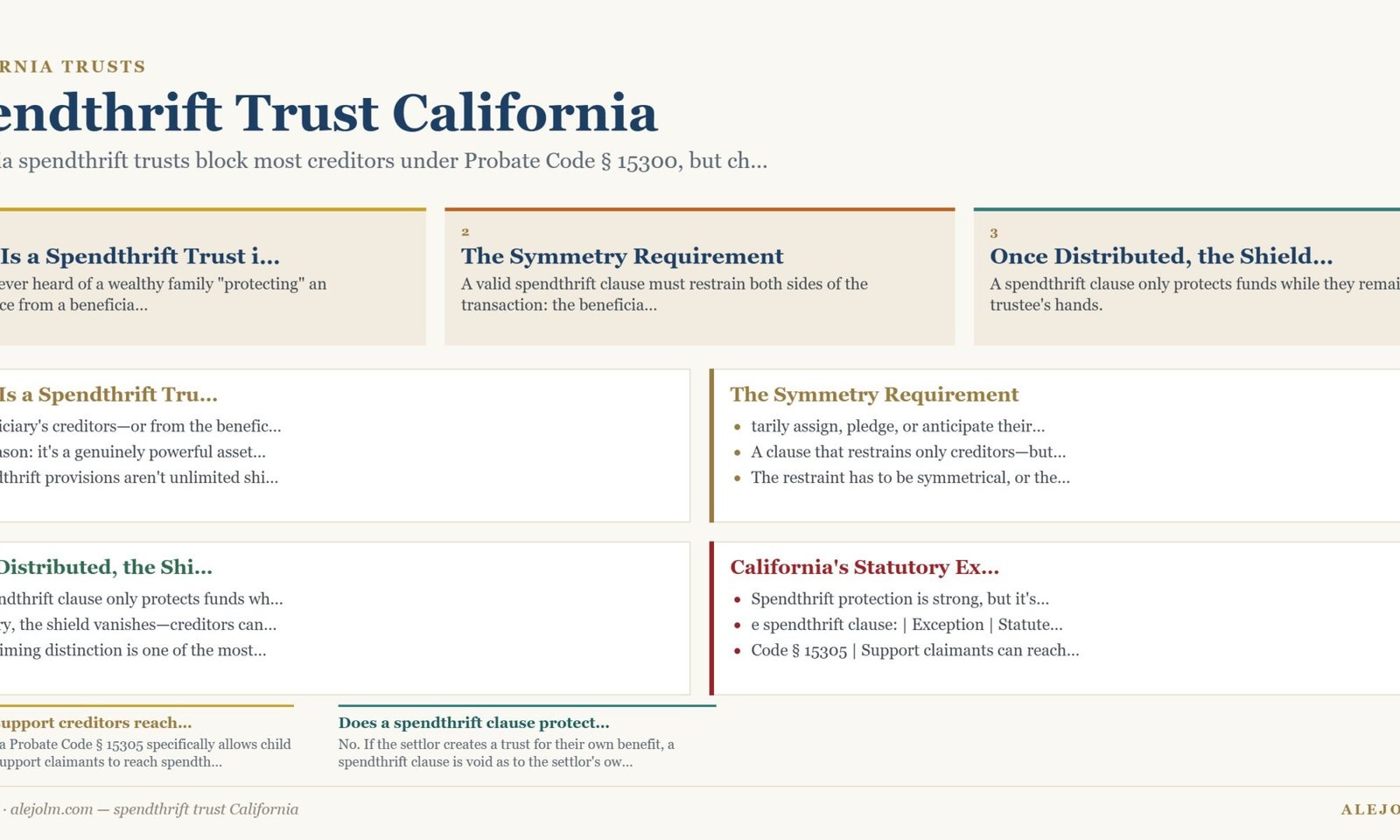
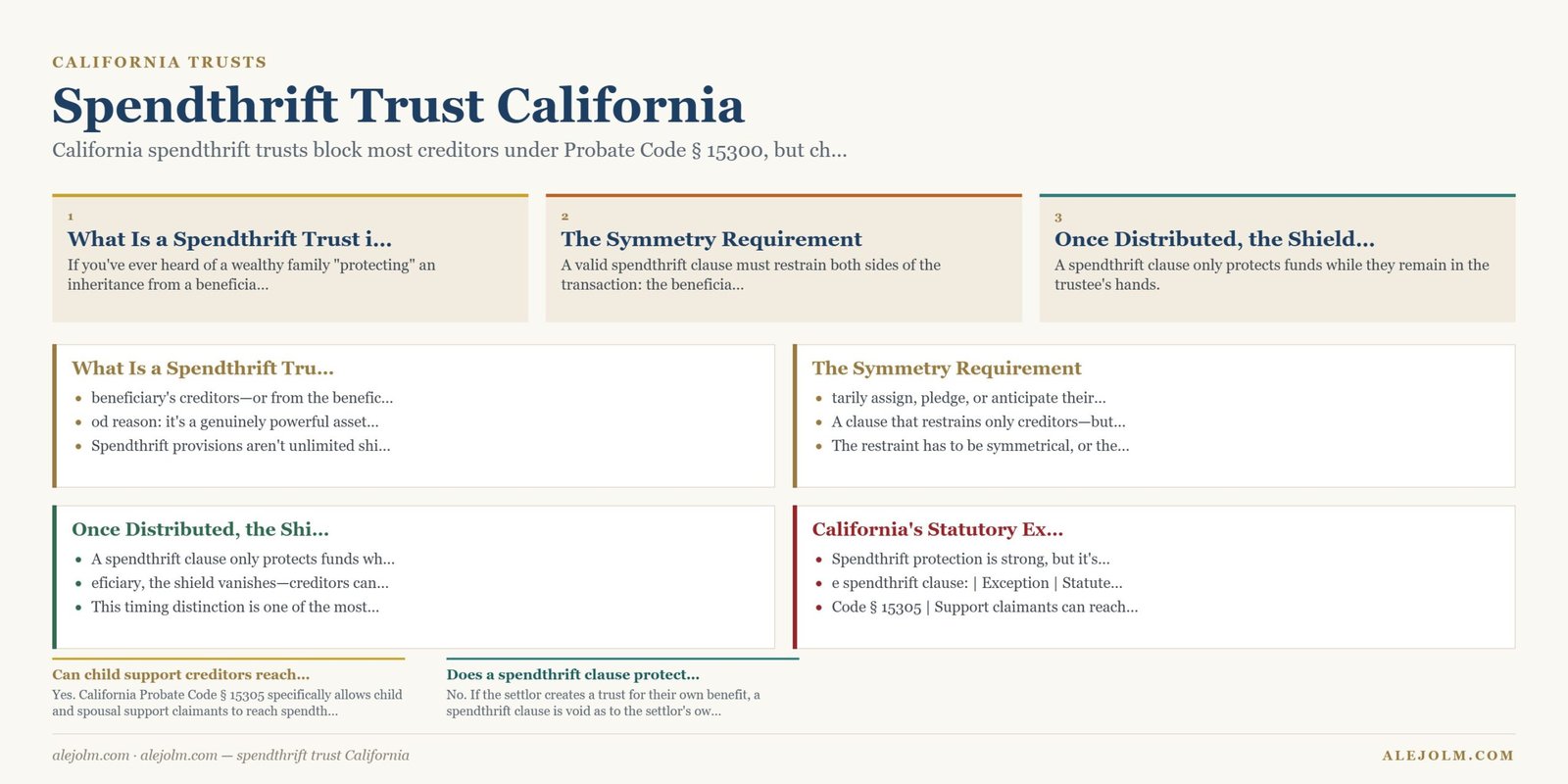
A valid spendthrift clause must restrain both sides of the transaction: the beneficiary cannot voluntarily assign, pledge, or anticipate their interest, and creditors cannot involuntarily attach or garnish it. A clause that restrains only creditors—but lets the beneficiary freely sell their interest—is invalid. The restraint has to be symmetrical, or the entire clause fails.
Classic spendthrift language reads something like: “No beneficiary shall have the power to assign, anticipate, pledge, or encumber this interest, and no creditor of any beneficiary shall have recourse to this trust estate.” When that language appears, California courts presume the settlor intended full spendthrift protection.
Once Distributed, the Shield Disappears
A spendthrift clause only protects funds while they remain in the trustee’s hands. The moment the trustee actually distributes money to the beneficiary, the shield vanishes—creditors can attach the funds the instant they land in the beneficiary’s pocket. This timing distinction is one of the most commonly missed points on exam fact patterns.
California’s Statutory Exceptions
Spendthrift protection is strong, but it’s not absolute. California carves out several categories of creditors who can pierce the trust regardless of the spendthrift clause:
| Exception | Statute | What It Allows |
|---|---|---|
| Child and spousal support | Cal. Prob. Code § 15305 | Support claimants can reach spendthrift-protected distributions |
| Government/tax claims | Cal. Prob. Code § 15305.5 | Tax liens and other government debts can proceed against the trust |
| Surplus beyond “station in life” needs | Cal. Prob. Code § 15307 | Any creditor can reach amounts exceeding reasonable support needs |
| Providers of necessaries | Limited recognition | Food, shelter, medical care providers—narrowly recognized in California |
The § 15305 support exception is the single most tested exception on the bar exam. It reflects a policy judgment that family support obligations outweigh a settlor’s desire to shield a beneficiary’s inheritance from an ex-spouse or children.
The § 15307 “station in life” exception is subtler: it lets any creditor reach the portion of trust income that exceeds what the beneficiary reasonably needs to maintain their accustomed standard of living. Defining that surplus is fact-intensive and often disputed, but the principle is clear—spendthrift protection covers reasonable support, not unlimited surplus wealth.
Tort Creditors and Necessaries Providers
Tort creditors (someone the beneficiary injured, for example) generally cannot pierce a spendthrift trust in California, though a small minority of jurisdictions grant tort victims preferred status. Providers of necessaries—doctors, landlords, grocers who extended credit for essentials—have a limited, cautiously recognized exception in some cases, but California courts haven’t embraced it broadly.
Self-Settled Trusts: The Big Exception
A spendthrift clause is void as to the settlor’s own interest when the settlor creates a trust for their own benefit. If Maria funds a trust naming herself as beneficiary and adds a spendthrift clause hoping to dodge her own creditors, the clause simply doesn’t work against her personal creditors. This rule exists precisely to prevent people from using trusts as a personal debt-shielding device. By contrast, a third-party trust—where Maria funds a trust for someone else’s benefit—gets full spendthrift protection, subject to the statutory exceptions above.
Worked Example: The Bar Exam Fact Pattern
Grandfather Walter creates an irrevocable trust for his son David, with a valid spendthrift clause, distributing $4,000 per month. David owes $30,000 in credit card debt, $15,000 in unpaid child support, and recently injured a pedestrian while driving, resulting in a $50,000 tort judgment against him.
Analysis:
- The credit card creditor cannot reach David’s undistributed trust interest—ordinary contract creditors are exactly what spendthrift clauses are designed to block.
- The child support claimant can reach David’s trust distributions under Cal. Prob. Code § 15305, regardless of the spendthrift clause. This is the classic statutory exception.
- The tort judgment creditor generally cannot reach the trust in California, since California hasn’t adopted the minority rule granting tort creditors preferred status.
- Once David actually receives his monthly $4,000 distribution, it becomes his personal property—at that point, the credit card creditor and the tort creditor can attach it, since the spendthrift shield no longer applies to distributed funds.
- Result: only the child support creditor can reach the trust corpus directly; everyone else has to wait until funds are distributed to David personally.
Common Mistakes to Avoid
Mistake 1: Believing a spendthrift clause protects distributed funds. It only protects assets still held by the trustee—once paid out, ordinary creditors can attach.
Mistake 2: Assuming spendthrift clauses are absolute. Child support, government claims, and station-in-life surplus can all pierce the shield.
Mistake 3: Missing the symmetry requirement. A one-sided restraint (only blocking creditors, not the beneficiary’s own assignments) invalidates the entire clause.
Mistake 4: Overlooking the self-settled trust rule. A settlor cannot use a spendthrift clause to protect their own interest from their own creditors.
Mistake 5: Conflating spendthrift clauses with discretionary trusts. They’re separate concepts—a spendthrift clause restrains alienation; a discretionary trust gives the trustee control over distribution timing and amount. A trust can have either, both, or neither.
FAQ
Can child support creditors reach a spendthrift trust in California?
Yes. California Probate Code § 15305 specifically allows child and spousal support claimants to reach spendthrift-protected trust distributions, overriding the general creditor bar that otherwise applies.
Does a spendthrift clause protect a self-settled trust?
No. If the settlor creates a trust for their own benefit, a spendthrift clause is void as to the settlor’s own interest, so the settlor’s personal creditors can still reach it.
Once a trustee distributes money to a beneficiary, can creditors seize it?
Yes. Spendthrift protection only covers assets still held by the trustee. Once distributed into the beneficiary’s hands, the funds are treated like any other personal asset and are fully exposed to creditor claims.
Key Takeaways
- A valid spendthrift clause must symmetrically restrain both voluntary assignment and involuntary creditor attachment.
- California Probate Code §§ 15300-15307 govern spendthrift trusts and their statutory exceptions.
- Child and spousal support claimants (§ 15305) and government claims (§ 15305.5) can pierce the shield.
- Amounts exceeding the beneficiary’s reasonable support needs can be reached by any creditor under § 15307.
- Spendthrift clauses are void as to a settlor’s own interest in a self-settled trust.
This article is educational and is not legal advice. Consult a licensed California attorney about your situation.
Related guides
- Breach of Trust Remedies in California
- Trust Termination and Modification in California
- Trust Creation: The Ascertainable Beneficiary Element