
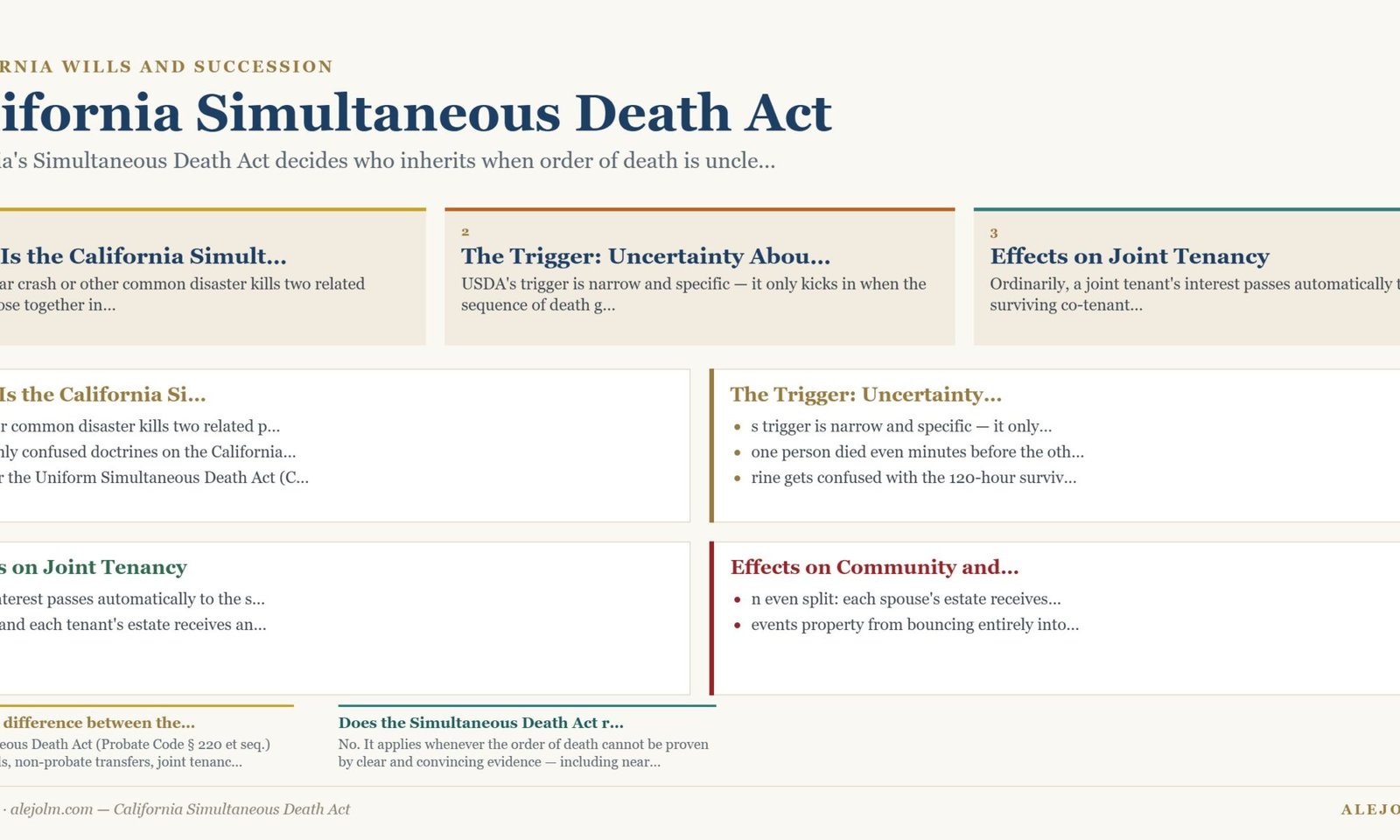
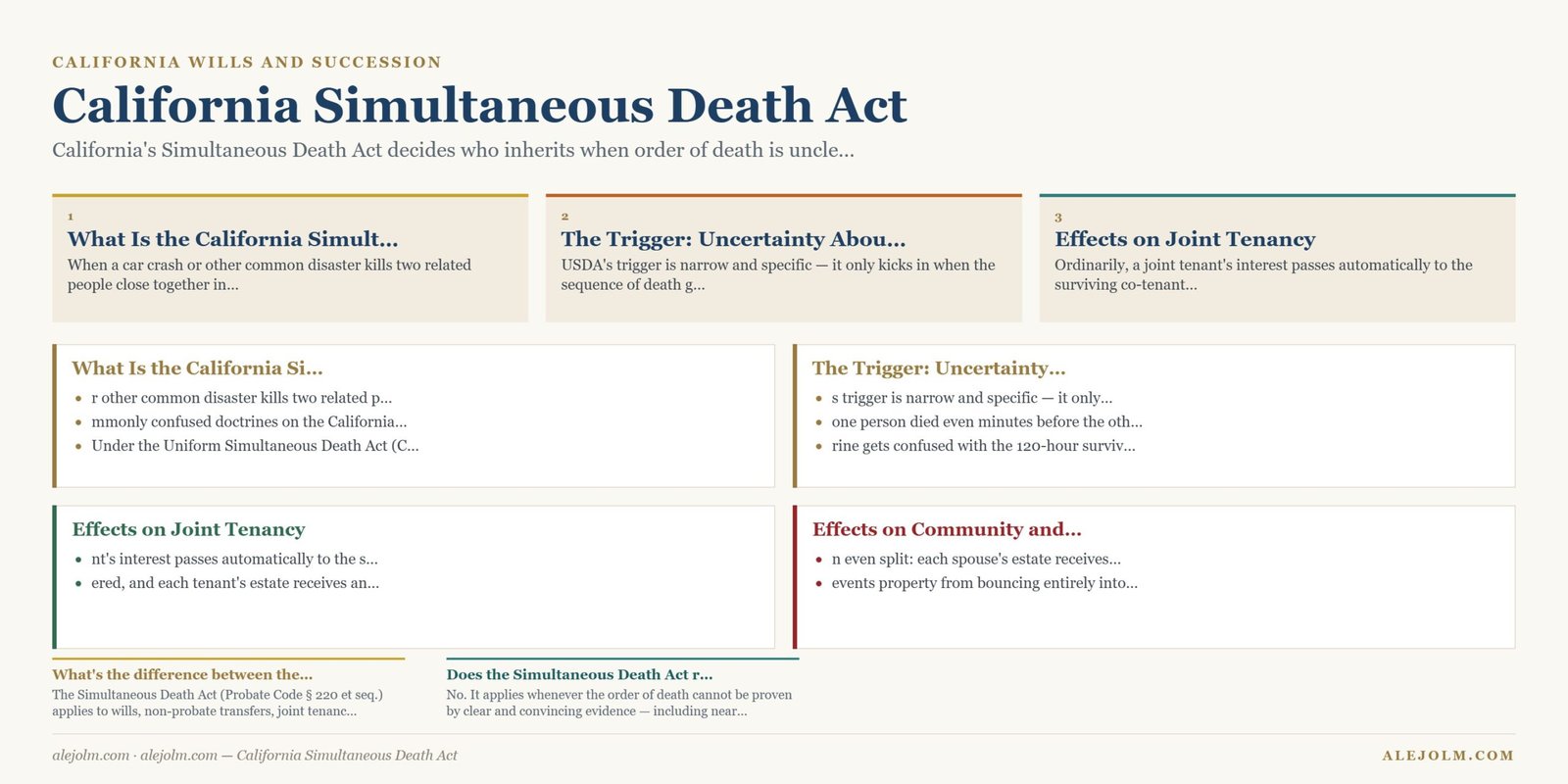
What Is the California Simultaneous Death Act?
When a car crash or other common disaster kills two related people close together in time, who is legally treated as dying first? The California Simultaneous Death Act answers that question for wills, joint tenancies, community property, and beneficiary-designated accounts — and it is one of the most commonly confused doctrines on the California Bar Exam because students mix it up with a different, related rule.
Under the Uniform Simultaneous Death Act (Cal. Probate Code § 220 et seq.), when it cannot be proven by clear and convincing evidence who died first, each person’s property is distributed as if that person survived the other. In plain terms: neither side inherits from the other through that transfer.
The Trigger: Uncertainty About Order, Not a Fixed Time Period
USDA’s trigger is narrow and specific — it only kicks in when the sequence of death genuinely cannot be established. If witnesses, medical examiners, or other evidence show that one person died even minutes before the other, USDA does not apply; ordinary survivorship rules govern instead.
This is exactly where the doctrine gets confused with the 120-hour survival rule that governs intestate succession under Probate Code § 6403. The two rules look similar but ask different questions:
| Feature | USDA (§ 220 et seq.) | 120-Hour Rule (§ 6403) |
|---|---|---|
| Applies to | Wills, non-probate transfers, joint tenancy, community/quasi-community property | Intestate succession only |
| Trigger | Order of death cannot be proven by clear and convincing evidence | Heir did not survive decedent by at least 120 hours |
| Works even when order is clear? | No — requires genuine uncertainty | Yes — applies even if the sequence of death is perfectly clear |
| Standard of proof | Clear and convincing evidence of survival order | Clear and convincing evidence of 120-hour survival |
Bar Exam fact patterns almost always signal which rule applies by the type of transfer at issue: intestacy problems call for the 120-hour rule, while will, insurance, joint tenancy, and community property problems call for USDA.
Effects on Joint Tenancy
Ordinarily, a joint tenant’s interest passes automatically to the surviving co-tenant by right of survivorship, with no probate at all. USDA changes that when the order of death is unknown: the joint tenancy is treated as severed, and each tenant’s estate receives an equal tenancy-in-common share instead of one side taking everything.
Effects on Community and Quasi-Community Property
For community and quasi-community property, USDA presumes an even split: each spouse’s estate receives fifty percent, rather than one spouse’s estate absorbing the whole. This prevents property from bouncing entirely into one side’s family line based on nothing more than uncertain timing.
Effects on Life Insurance and Beneficiary Designations
If a named beneficiary and the insured die together with no provable order of death, USDA treats the beneficiary as having predeceased the insured for that transfer. Proceeds pass to the insured’s estate — or to a properly named contingent beneficiary, if one exists.
Worked Example: The Common-Disaster Beneficiary
Renata names her husband, Paul, as the sole beneficiary of her life insurance policy and never names a contingent beneficiary. Renata and Paul are both killed in the same car accident. Investigators cannot determine, by clear and convincing evidence, who died first.
Analysis: Because the order of death cannot be established, USDA treats Paul as having predeceased Renata for purposes of the insurance transfer. Since no contingent beneficiary was named, the proceeds pass into Renata’s own probate estate rather than to Paul’s estate.
Variant: Suppose instead that Renata and Paul owned their house as joint tenants and died in the same accident with no provable order of death.
Analysis: USDA presumes severance of the joint tenancy. Each spouse’s estate receives a one-half tenancy-in-common interest in the house — Paul’s estate does not take the whole property by survivorship, and neither does Renata’s.
Why the California Bar Exam Tests This So Often
The examiners like pairing USDA with the 120-hour rule specifically because the two doctrines sound alike but produce different outcomes on nearly identical facts. A strong answer identifies the type of transfer first — intestate share versus will, joint tenancy, community property, or insurance — and only then selects the applicable doctrine. Applying the 120-hour minimum-duration standard to a will or insurance question, or applying USDA’s simple order-of-death presumption to an intestacy question with a known death sequence, is a common and costly error.
FAQ
What’s the difference between the Simultaneous Death Act and the 120-hour rule?
The Simultaneous Death Act (Probate Code § 220 et seq.) applies to wills, non-probate transfers, joint tenancy, and community property when the order of death cannot be established. The 120-hour rule (§ 6403) applies only to intestate succession and requires the heir to survive the decedent by at least 120 hours, even if the order of death is otherwise clear.
Does the Simultaneous Death Act require the deaths to happen at the exact same moment?
No. It applies whenever the order of death cannot be proven by clear and convincing evidence — including near-simultaneous deaths in a common disaster, not only literally identical moments of death.
What happens to a joint tenancy under the Simultaneous Death Act?
The joint tenancy is treated as severed. Instead of the survivor taking the whole property, each joint tenant’s estate receives a tenancy-in-common share proportional to that tenant’s interest.
Key Takeaways
- California’s Simultaneous Death Act (Cal. Probate Code § 220 et seq.) applies when the order of death cannot be proven by clear and convincing evidence.
- It governs wills, non-probate transfers, joint tenancies, and community and quasi-community property — not intestate succession.
- Joint tenancies are treated as severed; each tenant’s estate gets a proportional tenancy-in-common share instead of full survivorship.
- Community and quasi-community property is split fifty-fifty between the spouses’ estates.
- Keep USDA separate from the 120-hour intestacy rule (§ 6403), which is a fixed minimum-survival period that applies even when the death sequence is known.
This article is educational and is not legal advice. Consult a licensed California attorney about your situation.
Related guides
- intestate succession spouse share
- community property presumptions
- life estate and remainder in a will