
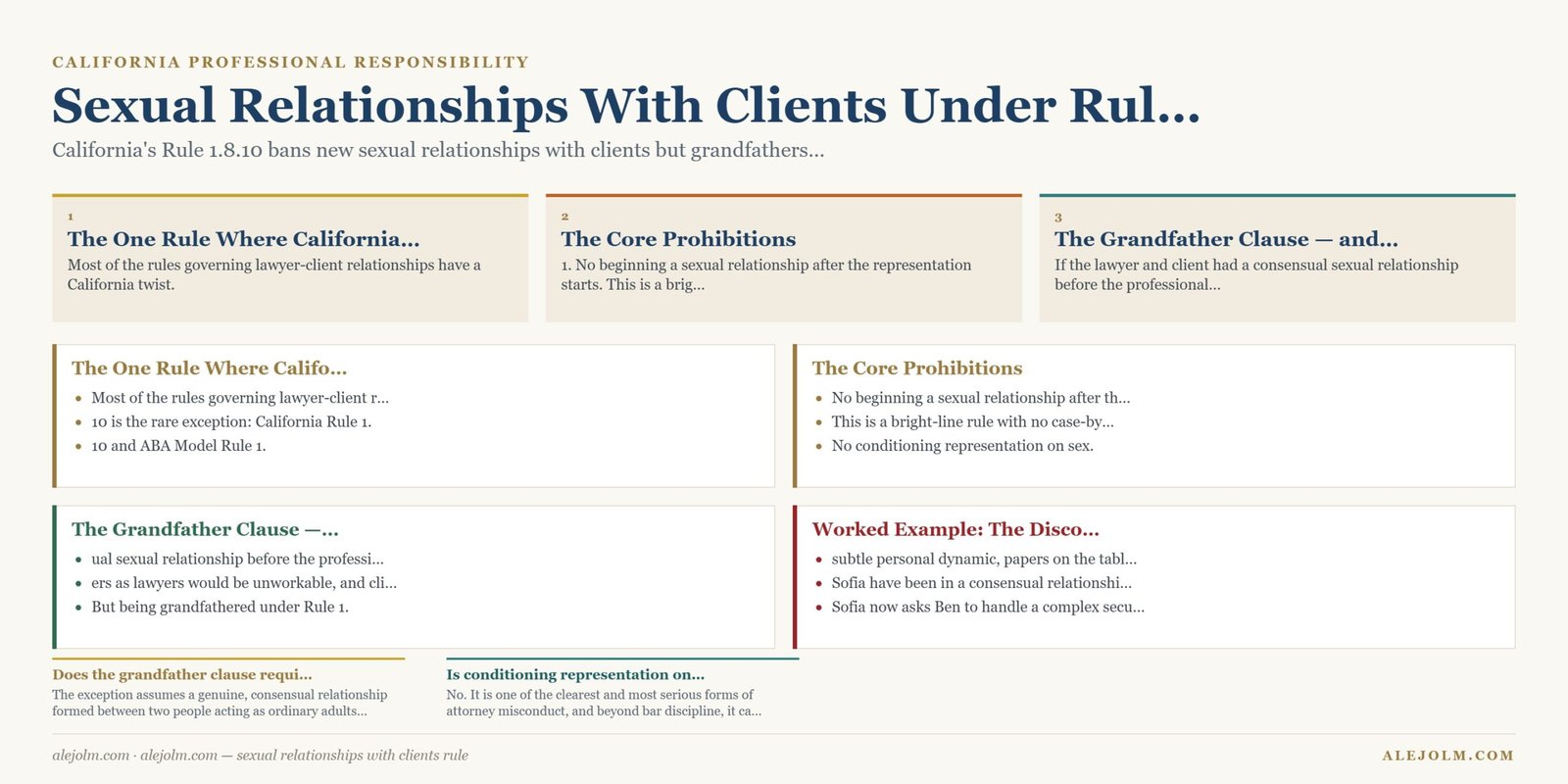
The One Rule Where California and the ABA Actually Agree
Most of the rules governing lawyer-client relationships have a California twist. Rule 1.8.10 is the rare exception: California Rule 1.8.10 and ABA Model Rule 1.8(j) are substantially identical. But the rule’s grandfather clause creates a trap that catches lawyers who stop their analysis too early — and that’s where the real exam testing happens.
California Rule 1.8.10 bars a lawyer from beginning a sexual relationship with a client after representation commences, and bars conditioning representation on sex, but permits a pre-existing consensual sexual relationship to continue. If a new relationship starts during representation, the lawyer must withdraw. The catch: even a grandfathered relationship can still trigger a separate conflict-of-interest problem under Rule 1.7.
The Core Prohibitions
- No beginning a sexual relationship after the representation starts. This is a bright-line rule with no case-by-case balancing.
- No conditioning representation on sex. Demanding sexual favors as a term of taking or continuing a case is a dual violation — it breaks this rule and likely constitutes extortion or coercion under other law.
- Mandatory withdrawal if a relationship begins mid-representation. The lawyer must withdraw, give the client reasonable notice to find new counsel, and comply with all standard withdrawal duties.
The Grandfather Clause — and Its Limits
If the lawyer and client had a consensual sexual relationship before the professional engagement began, that relationship is allowed to continue. The rationale is practical: banning people from hiring their existing partners as lawyers would be unworkable, and clients often do seek out romantic partners who happen to be attorneys.
But being grandfathered under Rule 1.8.10 doesn’t end the analysis. Both California and the ABA treat a pre-existing romantic relationship as a fact the lawyer must independently evaluate under Rule 1.7(a)(2) — the material-limitation conflict rule. Romantic feelings can impair objective judgment about strategy, fees, or competence even when the relationship itself is perfectly permissible.
| Question | Rule 1.8.10 Analysis | Rule 1.7 Analysis |
|---|---|---|
| Did the relationship begin before or during representation? | Determines if it’s grandfathered or a flat violation | Not the focus |
| Does the relationship affect judgment, fees, or diligence? | Not addressed | Central question |
| Is disclosure and consent required? | No, if grandfathered | Yes, if judgment is materially limited |
Worked Example: The Discounted Fee
Attorney Ben and his client Sofia have been in a consensual relationship for five years — long before Sofia ever hired Ben professionally. Sofia now asks Ben to handle a complex securities matter, well outside his usual practice area. Ben, wanting to please Sofia, agrees to take the case at half his normal rate.
Rule 1.8.10 is satisfied: the relationship pre-dates the representation, so it’s grandfathered, and no violation exists on that front. But Ben cannot stop there. The combination of romantic pressure to say yes, financial pressure from the deeply discounted fee, and a genuine question about whether Ben is competent in securities law creates a Rule 1.7(a)(2) material-limitation conflict. Ben’s professional judgment may be compromised by factors that have nothing to do with whether the relationship itself is allowed. The correct move is for Ben to disclose the conflict to Sofia, obtain her informed written consent to proceed despite it, or — more prudently — decline the matter and refer Sofia to a competent securities lawyer.
Contrast this with a lawyer who begins dating a personal-injury client mid-case after romantic feelings develop during representation. That is a clean, unambiguous Rule 1.8.10 violation with no grandfather clause available. The lawyer must withdraw immediately, give the client reasonable time to find substitute counsel, and expect that discipline is likely regardless of how the withdrawal is handled.
Organizational Clients
For a corporate or organizational client, Rule 1.8.10 reaches the individual constituent who supervises the lawyer’s work or regularly consults with the lawyer on the matter. A lawyer cannot escape the rule by pointing to the corporate structure; if the relationship is with the person actually directing the representation, the rule applies just as it would to an individual client.
Common Mistakes
- Stopping the analysis once the relationship is confirmed as grandfathered. A pre-existing relationship can still trigger an independent Rule 1.7 problem.
- Delaying withdrawal after a new relationship begins. Hoping to finish the matter quietly before anyone notices only compounds the violation.
- Ignoring power dynamics in “consensual” relationships. If the lawyer holds leverage over the client, courts scrutinize whether consent was genuinely free.
- Assuming corporate clients are immune. The rule follows the individual constituent who directs the lawyer’s work, not the entity’s paperwork.
FAQ
Does the grandfather clause require proof the relationship was purely romantic and not transactional?
The exception assumes a genuine, consensual relationship formed between two people acting as ordinary adults before any professional engagement existed. Courts look closely at whether real consent existed or whether a power imbalance undermines that assumption.
Is conditioning representation on sex ever excusable?
No. It is one of the clearest and most serious forms of attorney misconduct, and beyond bar discipline, it can expose the lawyer to civil liability and even criminal charges for coercion or related offenses.
Does a firm-wide conflict arise if one lawyer has a sexual relationship with a client?
No, Rule 1.8.10 is personal to the individual lawyer involved. It does not automatically disqualify the rest of the firm, though other conflicts rules could independently apply depending on the facts.
Key Takeaways
- California Rule 1.8.10 and ABA Model Rule 1.8(j) are essentially the same — a rare point of agreement between the two regimes.
- Beginning a sexual relationship during representation requires the lawyer to withdraw; a pre-existing relationship is grandfathered.
- Conditioning representation on sex is a dual violation with potential criminal exposure.
- A grandfathered relationship can still trigger a separate Rule 1.7 material-limitation conflict requiring disclosure and consent.
- The rule follows the individual who supervises or consults with the lawyer, even for organizational clients.
This article is educational and is not legal advice. Consult a licensed California attorney about your situation.
Related guides
- California’s undue influence rule for gifts from clients
- California’s consent exception to the advocate-witness rule
- conflicts of interest