
What Happens When Community Money Pays Off a Premarital Debt?
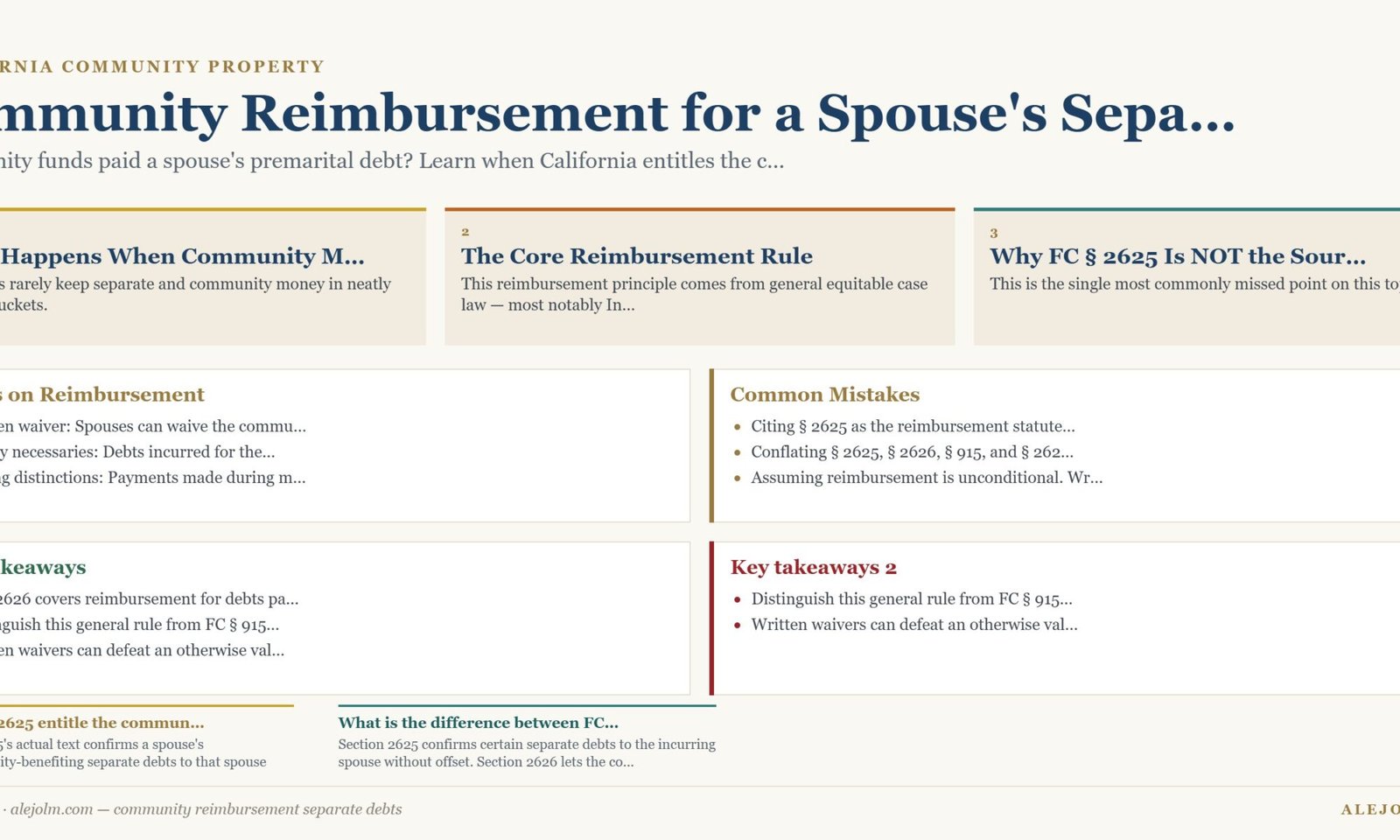
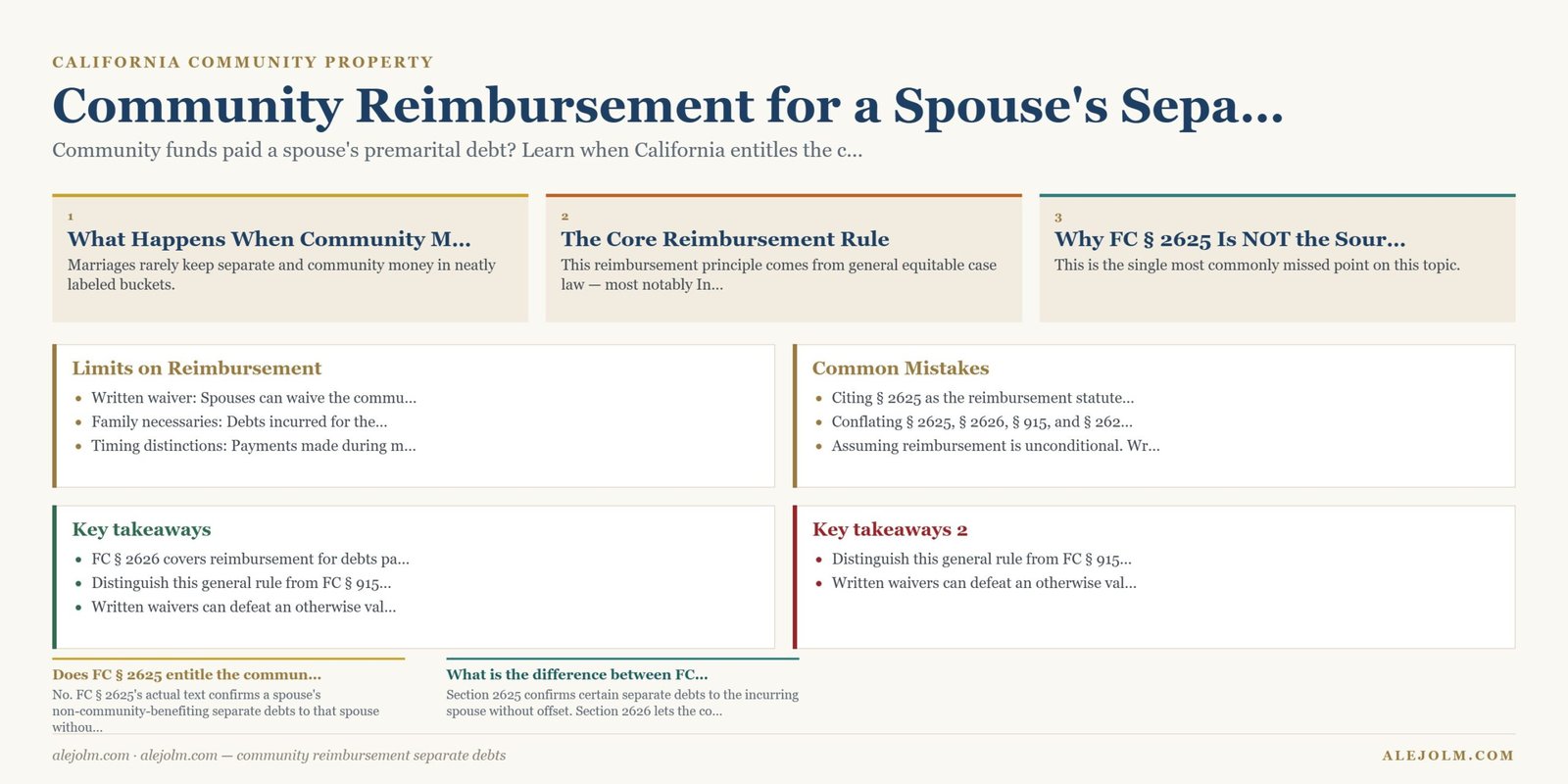
Marriages rarely keep separate and community money in neatly labeled buckets. A couple’s joint paycheck often pays down a car loan or tax bill one spouse brought into the marriage. When that happens, California law generally lets the community claim its money back at divorce — but the statute students love to cite for this rule is not actually the one that creates it.
Getting this right on the bar exam means knowing the difference between a debt-confirmation rule and a reimbursement right, and knowing which Family Code sections do which job.
The Core Reimbursement Rule
When community funds are used during marriage to pay down a spouse’s premarital or otherwise separate debt, the community is generally entitled to reimbursement at divorce for those contributions, chargeable against the debtor spouse’s share of the community estate.
This reimbursement principle comes from general equitable case law — most notably In re Marriage of Walter (1976) 57 Cal.App.3d 997 — applied within the broader debt-division framework of Family Code §§ 2620–2627. It is not limited to any single type of debt; a premarital auto loan, a premarital tax liability, or any other pre-existing separate obligation qualifies.
Why FC § 2625 Is NOT the Source of This Right
This is the single most commonly missed point on this topic. Family Code § 2625 does not say “the community gets reimbursed for paying a spouse’s separate debt.” Its actual text does something narrower: it confirms a spouse’s separate debts — meaning debts incurred during marriage but before separation that were NOT incurred for the community’s benefit — to the spouse who incurred them, without offset.
That is a debt-confirmation rule: it decides which spouse is stuck holding a non-community-benefiting debt at divorce. It says nothing about reimbursing the community for CP dollars already spent paying down a spouse’s premarital debt. Cite the general case-law reimbursement principle for that; reserve § 2625 for the separate confirmation issue.
| Statute | What It Actually Does |
|---|---|
| General reimbursement principle (Marriage of Walter and equitable case law) | Entitles the community to recover CP used to pay a spouse’s premarital/separate debt |
| FC § 2625 | Confirms a spouse’s non-community-benefiting separate debt to that spouse, without offset |
| FC § 2626 | Lets the court order reimbursement for post-separation payments made before trial |
| FC § 915 | Reimburses the community for CP used on premarital child/spousal support, if unused SP income existed |
| FC § 2627 | Assigns educational loans to the educated spouse, without offset |
FC § 2626: The Post-Separation Cousin
Family Code § 2626 covers a related but distinct scenario: after separation, one spouse uses separate funds (or the other uses community funds) to pay debts before trial. The court retains jurisdiction to order reimbursement for those post-separation payments. Do not confuse this with the “CP paid a premarital debt during marriage” scenario above — the timing and direction of the payment are different, even though both sit within the same §§ 2620–2627 framework.
Worked Example: The Premarital Car Loan
Before marriage, Husband financed a car and still owed $8,000 on the loan on the wedding day. During the marriage, the couple paid off the remaining $8,000 using community salary.
Analysis: The car loan is Husband’s separate debt because it was incurred before marriage. Community funds paid it down. Under the general reimbursement principle, the community is entitled to recover the $8,000 at divorce, charged against Husband’s share of the community estate. Note that § 2625 is irrelevant here — there was no community-benefiting-versus-not-community-benefiting confirmation question, because the debt was never a marital debt in the first place.
Worked Example: The Premarital Tax Debt
Wife owed $15,000 in income tax accrued before the marriage. The couple paid it off with community funds during the marriage.
Analysis: Same result. The community may recover $15,000 from Wife’s share of the estate under general reimbursement principles. Contrast this with a debt incurred DURING marriage that did not benefit the community — that debt would instead be analyzed under § 2625’s confirmation rule (whether it gets assigned to Wife without offset), a separate legal question.
Limits on Reimbursement
Reimbursement is not automatic in every direction. A few limits matter:
- Written waiver: Spouses can waive the community’s reimbursement right in writing.
- Family necessaries: Debts incurred for the benefit of the family may not trigger the same reimbursement logic.
- Timing distinctions: Payments made during marriage (general reimbursement principle) are analyzed differently from payments made after separation (§ 2626).
Common Mistakes
- Citing § 2625 as the reimbursement statute. It is a confirmation-without-offset rule for a spouse’s own non-community-benefiting debts, not a reimbursement-generating provision.
- Conflating § 2625, § 2626, § 915, and § 2627. Each governs a distinct scenario within the same statutory scheme; the bar exam rewards precise section-matching.
- Assuming reimbursement is unconditional. Written waivers and other equitable limits can defeat an otherwise valid claim.
FAQ
Does FC § 2625 entitle the community to reimbursement for paying a spouse’s premarital debt?
No. FC § 2625’s actual text confirms a spouse’s non-community-benefiting separate debts to that spouse without offset. The reimbursement right for CP payments on a spouse’s premarital debt comes from general case law, such as Marriage of Walter, applied within the §§ 2620–2627 framework.
What is the difference between FC § 2625 and FC § 2626?
Section 2625 confirms certain separate debts to the incurring spouse without offset. Section 2626 lets the court order reimbursement for debts paid after separation but before trial, regardless of which estate paid.
Can a spouse waive the community’s reimbursement right?
Yes. A written waiver of the community’s reimbursement claim is generally enforceable, which is why practitioners should always check for one before assuming reimbursement applies.
Key Takeaways
- Community funds used to pay a spouse’s premarital or separate debt are generally reimbursable to the community at divorce.
- FC § 2625 confirms non-community-benefiting separate debts to the incurring spouse without offset — it does not itself create the reimbursement right.
- FC § 2626 covers reimbursement for debts paid after separation but before trial, a distinct scenario.
- Distinguish this general rule from FC § 915 (premarital support) and FC § 2627 (educational loans), which are narrower, specific provisions.
- Written waivers can defeat an otherwise valid reimbursement claim.
This article is educational and is not legal advice. Consult a licensed California attorney about your situation.
Related guides
- community funds improving a spouse’s separate property
- premarital child support reimbursement
- community property presumptions