

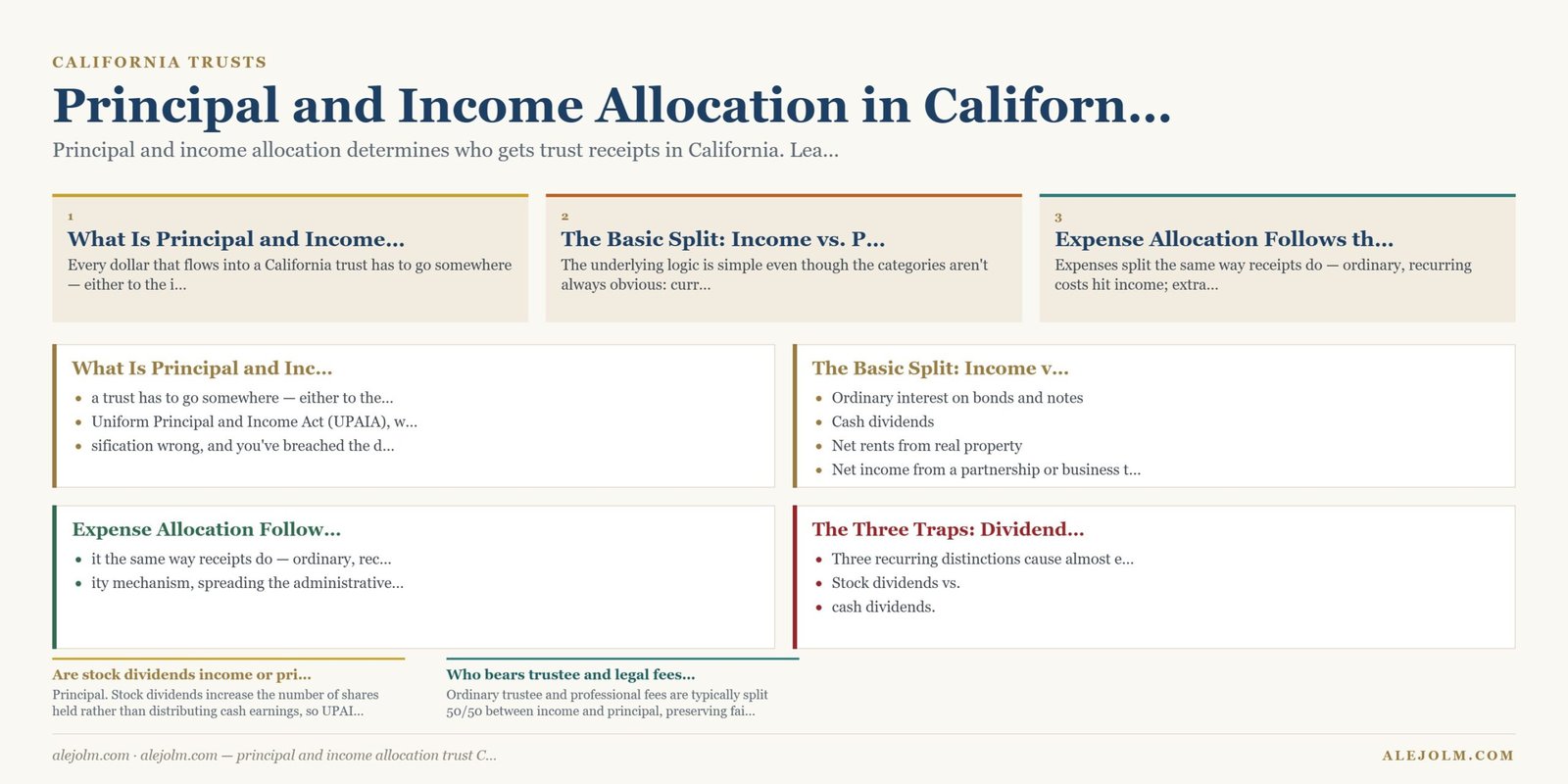
What Is Principal and Income Allocation?
Every dollar that flows into a California trust has to go somewhere — either to the income beneficiary or into principal for the remainder beneficiary. Principal and income allocation is the process of classifying trust receipts and expenses under the Uniform Principal and Income Act (UPAIA), which supplies default rules whenever the trust instrument is silent. Get the classification wrong, and you’ve breached the duty of impartiality even if every underlying investment was prudent.
California codified UPAIA at Probate Code §§ 16320–16370, and it’s a favorite bar exam topic precisely because the rules are counterintuitive in a few specific spots.
The Basic Split: Income vs. Principal
The underlying logic is simple even though the categories aren’t always obvious: current, recurring receipts go to income; extraordinary, capital-building receipts go to principal.
Allocated to income (for the income beneficiary):
- Ordinary interest on bonds and notes
- Cash dividends
- Net rents from real property
- Net income from a partnership or business the trust holds
- Insurance proceeds compensating for lost income
Allocated to principal (for the remainder beneficiary):
- Capital gains from selling trust assets
- Stock dividends and stock splits
- Proceeds from liquidating an asset
- Insurance proceeds for casualty or property loss
- Loan proceeds received by the trust
Expense Allocation Follows the Same Logic
Expenses split the same way receipts do — ordinary, recurring costs hit income; extraordinary, capital costs hit principal.
| Charged to Income | Charged to Principal |
|---|---|
| Interest on debt | Principal repayment of debt |
| Ordinary repairs and maintenance | Capital improvements and major repairs |
| Recurring property taxes | Estate and inheritance taxes |
| Regular insurance premiums | — |
| Half of ordinary trustee fees | Half of ordinary trustee fees |
| Half of ordinary legal/accounting fees | Half of ordinary legal/accounting fees |
Notice that many professional fees are deliberately split 50/50 between income and principal — that split is itself an impartiality mechanism, spreading the administrative cost across both beneficiary classes rather than dumping it on one.
The Three Traps: Dividends, Gains, and Repairs
Three recurring distinctions cause almost every allocation error on the bar exam:
- Stock dividends vs. cash dividends. Cash dividends are income. Stock dividends — additional shares issued to existing holders — are principal, because they represent a change in the number of shares, not a cash distribution of earnings.
- Realized vs. unrealized gains. A capital gain only becomes allocable once realized through a sale. Unrealized appreciation sitting in an unsold asset isn’t allocated to anyone yet.
- Ordinary repairs vs. capital improvements. Fixing a leaking pipe is income (ordinary maintenance). Replacing the entire roof is principal (capital improvement).
Worked Example: A Trust’s Annual Receipts
Suppose a trust receives, in one year: a $10,000 cash dividend, a $50,000 realized capital gain from selling stock, and pays $2,000 in property tax plus $30,000 to replace a rental property’s roof.
Correct allocation: the $10,000 dividend is income (goes to the income beneficiary); the $50,000 capital gain is principal (stays for the remainder beneficiary); the $2,000 property tax is charged against income; and the $30,000 roof replacement is charged against principal as a capital improvement. A trustee who instead pays the roof replacement out of income — or distributes the capital gain to the income beneficiary — has misallocated funds and breached the duty of impartiality, exposing themselves to surcharge for the shortfall.
Allocation Is Mandatory, Not Discretionary
A trustee doesn’t get to pick and choose. Absent contrary language in the trust instrument, UPAIA’s categories control, and the trustee must apply them correctly. This matters on exam fact patterns where a trustee tries to justify a misallocation as a “reasonable business judgment” — that defense doesn’t exist here. UPAIA is a default rulebook, and the trust instrument is the only thing that can override it.
When the Trust Instrument Changes the Default
A settlor can specify a different allocation scheme entirely — for example, converting the trust to a unitrust that distributes a fixed percentage of total value each year, sidestepping the income/principal distinction altogether. When the instrument is silent, though, UPAIA’s default rules apply automatically.
Common Mistakes to Avoid
The most common error is treating all dividends alike — remember, stock dividends are principal, cash dividends are income. A close second is charging an entire professional fee to one category instead of splitting it, and a third is confusing ordinary repairs with capital improvements. Each of these misallocations is, on its own, a distinct breach of fiduciary duty trustee exposure, separate from any investment-related claim.
Frequently Asked Questions
Are stock dividends income or principal?
Principal. Stock dividends increase the number of shares held rather than distributing cash earnings, so UPAIA classifies them as principal for the remainder beneficiary.
Who bears trustee and legal fees under UPAIA?
Ordinary trustee and professional fees are typically split 50/50 between income and principal, preserving fairness between the income beneficiary and the remainder beneficiary.
Can the trust instrument override UPAIA’s default allocation?
Yes. UPAIA supplies default rules only when the trust instrument is silent. A settlor can specify a different allocation method, including a unitrust or total-return approach.
Key Takeaways
- UPAIA (Probate Code §§ 16320–16370) governs default allocation when the trust is silent.
- Interest, cash dividends, and net rents go to income; capital gains, stock dividends, and sale proceeds go to principal.
- Ordinary expenses hit income; capital and extraordinary expenses hit principal, with fees often split 50/50.
- Misallocation is a breach of the duty of impartiality even when investments themselves were prudent.
- The trust instrument, not the trustee’s discretion, is the only thing that overrides UPAIA’s default categories.
This article is educational and is not legal advice. Consult a licensed California attorney about your situation.
Related guides
- duty of impartiality for California trustees
- prudent investor rule for California trustees
- trustee surcharge remedy in California
- trust tracing and lowest intermediate balance
- trustee-duties