
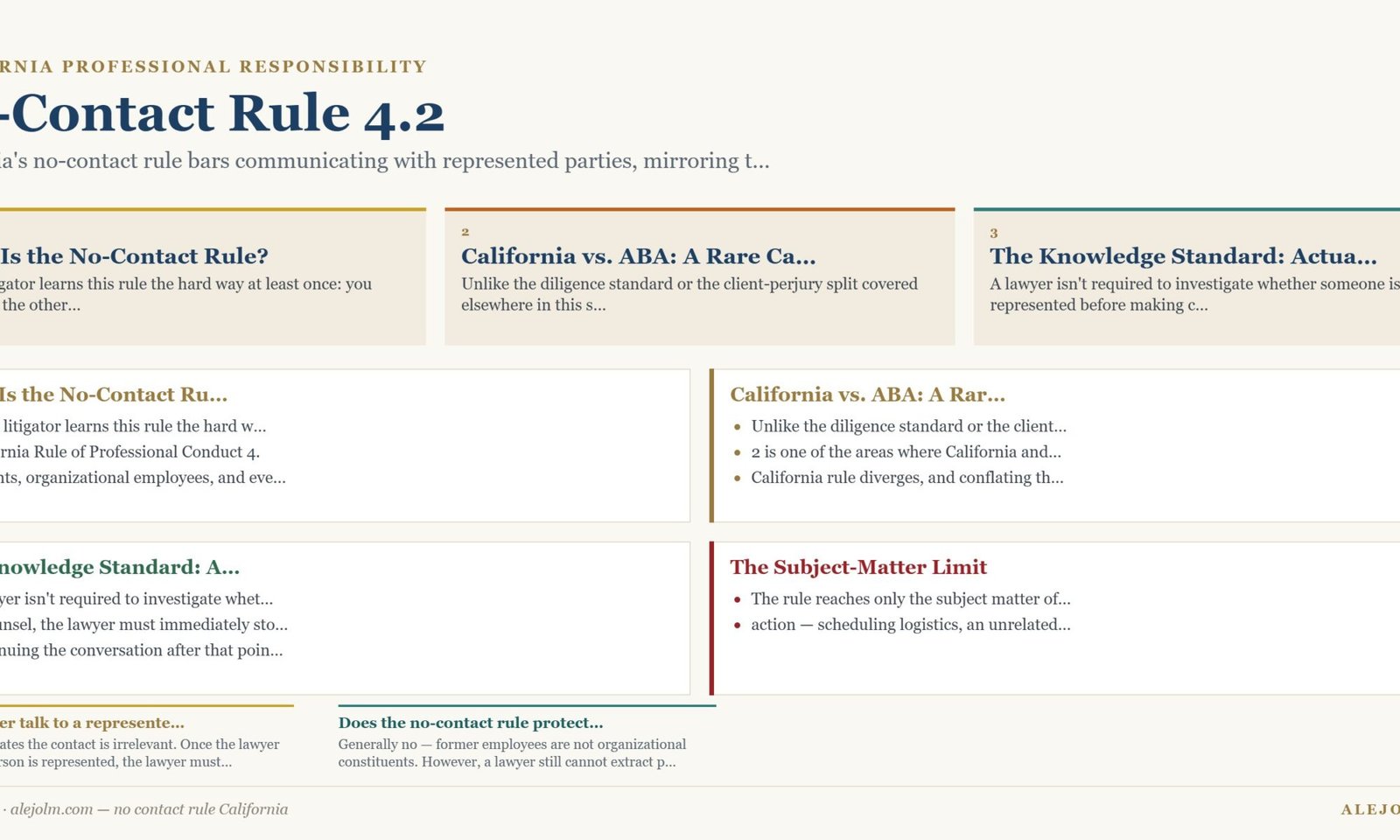
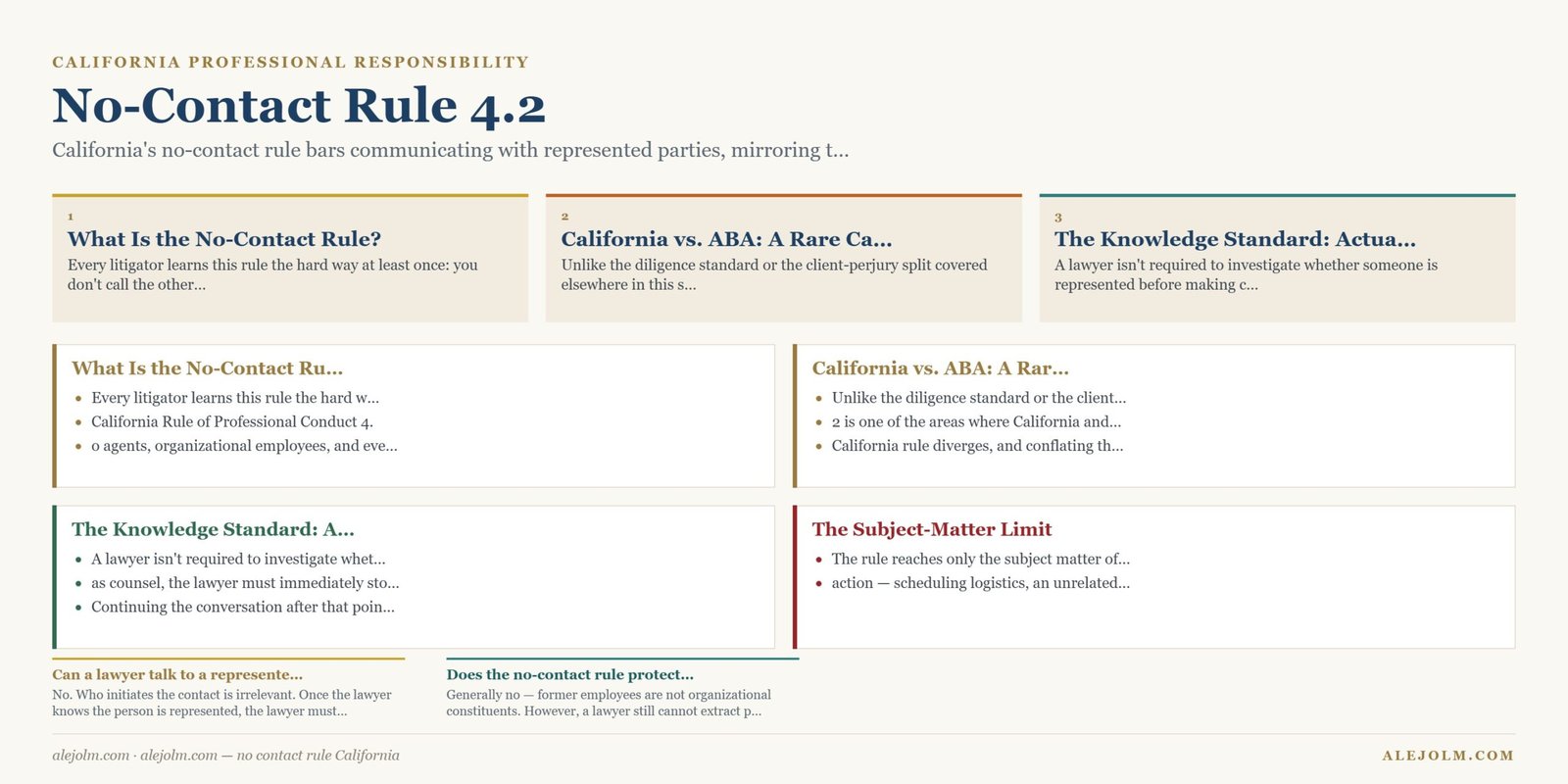
What Is the No-Contact Rule?
Every litigator learns this rule the hard way at least once: you don’t call the other side directly. California Rule of Professional Conduct 4.2 makes that instinct mandatory, and it reaches further than most new lawyers expect — into agents, organizational employees, and even conversations that start innocently and turn represented mid-call.
No-contact rule, defined: a California lawyer may not communicate, directly or indirectly, about the subject matter of a representation with a person the lawyer knows is represented by another lawyer in that matter, without that lawyer’s consent or authorization by law.
California vs. ABA: A Rare Case of Near-Total Alignment
Unlike the diligence standard or the client-perjury split covered elsewhere in this series, Rule 4.2 is one of the areas where California and the ABA genuinely agree on substance. That alignment is itself worth stating plainly for exam purposes — students should not assume every California rule diverges, and conflating this rule with the ones that do diverge is a common, costly mistake.
| Element | ABA Model Rule 4.2 | California Rule 4.2 |
|---|---|---|
| Core prohibition | No contact with a person known to be represented, absent consent | Same |
| Knowledge standard | Actual knowledge required | Same |
| Organizational constituents protected | Managerial authority + imputable-conduct employees | Same |
| Former employees | Generally not protected (with privileged-information carve-out) | Same |
| Citation | “Model Rule 4.2” | “Cal. Rule of Prof’l Conduct 4.2” — cite the California rule number on a California essay |
The lesson here is as much about exam strategy as substance: knowing which rules diverge (diligence, client perjury, work product, privilege duration, mediator disclosure) and which ones don’t (this one, allocation of authority, the advisor role) is itself a skill the graders are testing.
The Knowledge Standard: Actual Knowledge, Immediate Termination
A lawyer isn’t required to investigate whether someone is represented before making contact. But the moment the lawyer learns — mid-conversation — that the person has counsel, the lawyer must immediately stop talking about the subject matter and redirect to opposing counsel. Continuing the conversation after that point is the violation, even if the call started in good faith.
The Subject-Matter Limit
The rule reaches only the subject matter of the representation. A lawyer suing a represented business over a contract dispute may still contact that business about a completely unrelated transaction — scheduling logistics, an unrelated invoice — as long as that separate matter isn’t itself represented.
“Directly or Indirectly”: No End-Runs Through Agents
A lawyer cannot dodge the rule by sending a paralegal, investigator, or even the client to extract the same information the lawyer couldn’t get directly. That said, the represented parties themselves remain free to talk to each other — the rule restrains the lawyer’s conduct, not the parties’ independent choices, and the lawyer simply cannot direct or orchestrate those conversations to subvert the rule.
Organizational Constituents: Who Counts as “Represented”
When the opposing party is a corporation, partnership, or government agency, the no-contact rule extends beyond the CEO’s office:
- Anyone with managerial authority who can bind the organization (CEO, CFO, VP, partners).
- Employees whose act or omission is imputable to the organization for liability purposes — for example, the supervisor whose decision is the basis of a discrimination claim.
- Persons who regularly consult with organizational counsel on the matter.
The Former Employees Exception
Rule 4.2 generally does not protect former employees — they’re no longer organizational constituents. But a lawyer still cannot use a former employee to extract privileged information the employee learned while employed, and cannot use the former employee as a workaround to reach information the rule would otherwise block.
Worked Example: The Mid-Call Discovery
Lawyer, representing a plaintiff in a products-liability suit, calls a defendant company’s mid-level operations manager, believing (with no prior investigation) that this person is unrepresented on the matter. Partway through the call, the manager says, “As my company’s lawyer told me to say, I can’t discuss the incident details.” Lawyer continues the conversation for another ten minutes, asking several more questions about the incident before hanging up.
Analysis: Lawyer violated Rule 4.2. Beginning the call without prior investigation was permissible — actual knowledge, not diligence in investigating, is the trigger. But once the manager’s statement gave Lawyer actual knowledge of representation, Lawyer was required to terminate the conversation immediately. Continuing for ten more minutes and asking substantive questions about the incident is a clear violation, regardless of Lawyer’s initial good faith.
Common Mistakes Bar Examiners Test
- Assuming a represented person’s own initiation of contact excuses the lawyer. It doesn’t — the lawyer must still redirect once representation is known.
- Believing lower-level employees are automatically unprotected. Many are protected if their conduct is imputable to the organization or they have managerial authority.
- Using an agent to get around the rule. Indirect contact through a paralegal, investigator, or client violates the rule just as much as direct contact.
FAQ
Can a lawyer talk to a represented person if that person calls first?
No. Who initiates the contact is irrelevant. Once the lawyer knows the person is represented, the lawyer must end the conversation about the subject matter and direct the person to their own counsel.
Does the no-contact rule protect former employees of an opposing organization?
Generally no — former employees are not organizational constituents. However, a lawyer still cannot extract privileged information the former employee learned during employment.
Is California’s no-contact rule different from the ABA’s Model Rule 4.2?
No major divergence exists. CRPC 4.2 tracks ABA Model Rule 4.2 closely on the core prohibition, the knowledge standard, and organizational-constituent protections.
Key Takeaways
- A lawyer cannot contact a person known to be represented about the subject matter of the representation, directly or indirectly.
- Actual knowledge triggers the duty; a lawyer must immediately stop a conversation upon learning of representation mid-call.
- Organizational constituents with managerial authority or imputable conduct are protected; most former employees are not.
- The rule doesn’t bar contact about entirely unrelated, unrepresented matters.
- California Rule 4.2 substantively mirrors the ABA Model Rule — a rare area of near-total alignment worth flagging on the exam.
Related guides
- client perjury and the California narrative-testimony rule
- means vs. ends: who decides in California
- lawyer as third-party neutral in California
Sources and further reading
This article is educational and is not legal advice. Consult a licensed California attorney about your situation.