
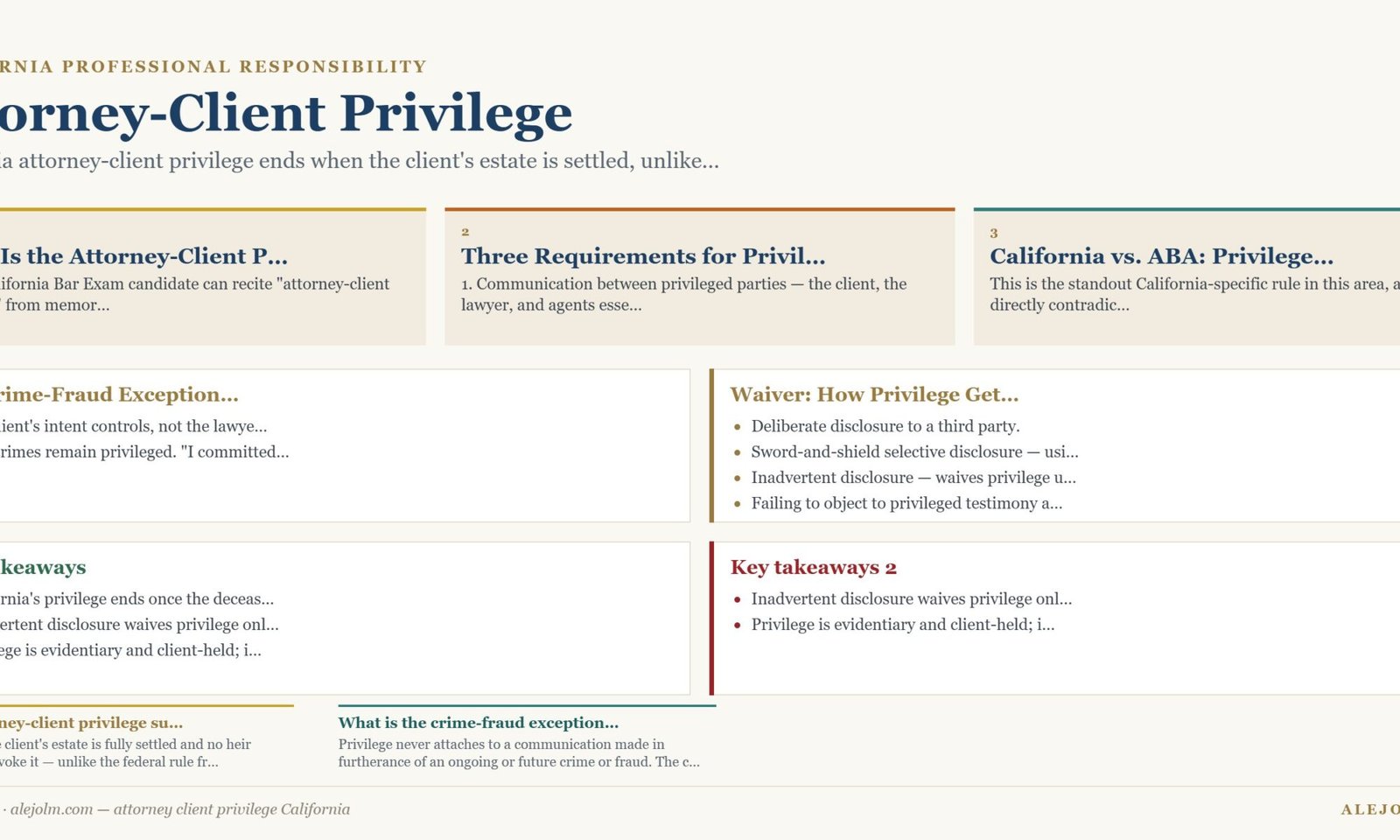
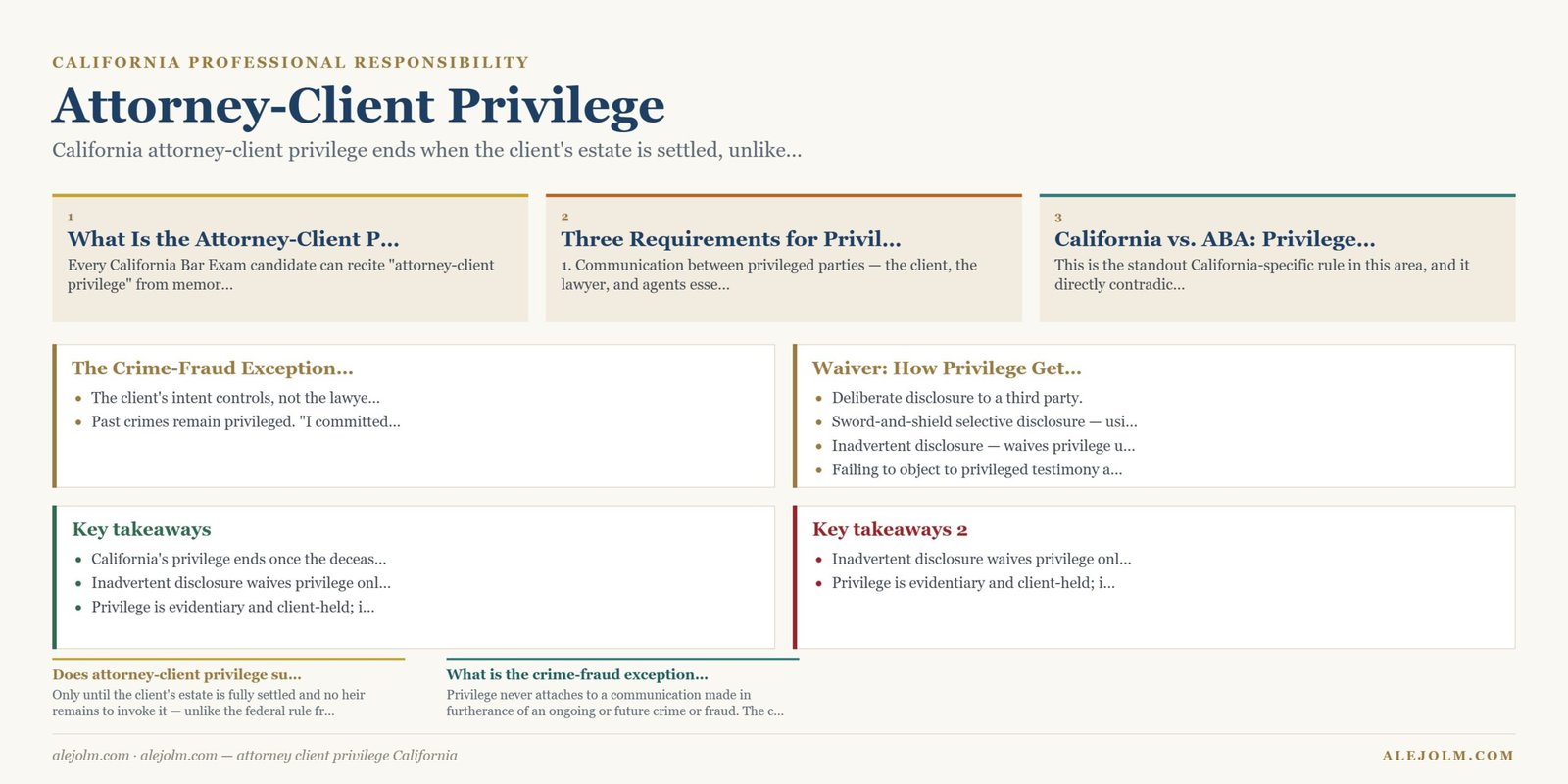
What Is the Attorney-Client Privilege?
Every California Bar Exam candidate can recite “attorney-client privilege” from memory — far fewer can correctly apply the three-part test or spot California’s most distinctive twist on the doctrine: what happens to the privilege after the client dies.
Attorney-client privilege, defined: an evidentiary rule, codified in California at Evidence Code § 954, that lets a client refuse to disclose — and prevent others from disclosing — confidential communications made between the client and lawyer for the purpose of seeking or giving legal advice.
Privilege is not the same as the ethical duty of confidentiality, and it’s not work product. Privilege is evidentiary, held by the client, and enforced in court when someone tries to compel testimony.
Three Requirements for Privilege to Attach
- Communication between privileged parties — the client, the lawyer, and agents essential to legal services (paralegals, associates, interpreters, expert consultants). A general statement of law (“robbery is a felony”) isn’t privileged; applying that law to the client’s specific facts (“by taking X, you committed robbery”) is.
- Made in confidence — the parties must reasonably believe the communication is private. An eavesdropper overhearing a genuinely private conversation does not destroy the privilege.
- For the purpose of seeking or providing legal advice — not business advice, not personal advice. Client identity, fee arrangements, and the general purpose of representation are typically not privileged.
California vs. ABA: Privilege Doesn’t Survive Death Forever in California
This is the standout California-specific rule in this area, and it directly contradicts the U.S. Supreme Court’s federal holding — which makes it an ideal exam trap for students who over-rely on federal case law.
| Issue | ABA / Federal Rule | California Rule |
|---|---|---|
| Privilege after client’s death | Survives indefinitely (Swidler & Berlin v. United States, 1998) | Ends once the client’s estate is fully settled and no heir remains to invoke it |
| Estate disputes among heirs | Privilege can still apply | Privilege may be pierced to determine the deceased client’s testamentary intent |
| Underlying rationale | Privilege protects candor even after death | Privilege belongs to the client’s living interest; once the estate closes, the privacy interest is gone |
Swidler & Berlin held that federal privilege survives death indefinitely. California takes the opposite policy position: privilege is tied to a living client’s ongoing interest, so once probate closes and no heir remains to assert it, the privilege lapses. This is precisely the kind of “California says otherwise” rule that makes for a strong essay answer — and a strong search query from students Googling “does attorney-client privilege survive death in California.”
The Crime-Fraud Exception (Most Heavily Tested)
Privilege never attaches to communications made in furtherance of an ongoing or future crime or fraud — even if the crime is never actually committed, intent alone is enough. Two rules to memorize:
- The client’s intent controls, not the lawyer’s knowledge. If the client intends to commit fraud and the lawyer is fooled, privilege still never attached.
- Past crimes remain privileged. “I committed fraud five years ago and fear an audit” is privileged legal-advice-seeking. “Help me structure this fraud so no one finds out” is not privileged at all.
California requires the party seeking disclosure to make a prima facie showing that a reasonable person would have a reasonable basis to expect crime or fraud.
Waiver: How Privilege Gets Lost
- Deliberate disclosure to a third party.
- Sword-and-shield selective disclosure — using part of a privileged communication to gain advantage while shielding the rest waives the whole.
- Inadvertent disclosure — waives privilege unless the lawyer promptly acts to rectify it (demanding return, notifying opposing counsel immediately).
- Failing to object to privileged testimony at trial.
Worked Example: The Estate Fight Over a Will
Attorney drafted a will for now-deceased Client, including a confidential conversation about Client’s intent to disinherit one child. Years later, the estate is fully distributed and closed, with no ongoing dispute. A journalist later sues to compel Attorney’s testimony about that conversation for a book.
Analysis: Under the ABA/federal rule of Swidler & Berlin, the privilege would survive indefinitely regardless of whether the estate is closed — the journalist could not compel testimony. Under California law, the analysis flips: because the estate has been fully settled and no heir remains to invoke the privilege, California would find the privilege has lapsed, potentially permitting compelled disclosure. Note the sub-rule, though — had the heirs still been actively disputing the estate (not yet settled), California would allow disclosure specifically to resolve that dispute, but only for that purpose.
Common Mistakes Bar Examiners Test
- Assuming privilege covers everything said to a lawyer. Business or personal advice unrelated to legal services isn’t privileged.
- Believing the lawyer’s ignorance of a client’s fraudulent intent preserves privilege. It doesn’t — the client’s intent alone controls.
- Applying the federal indefinite-survival rule on a California-specific question. California’s estate-settlement cutoff is a distinct, testable rule.
FAQ
Does attorney-client privilege survive a client’s death in California?
Only until the client’s estate is fully settled and no heir remains to invoke it — unlike the federal rule from Swidler & Berlin, where privilege survives indefinitely.
What is the crime-fraud exception to attorney-client privilege?
Privilege never attaches to a communication made in furtherance of an ongoing or future crime or fraud. The client’s intent controls, and the exception applies even if the crime is never actually committed.
Can inadvertent disclosure of a privileged document waive the privilege?
Yes, unless the disclosing lawyer promptly takes steps to rectify the mistake, such as immediately notifying the recipient and demanding the document’s return.
Key Takeaways
- Privilege requires a confidential communication between privileged parties made for legal advice.
- The crime-fraud exception turns on the client’s intent, not the lawyer’s knowledge, and never protects assistance with ongoing wrongdoing.
- California’s privilege ends once the deceased client’s estate is fully settled — federal privilege survives indefinitely.
- Inadvertent disclosure waives privilege only if the lawyer fails to promptly rectify the mistake.
- Privilege is evidentiary and client-held; it is distinct from work product (attorney-held) and the ethical confidentiality duty (State Bar-enforced).
This article is educational and is not legal advice. Consult a licensed California attorney about your situation.
Related guides
- work-product doctrine in California
- client perjury and the California narrative-testimony rule
- California’s duty of diligence standard