
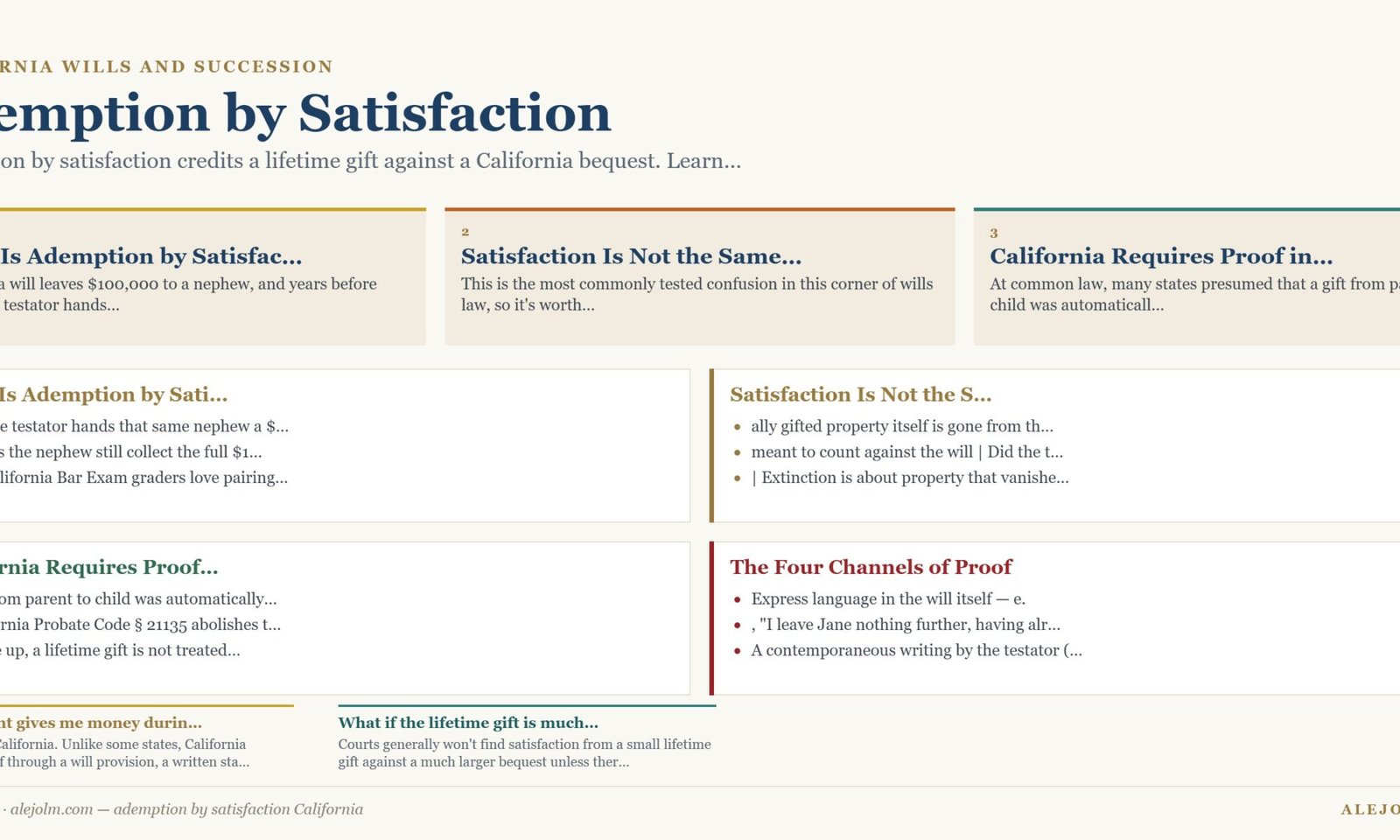
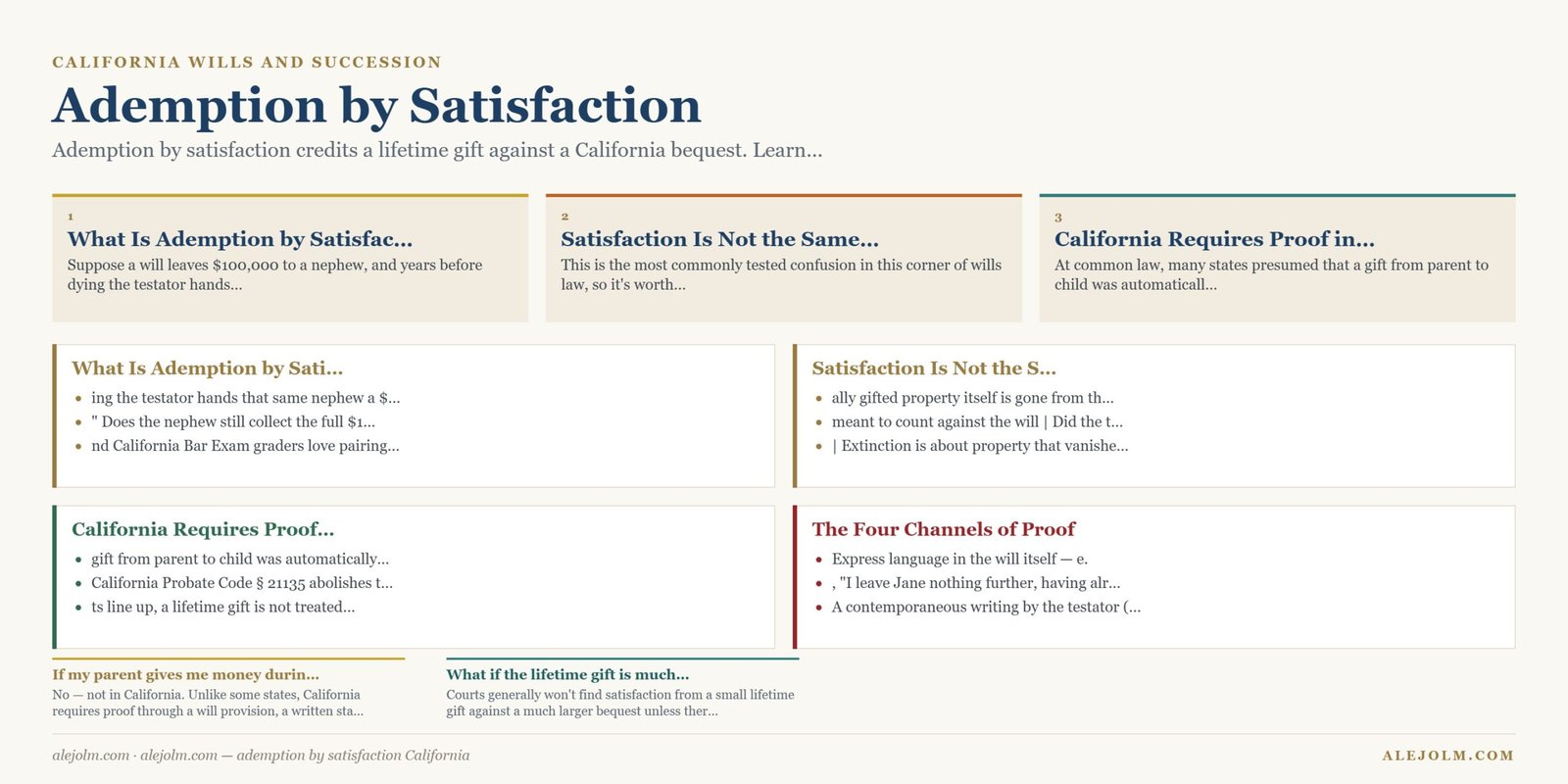
What Is Ademption by Satisfaction?
Suppose a will leaves $100,000 to a nephew, and years before dying the testator hands that same nephew a $100,000 check, saying “consider this an advance on your inheritance.” Does the nephew still collect the full $100,000 from the estate too? That’s the question ademption by satisfaction answers, and California Bar Exam graders love pairing it with ademption by extinction to see if students confuse the two. For families, this doctrine explains whether a lifetime gift “counts” against what a loved one leaves you in their will.
Ademption by satisfaction, defined simply: it’s the doctrine that reduces or eliminates a bequest when the testator made a lifetime gift to the beneficiary that the testator intended to count against that later testamentary gift.
Satisfaction Is Not the Same as Extinction — Don’t Merge Them
This is the most commonly tested confusion in this corner of wills law, so it’s worth stating plainly:
| Doctrine | What Disappears | Governing Question |
|---|---|---|
| Ademption by extinction | The specifically gifted property itself is gone from the estate | Does the exact item still exist in the estate at death? |
| Ademption by satisfaction | Nothing disappears — the testator intentionally gave a lifetime gift meant to count against the will | Did the testator intend the lifetime gift to be credited against the bequest? |
Extinction is about property that vanished. Satisfaction is about a deliberate lifetime substitute the testator meant as a down payment on the inheritance. Mixing these two up on the bar exam is a classic, costly mistake.
California Requires Proof in Writing — No Presumptions From Family Ties Alone
At common law, many states presumed that a gift from parent to child was automatically an advance on inheritance, just because of the family relationship. California Probate Code § 21135 abolishes that presumption entirely. No matter how close the relationship, and no matter how neatly the dollar amounts line up, a lifetime gift is not treated as satisfaction unless proven through one of four specific channels. Absent proof, the beneficiary keeps both the lifetime gift and the full bequest.
The Four Channels of Proof
- Express language in the will itself — e.g., “I leave Jane nothing further, having already given her $25,000.”
- A contemporaneous writing by the testator (separate from the will) — e.g., a letter stating “this $30,000 is in satisfaction of your bequest.”
- A written acknowledgment by the beneficiary — signed at any time, even after the testator’s death, admitting the lifetime gift satisfies the bequest.
- Identification, for specific gifts only — if the will leaves “my diamond ring” and the testator gives that very ring during life, satisfaction is presumed without any additional writing.
Only one channel needs to be satisfied — but without at least one, informal evidence like timing, family closeness, or “it seemed obvious” isn’t enough.
Valuing the Credit
Once satisfaction is established, the bequest is reduced using this priority order:
- The amount stated in the will, if specified.
- The amount stated in a contemporaneous writing, if specified.
- Fair market value of the gift at the time of transfer, or at the testator’s death, whichever is earlier — preventing a testator’s later-acquired wealth from artificially inflating the credit.
Reducing the bequest by the gift’s value frees up money for the residuary estate or co-beneficiaries — it’s not a total forfeiture unless the lifetime gift equals or exceeds the bequest.
Satisfaction vs. Advancement: Same Idea, Different Context
| Concept | Satisfaction | Advancement |
|---|---|---|
| Applies to | Named beneficiaries under a will | Heirs under intestate succession |
| Source of the gift | The will | Intestacy statutes |
| Proof required | Will language, testator’s writing, beneficiary’s acknowledgment, or identification | Contemporaneous writing by testator or acknowledgment by heir |
Satisfaction is the will-based version of the exact same equitable idea that governs intestate advancement — crediting a lifetime gift against what someone would otherwise inherit.
Worked Example: The “Advance on Your Inheritance”
Facts: Testator T’s 2018 will leaves $100,000 to nephew N and $50,000 to niece I, with the residue to charity. In 2021, T gives N a check for $100,000 and says, “This is an advance on your inheritance.” T dies in 2023.
Analysis:
- Proof of intent: T’s statement is a contemporaneous writing (or oral-plus-documented statement) indicating intent to credit the gift against N’s bequest.
- Amount match: The lifetime gift ($100,000) exactly matches the will’s bequest to N ($100,000), reinforcing that satisfaction was intended.
Result: N’s bequest is satisfied — N received the $100,000 already, in 2021, and gets nothing further from the estate. I still receives her full $50,000, untouched. The $100,000 that would have gone to N now flows to the charity as part of the residue.
What Happens if the Beneficiary Dies First?
Under Probate Code § 21137, if the satisfied beneficiary predeceases the testator, that beneficiary’s descendants are presumed to take subject to the same satisfaction — meaning they don’t get an extra bequest on top of what was already given during life, unless the will names them separately and independently.
Frequently Asked Questions
If my parent gives me money during their lifetime, does it automatically reduce what I inherit under their will?
No — not in California. Unlike some states, California requires proof through a will provision, a written statement by the parent, a written acknowledgment by you, or identification of specific property. A gift alone, even from a parent to a child, doesn’t trigger satisfaction without one of those.
What if the lifetime gift is much smaller than the bequest?
Courts generally won’t find satisfaction from a small lifetime gift against a much larger bequest unless there’s a writing establishing the intent to credit that smaller amount. A big disparity, without proof, points toward no satisfaction.
How is satisfaction different from advancement?
Satisfaction reduces gifts under a will; advancement reduces an heir’s share under intestate succession when there’s no will. The underlying idea — crediting lifetime gifts against inheritance — is the same, but the legal context and specific statutes differ.
Key Takeaways
- Ademption by satisfaction reduces or eliminates a bequest when the testator intended a lifetime gift to count against it.
- California Probate Code § 21135 rejects any automatic presumption from family relationship alone — proof is required.
- Four channels can prove intent: will language, testator’s writing, beneficiary’s acknowledgment, or identification of specific property.
- Valuation uses the stated amount, or fair market value at transfer or death, whichever is earlier.
- Satisfaction is the testamentary analog to advancement in intestate succession.
- Under § 21137, a predeceased beneficiary’s descendants generally take subject to the same satisfaction already applied.
This article is educational and is not legal advice. Consult a licensed California attorney about your situation.
Related guides
- ademption by extinction in California wills
- California intestate succession basics
- dependent relative revocation in California wills