
What Is Rape Under California Law?
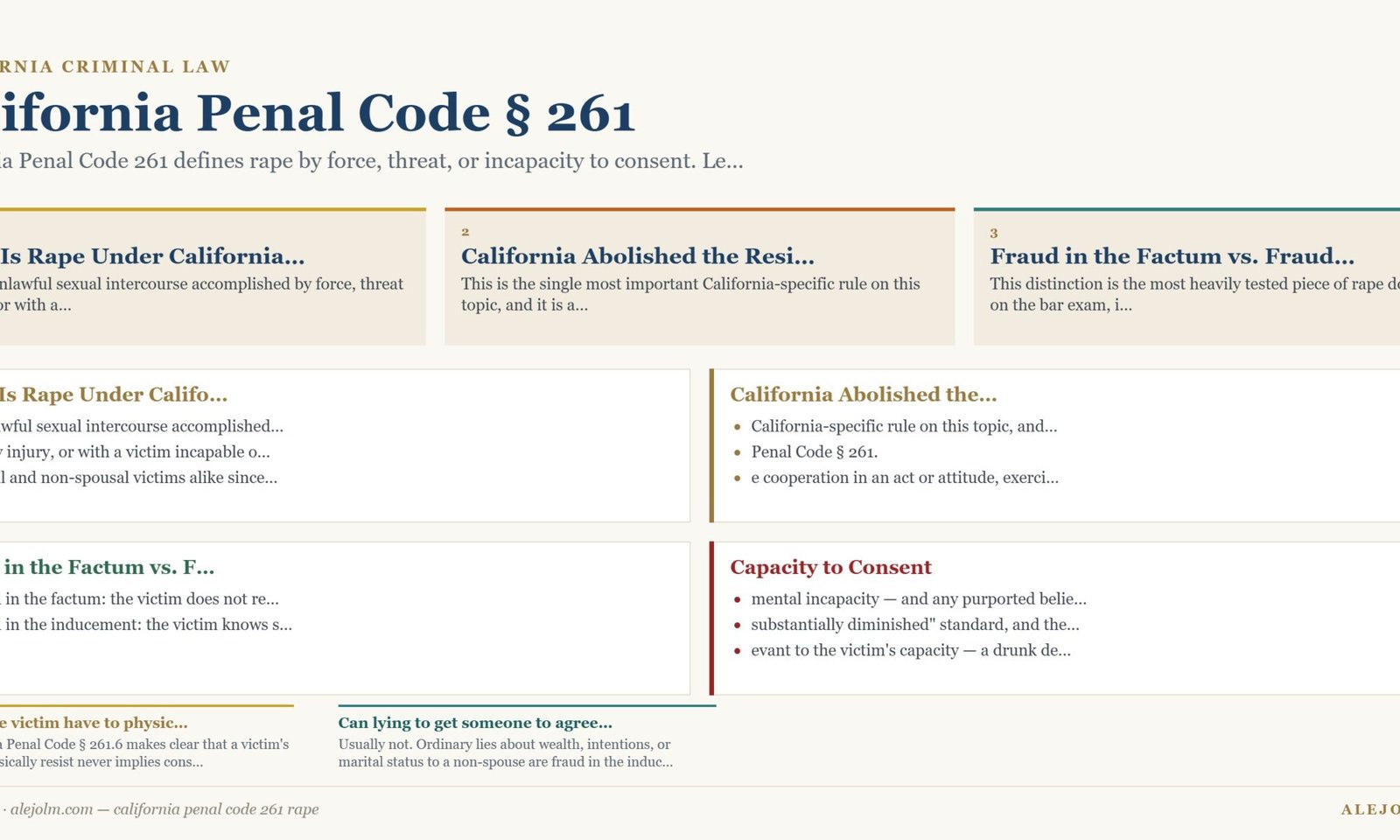
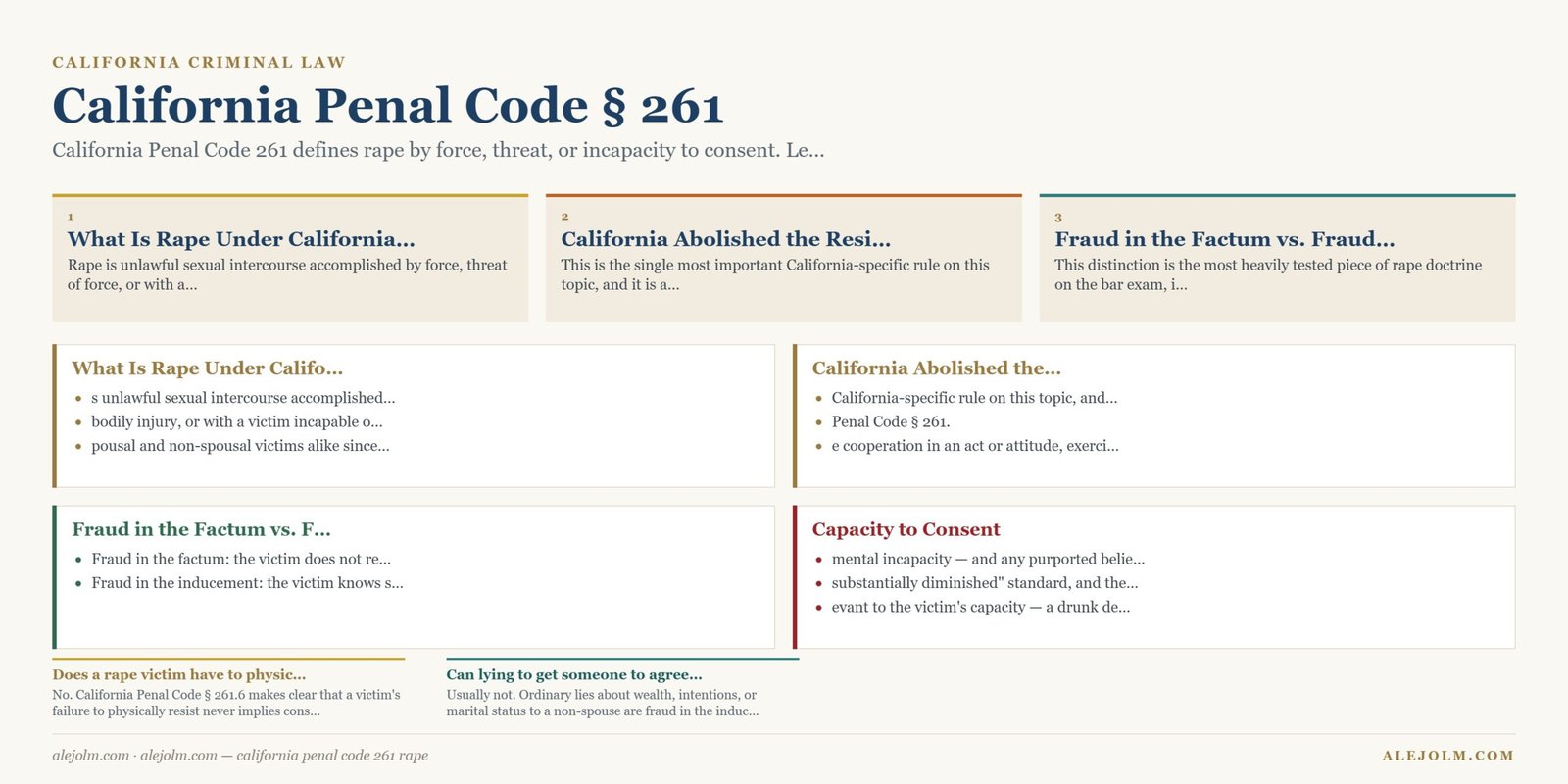
Rape is unlawful sexual intercourse accomplished by force, threat of force, or with a person incapable of consenting. California Penal Code § 261 defines rape as an act of sexual intercourse accomplished by force, violence, duress, menace, fear of immediate and unlawful bodily injury, or with a victim incapable of consent due to intoxication, unconsciousness, or mental disorder. It is a general-intent crime, and California’s statute is gender-neutral, covering spousal and non-spousal victims alike since former § 262’s spousal-rape provision was merged into § 261 in 2021.
Common law historically required only vaginal penetration; the Model Penal Code extends the offense to vaginal or anal penetration. Only minimal penetration is required to complete the act under any of these frameworks — withdrawal or lack of ejaculation is irrelevant.
California Abolished the Resistance Requirement
This is the single most important California-specific rule on this topic, and it is a frequent trap for students trained only on common-law rape. Penal Code § 261.6 defines consent as positive cooperation in an act or attitude, exercised freely and voluntarily, with knowledge of the nature of the act. Critically, California does not require the victim to physically resist — a victim’s lack of resistance never implies consent, reversing the common law’s historical “reasonable resistance” requirement.
California’s force element is also broader than bare physical force: § 261 reaches intercourse accomplished by force, violence, duress, menace, or fear of immediate and unlawful bodily injury, so psychological coercion or an implied threat can satisfy the force element even without a weapon or physical struggle.
Fraud in the Factum vs. Fraud in the Inducement
This distinction is the most heavily tested piece of rape doctrine on the bar exam, in California and elsewhere:
- Fraud in the factum: the victim does not realize she is engaging in a sexual act at all — the classic example is a physician who deceives a patient into believing a sexual act is a medical procedure. Consent is invalid, and rape has occurred.
- Fraud in the inducement: the victim knows she is consenting to a sexual act but is deceived about a collateral fact — false promises, false claims about wealth, or false statements about marital status to a non-spouse. Consent remains legally valid; no rape has occurred.
There is one important exception that bridges the two categories: spousal impersonation. If a man impersonates the victim’s spouse in the dark so that the victim knowingly engages in intercourse but is deceived about her partner’s identity, this is treated as fraud in the factum. Consent is invalid, and modern statutes, including California’s, codify this exception.
Capacity to Consent
Lack of consent exists whenever the victim is incapable of consenting — unconsciousness, intoxication, or mental incapacity — and any purported belief in consent under such circumstances is invalid as a matter of law. The precise standard for incapacity varies by jurisdiction: some use an “unable to consent” test, others a “substantially diminished” standard, and the Model Penal Code uses “incapacitated by alcohol or drugs” language. Critically, the defendant’s own intoxication is irrelevant to the victim’s capacity — a drunk defendant who has sex with a sober victim by force still commits rape.
Comparing the Two Fraud Categories
| Type of fraud | Victim’s knowledge | Effect on consent | Example |
|---|---|---|---|
| Fraud in the factum | Does not know a sexual act is occurring | Consent invalid — rape | Deceptive “medical exam” |
| Fraud in the inducement | Knows a sexual act is occurring | Consent valid — no rape | False promise of marriage |
| Spousal impersonation (exception) | Knows intercourse is occurring, deceived about partner’s identity | Consent invalid — rape | Impersonating a spouse in the dark |
Worked Example: The Bar Exam Fact Pattern
In the dark, Dan impersonates Vic’s husband and has intercourse with Vic, who believes she is having consensual relations with her actual spouse. Separately, Ann tells Ben she is on birth control (false) to induce him to have intercourse with her; he would not have consented had he known the truth.
Analysis: Dan’s spousal impersonation is treated as fraud in the factum under the recognized exception — Vic’s consent is invalid because she was deceived about her partner’s very identity, so Dan is guilty of rape. Ann’s lie about birth control is fraud in the inducement, a collateral fact rather than the nature of the act or her identity, so Ben’s consent remains legally valid and no rape occurred, whatever other civil liability might follow.
Procedural Protections
Rape shield laws, recognized in most jurisdictions including California, exclude evidence of the victim’s prior sexual history or reputation to prevent character attacks. A trial court’s erroneous admission of shield-excluded evidence can be reversible error if it affected the verdict. The defendant retains a Sixth Amendment right to confront the accuser under Crawford hearsay principles, though exceptions exist for witness unavailability. Some jurisdictions historically required prompt complaint or corroboration for a rape charge to proceed; most modern jurisdictions, recognizing that delayed disclosure is common in trauma cases, have relaxed or abolished these requirements.
Common Law and MPC Contrasts
Common law’s marital exemption barred prosecution of a husband for raping his wife entirely — a rule California has fully abolished by merging its spousal-rape provision into § 261. The Model Penal Code’s traditional resistance-oriented framing also differs from California’s approach: while older MPC-influenced doctrine treated victim resistance as evidence bearing on consent, Penal Code § 261.6 flatly forecloses that inference in California. Students trained primarily on common-law or MPC rape doctrine should not import a resistance requirement into a California-flagged fact pattern.
Frequently Asked Questions
Does a rape victim have to physically resist under California law?
No. California Penal Code § 261.6 makes clear that a victim’s failure to physically resist never implies consent, reversing the common law’s historical resistance requirement.
Can lying to get someone to agree to sex constitute rape in California?
Usually not. Ordinary lies about wealth, intentions, or marital status to a non-spouse are fraud in the inducement and do not negate consent. Only fraud in the factum and the spousal-impersonation exception invalidate consent.
Can a husband be prosecuted for raping his wife in California?
Yes. California’s rape statute is gender-neutral and covers spousal victims; the former separate spousal-rape statute was merged into Penal Code § 261 in 2021, eliminating any blanket marital exemption.
Key Takeaways
- California Penal Code § 261 defines rape by force, violence, duress, menace, fear of immediate injury, or victim incapacity.
- Penal Code § 261.6 eliminates any resistance requirement — a lack of resistance never implies consent.
- Fraud in the factum (victim unaware a sexual act is occurring) invalidates consent; fraud in the inducement (a collateral lie) does not, except for spousal impersonation.
- The defendant’s own intoxication never negates the victim’s lack of consent.
- California’s rape statute is gender-neutral and applies fully to spousal victims.
Related guides
- California kidnapping law under Penal Code 207
- the California felony murder rule
- California’s character evidence rules
- Miranda rights and custodial statements
Sources and further reading
This article is educational and is not legal advice. Consult a licensed California attorney about your situation.