

What Is Involuntary Manslaughter Under California Law?
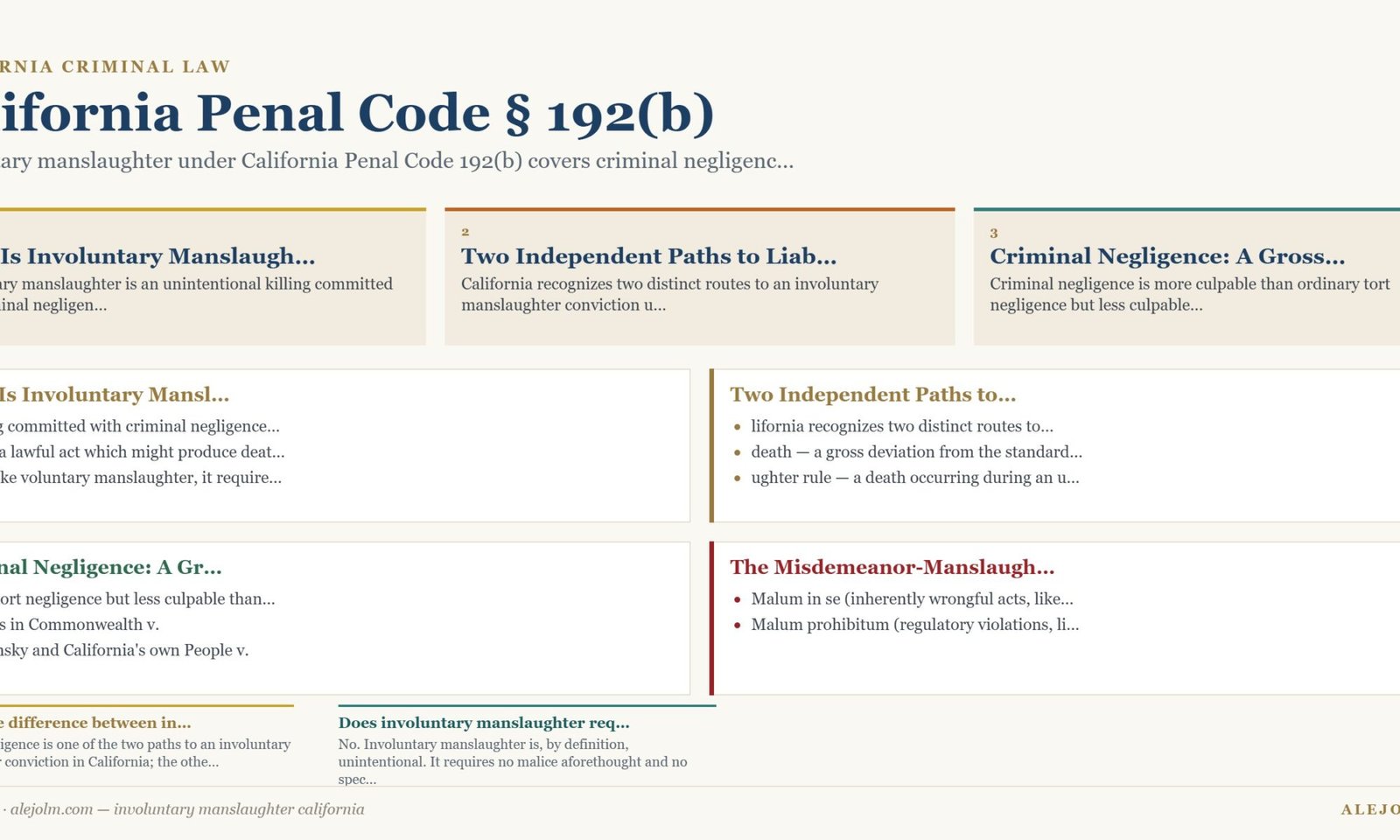
Involuntary manslaughter is an unintentional killing committed with criminal negligence, or during an unlawful act that does not qualify for felony murder. California Penal Code § 192(b) defines it as an unlawful killing without malice “in the commission of an unlawful act, not amounting to felony,” or “in the commission of a lawful act which might produce death, in an unlawful manner, or without due caution and circumspection.” Unlike voluntary manslaughter, it requires no intent to kill and no malice aforethought at all.
For California Bar Exam candidates, involuntary manslaughter sits at a narrow — and heavily tested — boundary between ordinary civil negligence (not a crime) and depraved-heart murder (a form of malice). Getting the line right is worth real points on the MBE and on essays.
Two Independent Paths to Liability
California recognizes two distinct routes to an involuntary manslaughter conviction under Penal Code § 192(b):
- Criminal negligence causing death — a gross deviation from the standard of care that a reasonable person would observe, judged objectively.
- The misdemeanor-manslaughter rule — a death occurring during an unlawful act that does not rise to the level of a dangerous felony.
Both paths must be proved beyond a reasonable doubt, and a fact pattern often supports one theory even where the other is unavailable.
Criminal Negligence: A Gross Deviation, Not Mere Carelessness
Criminal negligence is more culpable than ordinary tort negligence but less culpable than the conscious disregard of risk required for depraved-heart murder. Courts in Commonwealth v. Welansky and California’s own People v. Penny have confirmed that ordinary civil negligence is not enough — the defendant’s conduct must be a gross departure from what a reasonable person would do.
Crucially, criminal negligence is judged objectively. The defendant need not subjectively realize the risk; pure inadvertence to an obvious danger can suffice. A driver who runs a red light through simple inattention is ordinarily negligent, not criminally negligent. A driver who speeds through a marked school zone at 90 mph, ignoring visible children, has crossed into gross deviation territory.
The Misdemeanor-Manslaughter Rule: Malum in Se vs. Malum Prohibitum
Where a death occurs during an unlawful act that is not a dangerous felony, California’s misdemeanor-manslaughter doctrine can support a conviction under § 192(b) — but the analysis forks depending on the character of the underlying offense:
- Malum in se (inherently wrongful acts, like a simple assault): involuntary manslaughter attaches automatically upon a resulting death, with no independent foreseeability requirement.
- Malum prohibitum (regulatory violations, like an unpermitted bonfire or a licensing infraction): the prosecution must additionally prove the death was a foreseeable result of the violation.
Always classify the underlying misdemeanor before applying the rule — it is the most common point of confusion on this topic.
Comparing the Two Involuntary Manslaughter Theories
| Theory | What must be proved | Foreseeability required? |
|---|---|---|
| Criminal negligence | Gross deviation from the standard of care | No — negligence itself is the standard |
| Misdemeanor-manslaughter (malum in se) | Death during an inherently wrongful unlawful act | No |
| Misdemeanor-manslaughter (malum prohibitum) | Death during a regulatory violation | Yes — death must be foreseeable |
The Line Between Involuntary Manslaughter and Murder
The gap between conscious disregard of an obvious risk (depraved-heart murder) and gross negligence without that awareness (involuntary manslaughter) is narrow, and California Bar Exam examiners test it precisely because the facts can look alike at first glance. A defendant who fires a gun into a crowded room, knowing people are present, acts with conscious disregard — that is malice, supporting murder. A defendant who drives with brakes he does not know have failed acts only with gross negligence — that is involuntary manslaughter, even though both scenarios end in a shocking death.
Worked Example: The Bar Exam Fact Pattern
Dan lights an unpermitted bonfire in his backyard, violating a local ordinance, during a widely publicized period of extreme drought and high wind advisories. The fire spreads and kills a sleeping homeless man in a nearby lot.
Analysis: Dan is likely guilty of involuntary manslaughter under the misdemeanor-manslaughter rule. Lighting a bonfire without a permit is malum prohibitum, so the death must have been foreseeable — and given the publicized drought and wind warnings, a reasonable person would foresee that an unsupervised fire could spread and kill someone, satisfying that requirement. The same facts also support a stand-alone criminal-negligence theory: lighting an open fire under those extreme conditions is a gross deviation from the standard of care.
Double Jeopardy and Lesser-Included Offenses
Involuntary manslaughter is a lesser-included offense of murder. If a defendant is acquitted of murder, the Double Jeopardy Clause bars a subsequent prosecution for involuntary manslaughter on the same facts. This is a favorite trap on procedure-heavy bar questions: an acquittal on the greater charge forecloses the lesser one entirely, and students sometimes wrongly assume the door to a lesser charge stays open.
Frequently Asked Questions
What is the difference between involuntary manslaughter and criminal negligence generally?
Criminal negligence is one of the two paths to an involuntary manslaughter conviction in California; the other is the misdemeanor-manslaughter rule. Both require conduct well beyond ordinary civil carelessness.
Does involuntary manslaughter require intent to kill?
No. Involuntary manslaughter is, by definition, unintentional. It requires no malice aforethought and no specific intent, which is why voluntary intoxication generally cannot serve as a defense to it.
Can a felony support involuntary manslaughter in California?
No. The misdemeanor-manslaughter rule applies only to unlawful acts that are not felonies. If the underlying act is a dangerous felony, the felony murder rule applies instead.
Key Takeaways
- California Penal Code § 192(b) criminalizes unintentional killings caused by criminal negligence or by an unlawful act under the misdemeanor-manslaughter rule.
- Criminal negligence is an objective, gross-deviation standard — the defendant need not be subjectively aware of the risk.
- Malum in se misdemeanors need no foreseeability showing; malum prohibitum misdemeanors do.
- The line between involuntary manslaughter and depraved-heart murder is subjective awareness of an obvious risk.
- Double Jeopardy bars retrying a defendant for involuntary manslaughter after an acquittal on murder.
This article is educational and is not legal advice. Consult a licensed California attorney about your situation.
Related guides
- voluntary manslaughter under California law
- the California felony murder rule
- California murder and manslaughter law
- Miranda rights and custodial statements