
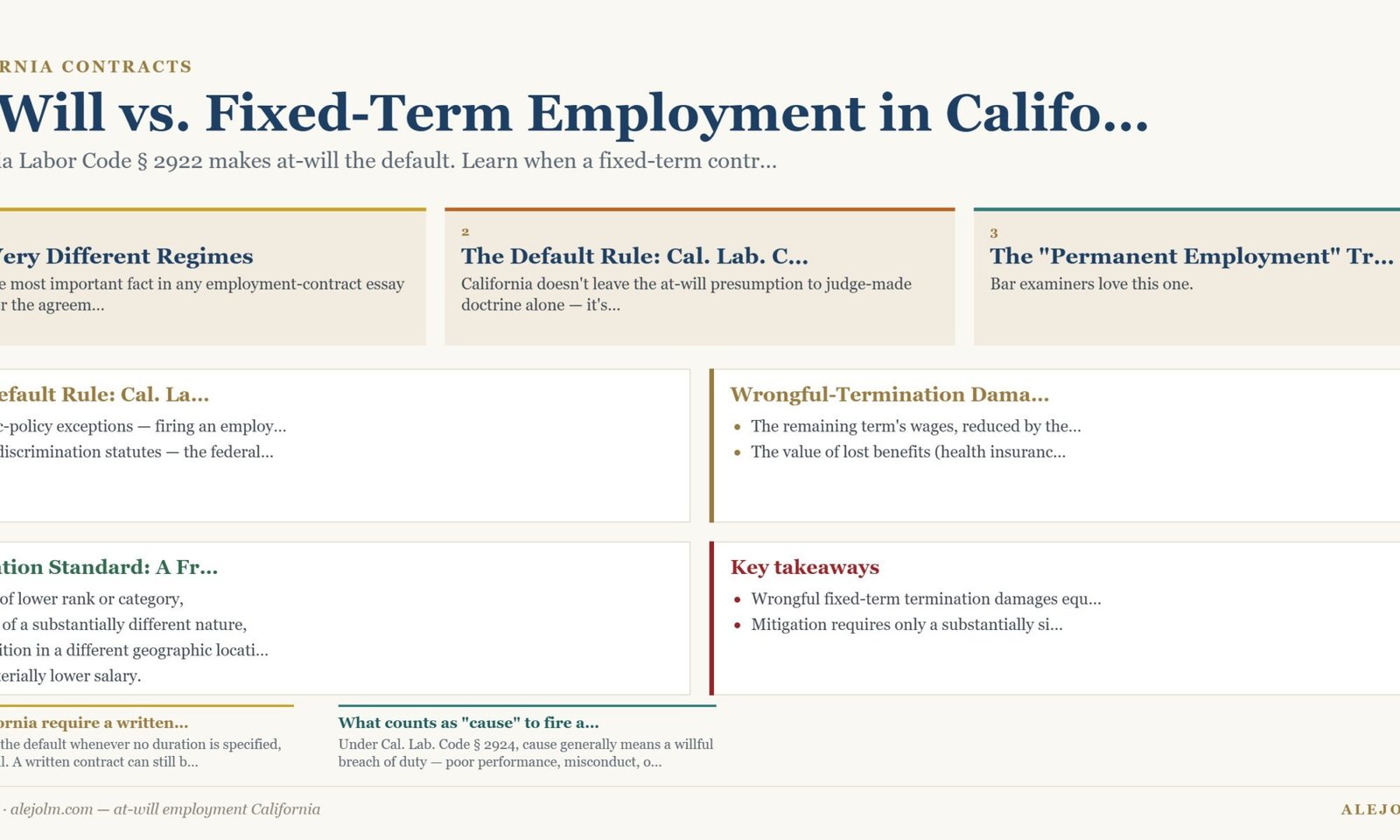
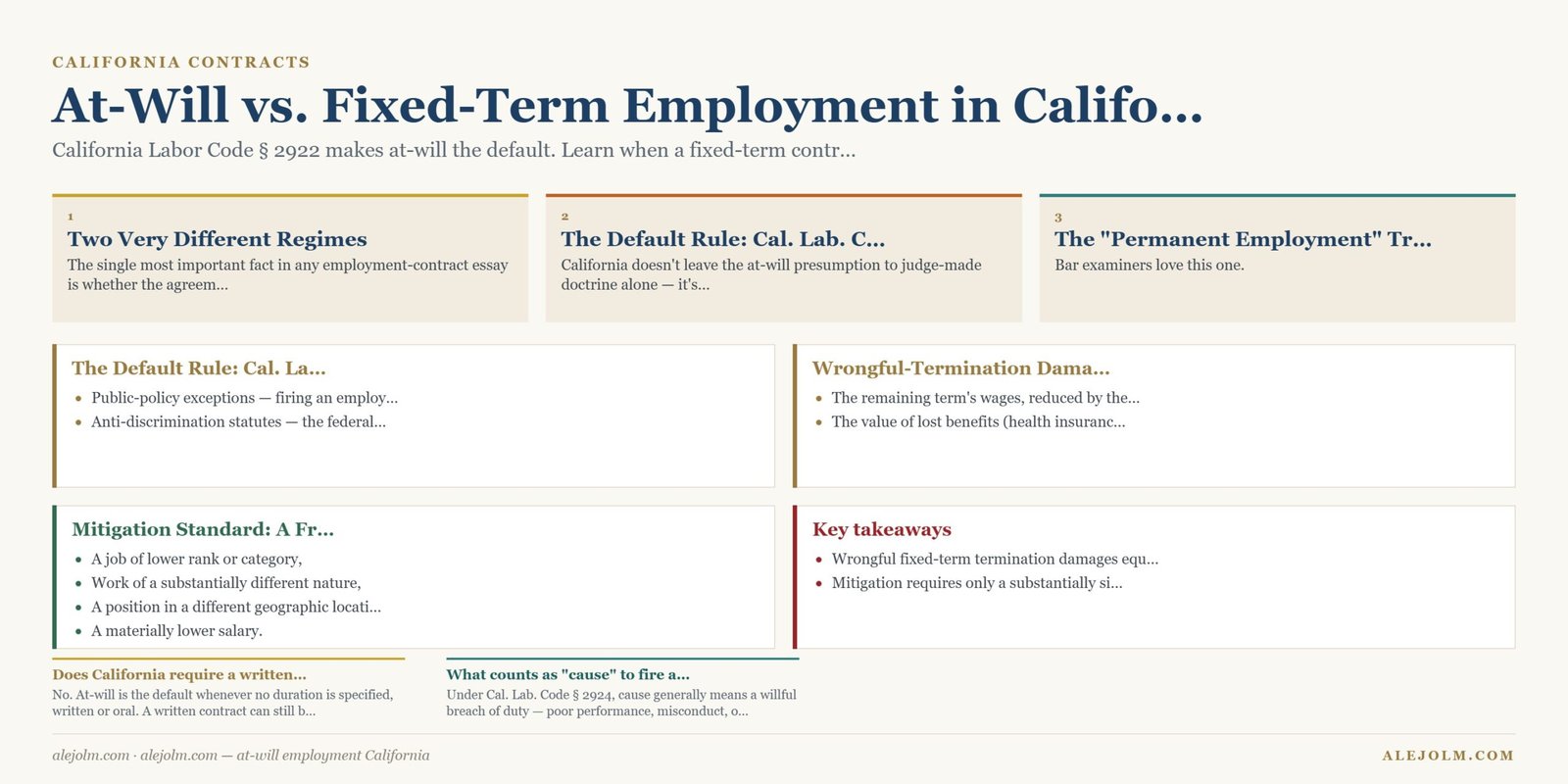
Two Very Different Regimes
The single most important fact in any employment-contract essay is whether the agreement states a duration. That one detail determines everything else — whether the employer needed a reason to terminate, and whether contract damages are even available.
Employment contracts split into two termination-and-damages regimes depending on duration. At-will employment — the default when no duration is specified — can be ended by either party at any time, for any reason or no reason. A fixed-term contract, which states a duration, can be terminated early only for cause, and wrongful early termination triggers ordinary contract-style expectation damages.
The Default Rule: Cal. Lab. Code § 2922
California doesn’t leave the at-will presumption to judge-made doctrine alone — it’s written directly into the Labor Code. Cal. Lab. Code § 2922 provides that an employment with no specified term “may be terminated at the will of either party on notice to the other.” That single sentence is the statutory backbone of California’s famously employer-friendly (and employee-friendly, since employees can quit anytime too) default rule.
At-will termination is presumptively lawful, subject to narrow exceptions:
- Public-policy exceptions — firing an employee for refusing to break the law, filing a workers’-compensation claim, or serving on a jury.
- Anti-discrimination statutes — the federal and California Fair Employment and Housing Act protections.
Because at-will employment carries no promise of continued work, ordinary wrongful-termination contract damages are unavailable absent one of these exceptions — recovery, if any, comes from a tort or statutory claim instead.
The “Permanent Employment” Trap
Bar examiners love this one. Language describing a job as “permanent” or “for life” is, despite its wording, still at-will absent additional consideration beyond the employee’s ordinary service. Some California authority requires the employee to show separate consideration — something given beyond simply agreeing to work — to overcome the at-will presumption. Don’t let “permanent” language alone convince you a fixed term exists.
Fixed-Term Contracts: For-Cause Termination Under Cal. Lab. Code § 2924
Once a contract states a duration (“employed for a term of two years”), California flips the default. Cal. Lab. Code § 2924 allows an employer to terminate a fixed-term employee early only for a willful breach of duty by the employee — poor performance, misconduct, or a material breach of the employee’s own obligations. Business reasons like cost-cutting or eliminating the position are not “cause.”
Wrongful-Termination Damages for Fixed-Term Employees
An employee wrongfully terminated before the end of a fixed term recovers:
- The remaining term’s wages, reduced by the duty to mitigate (what the employee earned, or reasonably could have earned, in comparable alternative employment), plus
- The value of lost benefits (health insurance, pension contributions, etc.).
Mitigation Standard: A Frequent Examiner Trap
The employee must accept only a substantially similar alternative position to mitigate — same or similar rank, pay, and location. The employee is not required to accept:
- A job of lower rank or category,
- Work of a substantially different nature,
- A position in a different geographic location, or
- A materially lower salary.
An employee can decline an inferior offer and still recover the full, unmitigated remaining-term wages.
Comparison Table
| Feature | At-Will (Cal. Lab. Code § 2922) | Fixed-Term (Cal. Lab. Code § 2924) |
|---|---|---|
| Default when contract is silent | Yes | No — requires stated duration |
| Termination standard | Any reason, or none | Only for willful breach/cause |
| “Permanent” language | Still at-will absent separate consideration | N/A |
| Wrongful-termination damages | Unavailable (absent public-policy/statutory claim) | Remaining wages minus mitigation, plus lost benefits |
Worked Hypothetical
Facts: Employer hires Employee under a written contract stating “Employee shall be employed as Regional Sales Director for a term of two years at an annual salary of $120,000.” Eight months in, Employer terminates Employee without any showing of poor performance, simply to cut headcount. Employee is offered a comparable sales director role at a different company for $100,000/year in the same city and declines it, remaining unemployed.
Analysis: This is a fixed-term contract, so under Cal. Lab. Code § 2924, Employer needed cause, and eliminating the position for cost reasons is not “willful breach of duty.” Employee has a claim for the remaining sixteen months: roughly 16/12 × $120,000 ≈ $160,000, subject to mitigation. Because the declined offer was substantially similar in rank, nature, and location, Employee’s refusal reduces recovery by what could have been earned there (16/12 × $100,000 ≈ $133,333) — capping actual recovery at roughly the $26,667 differential rather than the full unmitigated loss.
Frequently Asked Questions
Does California require a written contract for at-will employment?
No. At-will is the default whenever no duration is specified, written or oral. A written contract can still be at-will if it doesn’t state a term.
What counts as “cause” to fire a fixed-term California employee early?
Under Cal. Lab. Code § 2924, cause generally means a willful breach of duty — poor performance, misconduct, or material breach by the employee — not business convenience or cost-cutting.
Can an at-will employee ever recover contract damages for being fired?
Generally no, unless a public-policy exception (retaliation for refusing illegal conduct, workers’-comp filing, jury duty) or an anti-discrimination statute applies, in which case the claim sounds in tort or statute rather than contract.
Key Takeaways
- Cal. Lab. Code § 2922 makes at-will the default whenever a contract is silent on duration.
- “Permanent” or “for life” language does not, by itself, create a fixed term.
- Cal. Lab. Code § 2924 requires cause — willful breach of duty — to terminate a fixed-term employee early.
- Wrongful fixed-term termination damages equal remaining wages plus lost benefits, minus mitigation.
- Mitigation requires only a substantially similar alternative job, not any job offer.
This article is educational and is not legal advice. Consult a licensed California attorney about your situation.