
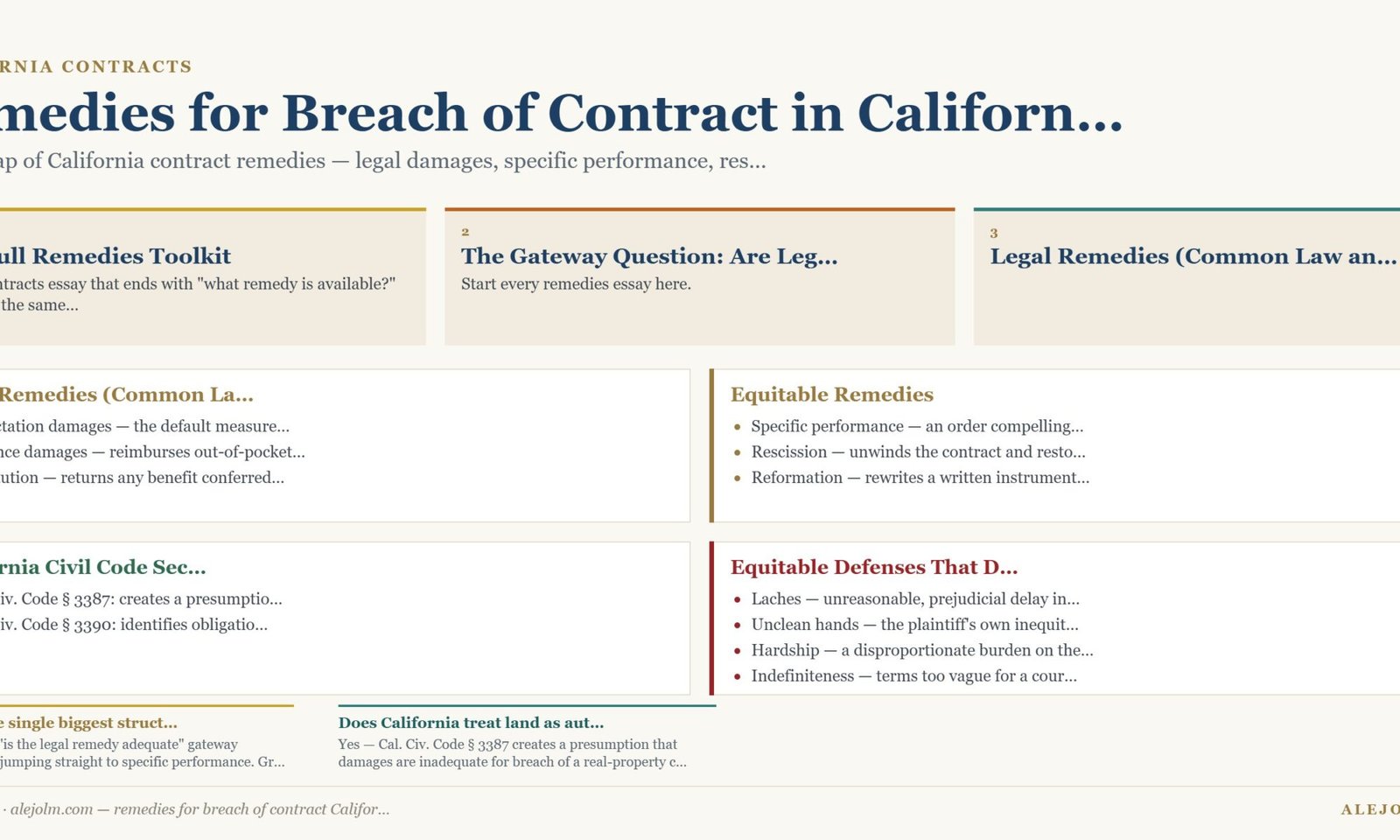
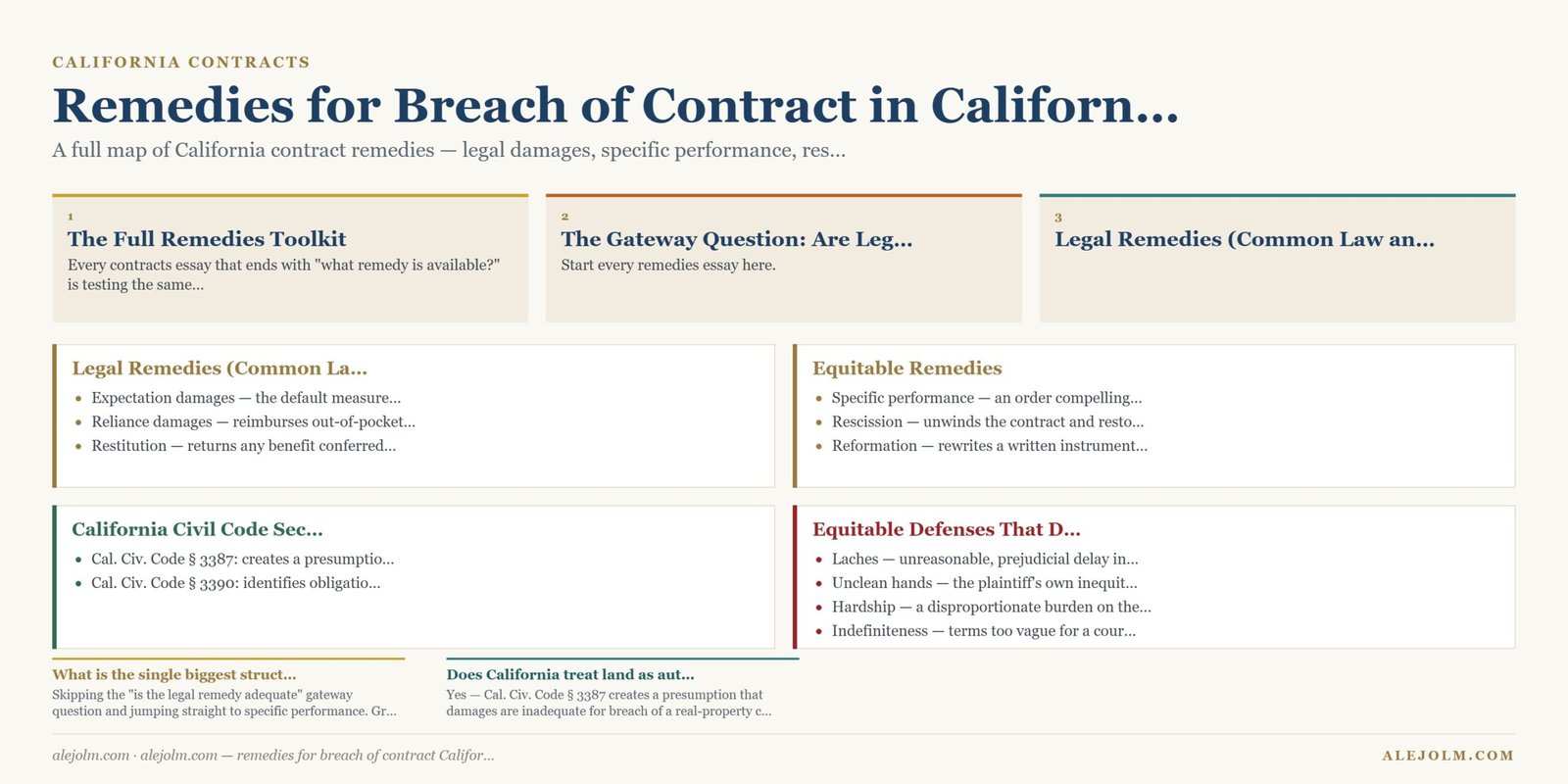
The Full Remedies Toolkit
Every contracts essay that ends with “what remedy is available?” is testing the same underlying structure: is this a legal remedy problem (money) or an equitable remedy problem (a court order)? Getting that gateway question right, and stating it explicitly, is worth more points than most students realize.
Remedies for breach of contract are the full set of tools available to a non-breaching party: legal remedies (expectation, reliance, and restitution damages) and equitable remedies (specific performance, rescission, and reformation), chosen based on whether money damages can actually make the injured party whole.
The Gateway Question: Are Legal Damages Adequate?
Start every remedies essay here. Under general contract-remedies principles applied in California courts, equitable remedies are available only when money damages are inadequate. If damages are adequate — the ordinary case — apply the expectation/reliance/restitution framework under Cal. Civ. Code § 3300 and stop. If damages are inadequate (unique goods, unique real property, an ongoing relationship money can’t replace), move into the equitable toolkit.
Legal Remedies (Common Law and Cal. Civ. Code § 3300)
- Expectation damages — the default measure, putting the plaintiff in the position full performance would have created.
- Reliance damages — reimburses out-of-pocket expenses incurred in reliance on the contract, used when expectation is too speculative to prove (a favorite fallback in promissory estoppel and new-business fact patterns).
- Restitution — returns any benefit conferred on the breaching party, appropriate when the plaintiff wants to recover the value it already delivered rather than lost future profit.
Equitable Remedies
- Specific performance — an order compelling actual performance, enforced by the court’s contempt power. Requires a valid, definite contract; plaintiff’s own performance or readiness; inadequate legal remedy; feasible judicial supervision; and no equitable defense.
- Rescission — unwinds the contract and restores both sides to their pre-contract positions. Available on the same grounds that make a contract voidable in the first place: mistake, misrepresentation, duress, undue influence, or lack of capacity.
- Reformation — rewrites a written instrument to match what the parties actually agreed, without unwinding the deal itself. Requires mutual mistake in drafting, a unilateral mistake the other side knew of and exploited, or a scrivener’s error — shown by clear and convincing evidence, a heightened standard.
California Civil Code Sections on Equitable Remedies
Unlike some states that leave specific performance and rescission purely to case law, California codifies equitable contract remedies directly in the Civil Code, in sections that run roughly §§ 3384–3395. Two provisions are worth memorizing:
- Cal. Civ. Code § 3387: creates a presumption that breach of an agreement to transfer real property cannot be adequately relieved by pecuniary damages, because land is treated as unique. This presumption is why real-estate specific-performance essays almost always come out “yes.”
- Cal. Civ. Code § 3390: identifies obligations that cannot be specifically enforced, including an obligation to render personal service — the statutory hook for why personal-services contracts default to a “no” on affirmative specific performance.
UCC Article 2 (California Commercial Code) Remedies for Goods
Goods contracts have their own remedies menu under California Commercial Code Division 2:
| Party | Remedy | Governing Section |
|---|---|---|
| Buyer | Cover (buy substitute goods) | Cal. Com. Code § 2712 |
| Buyer | Market-price damages | Cal. Com. Code § 2713 |
| Buyer | Specific performance for unique/scarce goods | Cal. Com. Code § 2716 |
| Seller | Resell and recover the difference | Cal. Com. Code § 2706 |
| Seller | Recover contract price minus market price (or lost profits) | Cal. Com. Code § 2708 |
| Seller | Reclaim goods from an insolvent buyer (within 10 days, longer if written misrepresentation of solvency) | Cal. Com. Code § 2702 |
Equitable Defenses That Defeat Any Equitable Remedy
Even a technically qualifying claim for specific performance, rescission, or reformation can be defeated by:
- Laches — unreasonable, prejudicial delay in seeking relief.
- Unclean hands — the plaintiff’s own inequitable conduct in the same transaction.
- Hardship — a disproportionate burden on the defendant relative to the benefit to the plaintiff.
- Indefiniteness — terms too vague for a court to enforce or supervise.
- Unconscionability — a contract so one-sided that equity refuses to lend its power.
Worked Hypothetical
Facts: Seller and Buyer sign a contract for a one-of-a-kind vintage sports car for $150,000. Before delivery, Seller learns a collector will pay $250,000 and refuses to close, offering Buyer $100,000 (the value difference) instead. Buyer wants the car, not money.
Analysis: Buyer should seek specific performance under Cal. Com. Code § 2716. Because the car is unique, money damages are inadequate — no substitute purchase makes Buyer whole. The remaining elements are satisfied: a valid, definite contract exists; Buyer has tendered or is willing to tender $150,000; a court can easily supervise a straightforward transfer of one chattel; and nothing suggests an equitable defense. Seller cannot force Buyer to accept money when Buyer, as the party entitled to elect its remedy, has a valid claim to the unique goods themselves.
Frequently Asked Questions
What is the single biggest structural mistake on a California remedies essay?
Skipping the “is the legal remedy adequate” gateway question and jumping straight to specific performance. Graders look for that explicit threshold statement before any equitable analysis.
Does California treat land as automatically unique for specific performance?
Yes — Cal. Civ. Code § 3387 creates a presumption that damages are inadequate for breach of a real-property contract, though a bona fide purchaser who later buys the property free of notice can cut off the original buyer’s equitable claim.
Can a plaintiff recover both damages and rescission for the same breach?
No. Rescission and damages are generally alternative remedies — rescission unwinds the deal (mutual restitution), while damages assume the contract stands and compensate for the loss. Recovering both would be a double recovery.
Key Takeaways
- Always open with the gateway question: are legal damages adequate?
- Legal remedies (expectation, reliance, restitution) are governed by Cal. Civ. Code § 3300.
- Cal. Civ. Code § 3387 presumes real property unique; § 3390 bars specific performance of personal-service obligations.
- For goods, California Commercial Code §§ 2706–2716 supply a parallel remedies menu.
- Equitable defenses — laches, unclean hands, hardship, indefiniteness, unconscionability — can defeat an otherwise valid equitable claim.
This article is educational and is not legal advice. Consult a licensed California attorney about your situation.
Related guides
- expectation damages in California
- specific performance in California contracts
- liquidated damages clauses
- statute of frauds