
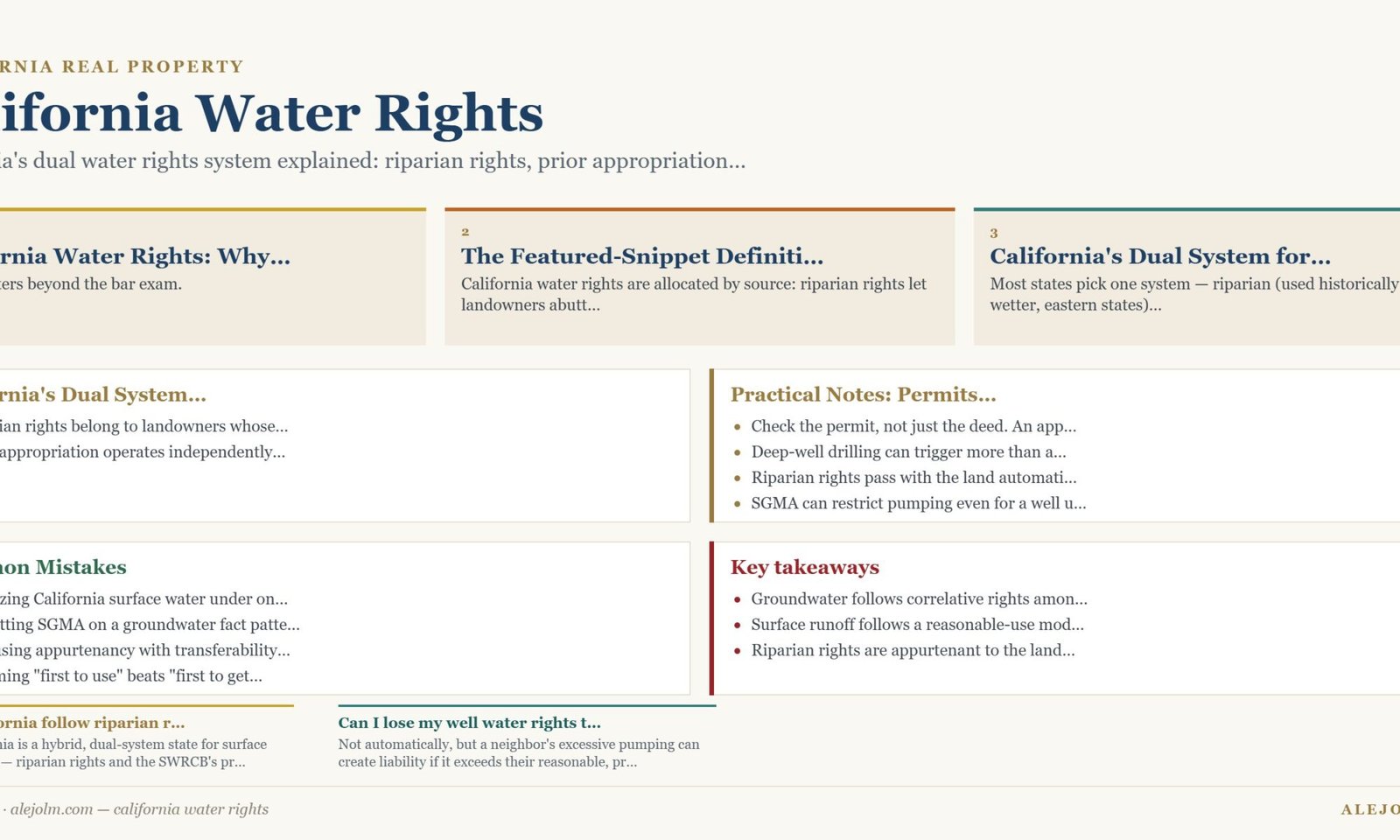

California Water Rights: Why the Rules Are More Complex Than Other States
California water rights are not a single system — they are four overlapping regimes layered on top of each other, and knowing which one governs a given drop of water is the first step in any dispute. Riparian rights, prior appropriation, percolating groundwater, and surface runoff each carry a different liability standard, and California is one of the few states that applies two regimes to the same watercourse at once.
This matters beyond the bar exam. Homeowners with wells, farmers irrigating from a creek, and developers assessing a parcel’s water supply all run into these same categories — getting the wrong one can mean litigating a right that was never yours to claim.
The Featured-Snippet Definition
California water rights are allocated by source: riparian rights let landowners abutting a watercourse make reasonable use of it; prior appropriation grants “first in time, first in right” permits administered by the state; percolating groundwater follows correlative rights among overlying owners; and surface runoff follows a reasonable-use rule between uphill and downhill owners.
California’s Dual System for Surface Watercourses
Most states pick one system — riparian (used historically in wetter, eastern states) or prior appropriation (the classic western-state approach). California uses both, simultaneously, for the same watercourse.
- Riparian rights belong to landowners whose property physically touches the water source. They can make reasonable use of it, and the right is appurtenant — it transfers automatically with the land and cannot be sold separately.
- Prior appropriation operates independently of land ownership. The state owns the water; whoever obtains the earliest valid permit for a beneficial use holds seniority over later permit holders, regardless of proximity to the source. In California, appropriative rights to surface water go through a permit system administered by the State Water Resources Control Board (SWRCB), which issues, tracks, and enforces priority.
A complete answer to any California surface-water fact pattern has to run both analyses — riparian reasonableness and appropriative priority — because either one can control the outcome, and they sometimes conflict.
Percolating Groundwater and California’s Correlative Rights Doctrine
Groundwater without a defined channel is governed differently. The modern majority rule lets the overlying owner make reasonable use of it without committing waste. California adds a twist: overlying owners of the same aquifer are co-equal correlative rights holders — no single owner can monopolize the shared basin, even by drilling first or deepest.
Since 2014, a statutory overlay sits on top of that common-law doctrine: the Sustainable Groundwater Management Act (SGMA). High- and medium-priority basins must be managed by local Groundwater Sustainability Agencies (GSAs), which adopt plans setting pumping allocations to prevent long-term overdraft. SGMA does not replace correlative rights; both can apply to the same well dispute.
| Water Source | Governing Rule | Tied to Land? | Key California Overlay |
|---|---|---|---|
| Riparian watercourse | Reasonable use among riparians | Yes (appurtenant) | Applies alongside appropriation |
| Appropriative watercourse | First in time, first in right | No (transferable permit) | SWRCB permit system |
| Percolating groundwater | Correlative reasonable use | Yes (overlying owner) | SGMA basin management (2014) |
| Surface runoff | Reasonable-use modification | Yes | Replaces old Common Enemy Doctrine |
Surface Water Drainage: From “Common Enemy” to Reasonable Use
Historically, courts treated stormwater runoff as a “common enemy” — an uphill owner could do almost anything to repel it, even if that flooded the property downhill. California, like most states today, has moved to a reasonable-use modification: an uphill owner may still manage drainage, but must exercise reasonable care and cannot impose disproportionate harm on a downhill neighbor.
This is a practical issue for anyone grading, building a berm, or regrading a lot near a property line. A drainage plan that simply pushes water onto a neighbor’s foundation, without regard to the resulting damage, can create liability even though no statute expressly prohibits grading your own land — and the same conduct can double as a private nuisance claim if the interference is severe and ongoing.
Practical Notes: Permits, Drought, and Buying Land With Water Rights
A few things matter in practice beyond the bar-exam framework:
- Check the permit, not just the deed. An appropriative right is documented through SWRCB permit and license records, separate from the property’s recorded chain of title — a title report alone won’t reveal it.
- Deep-well drilling can trigger more than a water dispute. Pumping that destabilizes a neighboring well or foundation can also raise lateral and subjacent support liability.
- Riparian rights pass with the land automatically on sale, but stay limited to reasonable use on the riparian parcel itself.
- SGMA can restrict pumping even for a well used for decades — check the basin’s priority designation before assuming unlimited access.
- During drought, appropriative rights are curtailed by seniority, with junior permit holders cut off first.
Worked Example: The Overdrawn Aquifer
Two almond growers, Hector and Wren, own adjoining parcels above the same groundwater basin. Hector drills a new, deeper well for an expanded orchard and begins pumping at triple his prior rate. Within a year, Wren’s shallower well runs dry.
Analysis: Both growers hold co-equal correlative rights in the shared aquifer — neither is an absolute owner of the groundwater beneath their land. Hector’s dramatic increase in pumping, if it exceeds his reasonable, proportionate share and injures Wren’s correlative right, can create liability even without any statute being violated. If the basin is designated high- or medium-priority under SGMA, the local Groundwater Sustainability Agency’s pumping allocations add another layer of restriction independent of this common-law dispute — Hector could be in violation of both correlative rights and the basin’s sustainability plan at once.
Common Mistakes
- Analyzing California surface water under only one system. California requires both riparian and prior-appropriation analysis for the same watercourse — skipping one is an incomplete answer.
- Forgetting SGMA on a groundwater fact pattern. Since 2014, high- and medium-priority basins are subject to statutory pumping management on top of correlative rights.
- Confusing appurtenancy with transferability. Riparian rights cannot be sold apart from the land; appropriative permits can be sold, leased, or mortgaged independently.
- Assuming “first to use” beats “first to get the permit.” In prior appropriation, seniority generally runs from the date of the valid permit or diversion, not from when heavy use actually began.
- Treating groundwater and surface water as the same body of law. Different rules, different agencies, different remedies.
FAQ
Does California follow riparian rights or prior appropriation?
Both. California is a hybrid, dual-system state for surface watercourses — riparian rights and the SWRCB’s prior-appropriation permit system apply simultaneously, and a complete legal analysis addresses both.
Can I lose my well water rights to a neighbor who drills a bigger well?
Not automatically, but a neighbor’s excessive pumping can create liability if it exceeds their reasonable, proportionate share of the shared aquifer under California’s correlative rights doctrine, and SGMA rules may further restrict extraction in regulated basins.
What is SGMA and does it apply to my property?
The Sustainable Groundwater Management Act is a 2014 California law requiring local agencies to manage high- and medium-priority groundwater basins. Whether it applies depends on your basin’s priority designation, which is tracked by the California Department of Water Resources.
Key Takeaways
- California allocates water rights by source: riparian, prior appropriation, percolating groundwater, and surface runoff, each with its own rule.
- California is a dual-system state — riparian and prior-appropriation rules both apply to the same surface watercourse.
- The State Water Resources Control Board administers appropriative permits and priority.
- Groundwater follows correlative rights among overlying owners, now layered with SGMA’s basin management requirements since 2014.
- Surface runoff follows a reasonable-use modification rather than the old Common Enemy Doctrine.
- Riparian rights are appurtenant to the land; appropriative permits are transferable independently.
This article is educational and is not legal advice. Consult a licensed California attorney about your situation.