
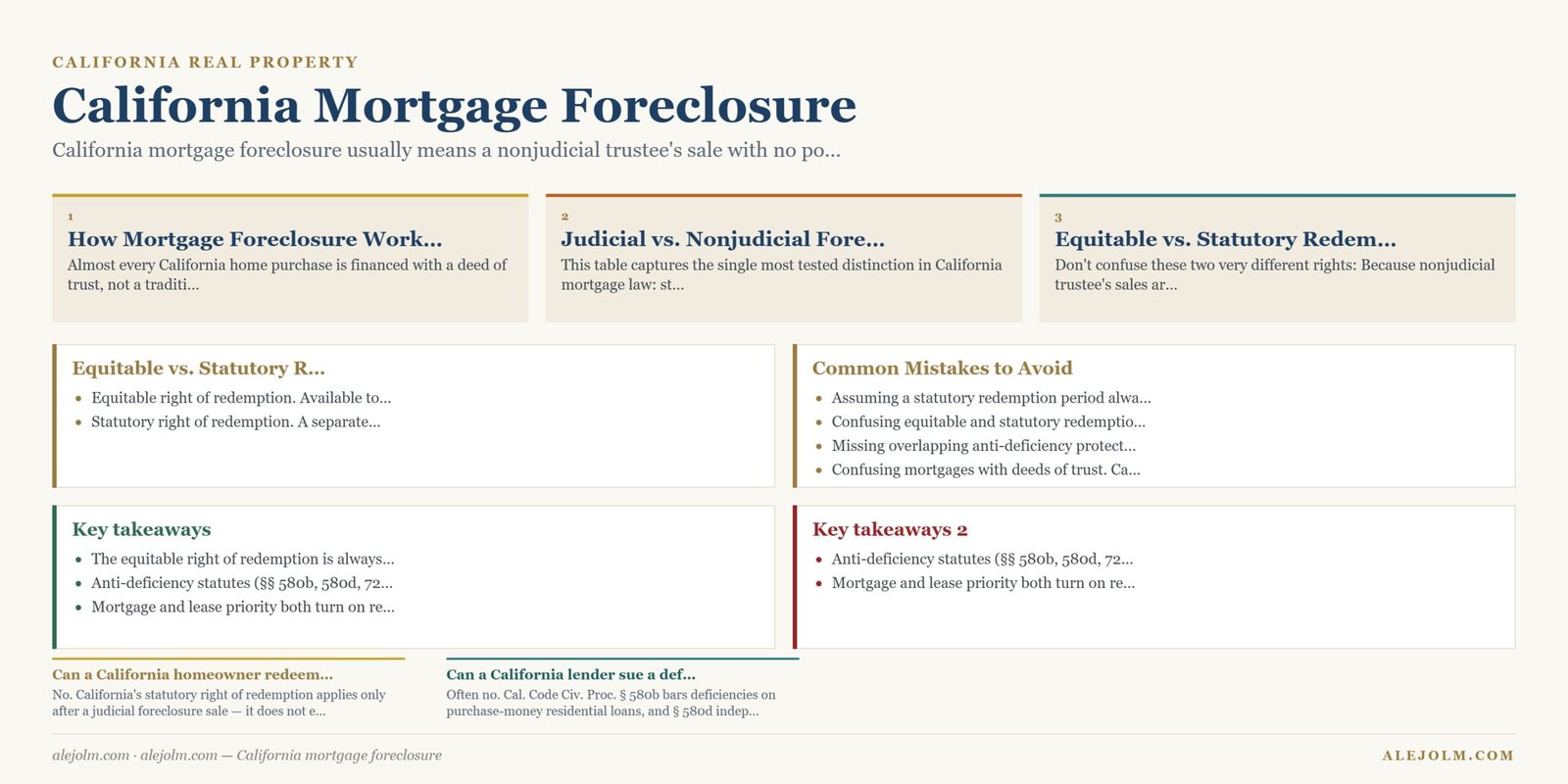
How Mortgage Foreclosure Works in California
Almost every California home purchase is financed with a deed of trust, not a traditional two-party mortgage — a distinction that drives everything about how foreclosure and redemption work in this state.
Mortgage foreclosure in California, defined in one sentence: it is the process by which a lender, after a borrower’s default, sells the secured real property — through either a court-supervised judicial sale or a private nonjudicial trustee’s sale — to satisfy the debt, with the borrower’s redemption rights depending entirely on which method the lender chose.
The deed of trust is a three-party instrument (borrower, lender/beneficiary, and a trustee) that allows the lender to foreclose without going to court — the overwhelmingly common path in California because it’s faster and cheaper than judicial foreclosure.
Judicial vs. Nonjudicial Foreclosure
| Feature | Judicial Foreclosure | Nonjudicial Trustee’s Sale |
|---|---|---|
| Process | Lawsuit, judgment, court-supervised sale | Private sale by trustee after statutory notice |
| Speed | Slower | Faster |
| Statutory right of redemption (post-sale) | Available, up to one year | Not available — sale is final |
| Deficiency judgment | Possible, subject to §§ 580b/726 limits | Barred entirely under § 580d |
This table captures the single most tested distinction in California mortgage law: statutory redemption survives only a judicial sale. A nonjudicial trustee’s sale under a deed of trust is final the moment the trustee’s deed is delivered — there is no post-sale do-over.
Equitable vs. Statutory Redemption
Don’t confuse these two very different rights:
- Equitable right of redemption. Available to every defaulting borrower, in every foreclosure, at any time before the sale — the borrower can stop the sale by paying the entire outstanding debt, interest, and costs (not just the missed payments). This right dies the moment the sale is conducted, regardless of foreclosure type.
- Statutory right of redemption. A separate, post-sale right allowing the borrower to buy back the property (up to one year, depending on the circumstances) — but in California, this right exists only after a judicial foreclosure sale. It does not exist after a nonjudicial trustee’s sale.
Because nonjudicial trustee’s sales are the norm in California, most defaulted homeowners in practice have no redemption right at all once the auction hammer falls.
California’s Anti-Deficiency Statutes
California shields many borrowers from personal liability for the shortfall between the debt and the foreclosure sale price:
- Cal. Code Civ. Proc. § 580b — bars a deficiency judgment on a purchase-money loan secured by owner-occupied 1-to-4-unit residential property, regardless of foreclosure method.
- Cal. Code Civ. Proc. § 580d — bars a deficiency judgment after any nonjudicial trustee’s sale, regardless of loan type.
- Cal. Code Civ. Proc. § 726 (the “one-action rule”) — requires the lender to exhaust the security (foreclose) before pursuing the borrower personally, and generally limits the lender to one lawsuit against the debt.
These three provisions frequently overlap in a single fact pattern, and bar examiners love stacking them: a purchase-money residential loan foreclosed nonjudicially can be independently protected by both § 580b and § 580d.
Worked Example
Buyer finances $400,000 of a $500,000 home purchase with a purchase-money loan secured by a deed of trust on the owner-occupied residence. Two years later, Buyer defaults. Bank elects a nonjudicial trustee’s sale rather than going to court. The trustee sells the home at auction for $320,000 — $80,000 short of the $400,000 balance.
Two questions: Can Buyer redeem the home after the sale? Can Bank sue Buyer for the $80,000 shortfall?
Neither. Because Bank chose a nonjudicial trustee’s sale, no statutory right of redemption exists post-sale in California — Buyer’s only redemption opportunity was the equitable right, which expired the moment the trustee’s sale was conducted. And Bank cannot recover a deficiency judgment: § 580d independently bars any deficiency following a nonjudicial trustee’s sale, and — even if Bank had foreclosed judicially instead — § 580b would separately bar a deficiency because this is a purchase-money loan on an owner-occupied 1-to-4 unit residence. Bank’s entire recovery is the $320,000 sale proceeds.
Mortgage Priority and Recording
Priority among multiple mortgages or deeds of trust on the same property is determined by recording order — first to record, first in line to be paid from foreclosure proceeds. A junior (second) lienholder takes subject to the senior lien and may be wiped out entirely if the senior debt equals or exceeds the sale price. An unrecorded mortgage risks losing priority to a later-recorded lender who takes without notice, under California’s race-notice recording statute.
Mortgages and Existing Leases
If a landlord’s property is later foreclosed, whether a tenant’s lease survives depends on priority: a lease that predates the mortgage generally survives foreclosure (subject to the lease’s own terms), while a lease that postdates the mortgage may be extinguished — unless the lease contains a subordination clause requiring the tenant to yield priority to the lender. California law (Civ. Code § 2924h) provides additional protections limiting a foreclosing lender’s ability to terminate certain residential tenancies.
Common Mistakes to Avoid
- Assuming a statutory redemption period always exists. It does not survive a nonjudicial trustee’s sale — the overwhelmingly common method in California.
- Confusing equitable and statutory redemption. Equitable redemption is always available pre-sale by paying the full debt; statutory redemption is a narrower, post-sale, judicial-foreclosure-only right.
- Missing overlapping anti-deficiency protections. A single fact pattern can trigger § 580b, § 580d, and § 726 simultaneously.
- Confusing mortgages with deeds of trust. California primarily uses deeds of trust, a three-party instrument enabling nonjudicial foreclosure — distinct from the two-party mortgage requiring judicial foreclosure in many other states.
FAQ
Can a California homeowner redeem their home after a nonjudicial foreclosure sale?
No. California’s statutory right of redemption applies only after a judicial foreclosure sale — it does not exist after a nonjudicial trustee’s sale under a deed of trust.
Can a California lender sue a defaulted borrower for the deficiency after foreclosure?
Often no. Cal. Code Civ. Proc. § 580b bars deficiencies on purchase-money residential loans, and § 580d independently bars any deficiency after a nonjudicial trustee’s sale.
What’s the difference between a mortgage and a deed of trust in California?
A mortgage is a two-party instrument (borrower and lender) typically requiring judicial foreclosure; a deed of trust is a three-party instrument (borrower, lender, trustee) that allows the faster, private nonjudicial trustee’s sale used in most California foreclosures.
Key Takeaways
- California predominantly uses deeds of trust, enabling nonjudicial trustee’s sales instead of court-supervised judicial foreclosure.
- The statutory right of redemption exists only after a judicial foreclosure sale — never after a nonjudicial trustee’s sale.
- The equitable right of redemption is always available before any sale, by paying the full outstanding debt.
- Anti-deficiency statutes (§§ 580b, 580d, 726) frequently overlap to bar a lender’s personal judgment against the borrower.
- Mortgage and lease priority both turn on recording order under California’s race-notice system.
Related guides
- marketable title in California real estate
- California adverse possession law
- California landlord-tenant law
Sources and further reading
This article is educational and is not legal advice. Consult a licensed California attorney about your situation.