
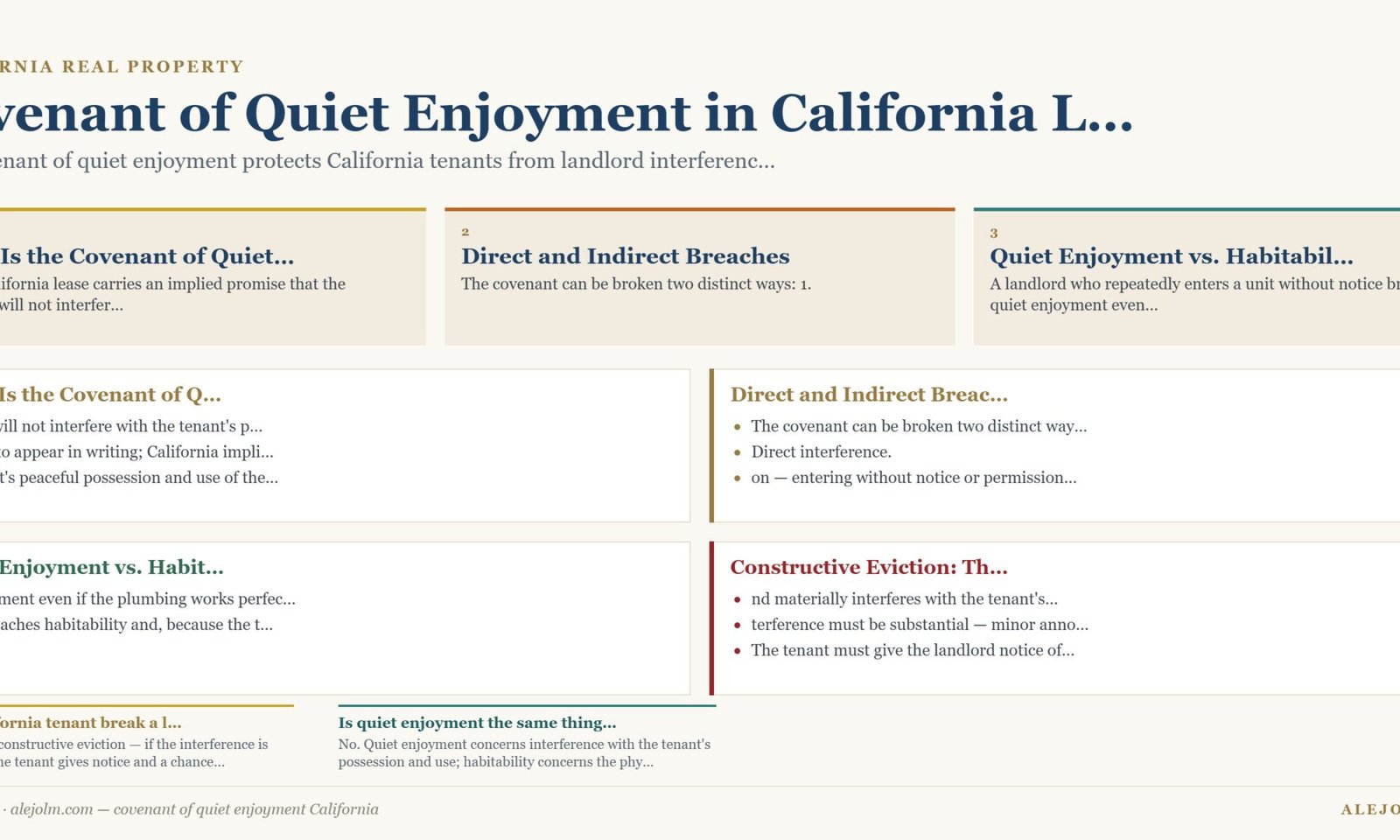
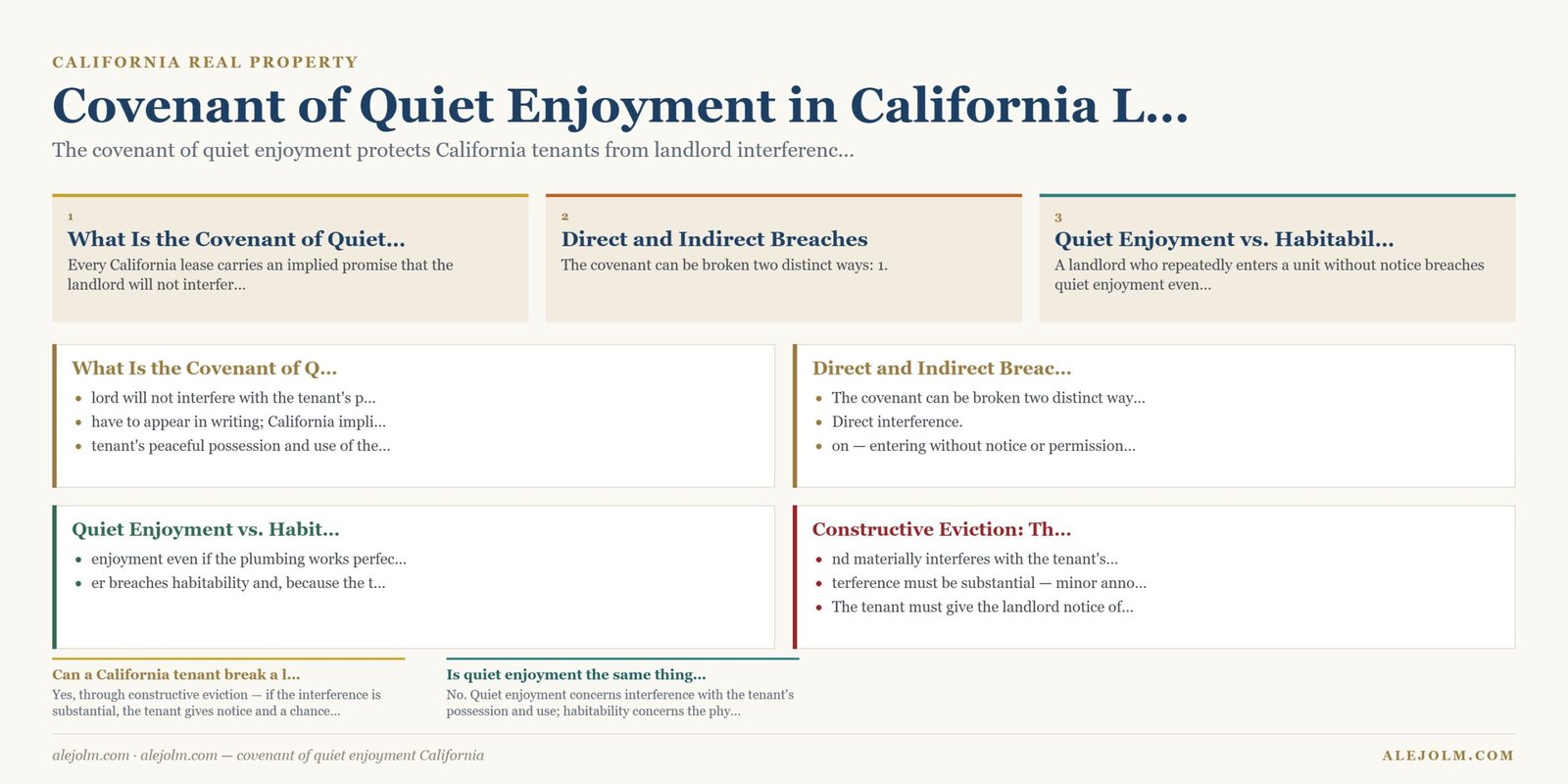
What Is the Covenant of Quiet Enjoyment?
Every California lease carries an implied promise that the landlord will not interfere with the tenant’s possession and use of the premises — the covenant of quiet enjoyment. It doesn’t have to appear in writing; California implies it by operation of law in every residential and commercial lease.
Covenant of quiet enjoyment, defined in one sentence: it is the landlord’s implied promise not to interfere — directly or by failing to prevent third-party interference — with the tenant’s peaceful possession and use of the leased premises, breach of which can support constructive eviction.
Bar examiners love pairing this doctrine with habitability because students routinely conflate the two, and the exam rewards precision on exactly where the line sits.
Direct and Indirect Breaches
The covenant can be broken two distinct ways:
- Direct interference. The landlord personally disrupts possession — entering without notice or permission, changing the locks, cutting off utilities, or harassing the tenant.
- Failure to prevent third-party interference. The landlord fails to maintain security (broken locks inviting break-ins), tolerates trespassers, or allows a persistent nuisance condition affecting the unit.
Either type of breach can support a tenant’s claim, but courts look for conduct — or inaction — substantial enough to interfere materially with the tenant’s use of the property.
Quiet Enjoyment vs. Habitability: The Line Bar Examiners Test
| Doctrine | Focus | Typical Breach | Overlap |
|---|---|---|---|
| Quiet enjoyment | Tenant’s undisturbed possession and use | Illegal entry, harassment, failure to exclude intruders | Can overlap with habitability if interference makes premises unusable |
| Habitability | Physical condition of the premises | No heat, broken plumbing, pest infestation | Severe condition failures also interfere with use, triggering both theories |
A landlord who repeatedly enters a unit without notice breaches quiet enjoyment even if the plumbing works perfectly — that’s a pure quiet-enjoyment claim, not a habitability claim. Conversely, a landlord who lets the heat stay broken all winter breaches habitability and, because the tenant effectively can’t use the unit, also breaches quiet enjoyment.
Constructive Eviction: The Remedy for a Serious Breach
When a landlord’s conduct (or inaction) substantially and materially interferes with the tenant’s use, the tenant can treat the lease as constructively terminated:
- The interference must be substantial — minor annoyances (occasional noise, a single missed repair) don’t qualify.
- The tenant must give the landlord notice of the problem and a reasonable opportunity to cure.
- If the landlord fails to cure, the tenant must vacate within a reasonable time. Staying too long after the breach can waive the constructive eviction defense.
Constructive eviction is both a sword and a shield: the tenant can affirmatively terminate the lease and sue for damages, and it also operates as a complete defense if the landlord later sues for unpaid rent or files an unlawful detainer action.
Worked Example
Tenant Whitney rents a ground-floor unit from Landlord Devon. After a dispute over a late rent payment, Devon starts entering Whitney’s apartment without notice “to check the pipes” roughly twice a week, and once changes the locks while Whitney is at work, leaving her locked out for six hours.
Has Devon breached the covenant of quiet enjoyment? Yes — repeated unauthorized entries and a lockout are direct, serious interference with Whitney’s possession, entirely independent of whether the unit’s physical condition is fine. Whitney can give Devon written notice demanding the harassment stop; if it continues, she may treat the lease as constructively terminated, vacate, and sue for damages, or raise the breach as a defense if Devon later tries to evict her for the earlier late payment.
Interaction With Recorded Restrictions and Co-Ownership
A recorded restrictive covenant limiting the property to single-family residential use doesn’t itself breach quiet enjoyment, because the tenant takes the lease with constructive notice of anything properly recorded. But when co-owners lease the same property, one co-owner’s interference with the tenant — excluding the tenant from common areas, for instance — can trigger a quiet enjoyment claim against the landlord co-owners collectively.
Common Mistakes to Avoid
- Conflating quiet enjoyment with habitability. One concerns interference with possession; the other concerns physical condition. They frequently overlap but are analyzed separately.
- Assuming any inconvenience breaches the covenant. Constructive eviction demands a substantial, material interference — not routine annoyances.
- Skipping the notice-and-cure step. A tenant who vacates without first giving the landlord a chance to fix the problem risks losing the constructive eviction defense.
- Thinking the covenant can be waived. A lease clause purporting to waive quiet enjoyment is void as against public policy in California.
FAQ
Can a California tenant break a lease over a landlord’s harassment?
Yes, through constructive eviction — if the interference is substantial, the tenant gives notice and a chance to cure, and then vacates within a reasonable time after the landlord fails to fix it.
Is quiet enjoyment the same thing as the warranty of habitability?
No. Quiet enjoyment concerns interference with the tenant’s possession and use; habitability concerns the physical condition of the premises. A landlord can breach one without breaching the other.
Does a landlord have to personally cause the interference to breach quiet enjoyment?
No. A landlord who fails to prevent third-party interference — like ignoring a broken lock that lets intruders in — can also breach the covenant.
Key Takeaways
- Quiet enjoyment is implied in every California lease and cannot be waived.
- It can be breached by the landlord’s direct interference or by a failure to prevent third-party interference.
- Constructive eviction requires substantial interference, notice and an opportunity to cure, and timely vacating.
- Quiet enjoyment and habitability overlap but are legally distinct theories.
- Constructive eviction works both as an offensive claim for damages and as a defense to an eviction action.
This article is educational and is not legal advice. Consult a licensed California attorney about your situation.
Related guides
- California landlord-tenant law
- implied warranty of habitability in California
- California eviction process
- nuisance