
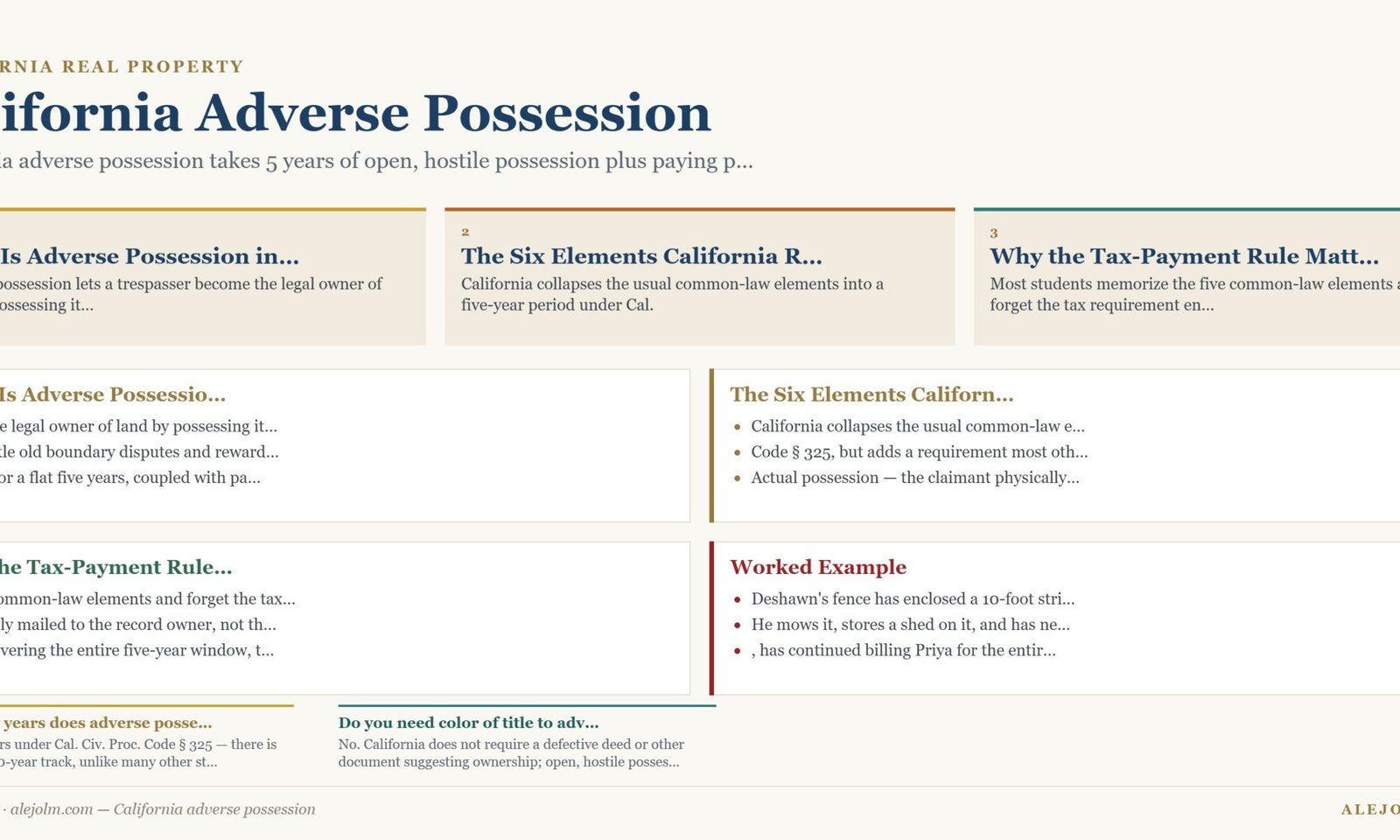
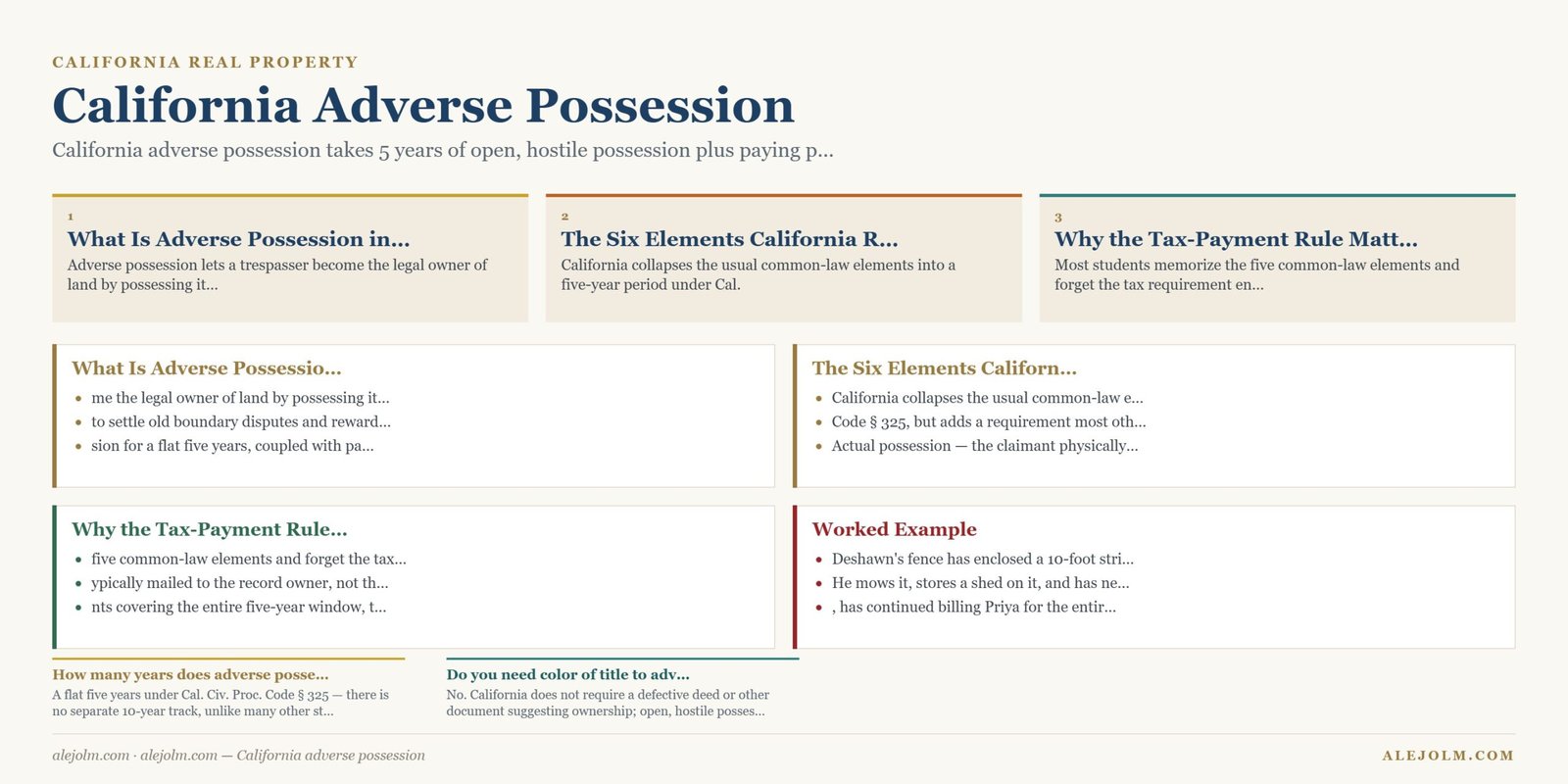
What Is Adverse Possession in California?
Adverse possession lets a trespasser become the legal owner of land by possessing it openly, exclusively, and without permission for a statutory period. It sounds like a loophole, but it exists to settle old boundary disputes and reward productive, visible use of land over an absent owner’s paper title.
Adverse possession in California, defined in one sentence: it is the acquisition of title to real property through actual, open and notorious, exclusive, continuous, and hostile possession for a flat five years, coupled with payment of all property taxes assessed on the land during that period.
This concept is a perennial California Bar Exam favorite because the state’s rule diverges sharply from the generic common-law version taught in most first-year Property courses.
The Six Elements California Requires
California collapses the usual common-law elements into a five-year period under Cal. Civ. Proc. Code § 325, but adds a requirement most other states don’t have:
- Actual possession — the claimant physically occupies and uses the land as a true owner would.
- Open and notorious — the possession is visible enough that a reasonable owner inspecting the property would discover it.
- Exclusive — the claimant doesn’t share possession with the true owner or the public.
- Continuous — uninterrupted for the entire five-year period (tacking between successive possessors is allowed if they’re in privity).
- Hostile — without the true owner’s permission (it does not require bad faith or knowledge of trespassing).
- Payment of all property taxes for the full five years — the California-specific element, and the one that sinks the overwhelming majority of claims.
Unlike many states, California does not require color of title (a defective deed or document suggesting ownership). Pure possession, if it satisfies all six elements, is enough.
Why the Tax-Payment Rule Matters So Much
Most students memorize the five common-law elements and forget the tax requirement entirely — which is exactly why bar examiners test it. County tax bills are typically mailed to the record owner, not the possessor, so a possessor often never even receives a bill to pay. If the claimant cannot show tax payments covering the entire five-year window, the claim fails regardless of how strong the other five elements are.
| Element | What It Requires | Common Trap |
|---|---|---|
| Actual possession | Physical use as an owner would use it | Sporadic or seasonal use may not qualify |
| Open and notorious | Visible enough to put the owner on notice | Hidden structures don’t start the clock |
| Exclusive | Not shared with the true owner | Owner’s occasional use can defeat exclusivity |
| Hostile | Without permission (no bad intent required) | Owner’s acquiescence can look like permission |
| Continuous (5 years) | Unbroken for the statutory period; tacking allowed in privity | Gaps in occupancy reset the clock |
| Property taxes (CA only) | Paid in full for all 5 years | Bills sent to record owner never reach possessor |
Worked Example
Deshawn’s fence has enclosed a 10-foot strip of his neighbor Priya’s backyard for six years. He mows it, stores a shed on it, and has never asked Priya’s permission. The county, however, has continued billing Priya for the entire parcel, including the disputed strip, and she has paid every bill.
Does Deshawn acquire title by adverse possession? He satisfies actual, open and notorious, exclusive, continuous, and hostile possession — the fence alone demonstrates most of these. But he has not paid any property taxes on the strip; Priya has. Under California’s sixth element, Deshawn’s claim fails entirely, even though five of the six elements are easily met. This is the single most common way a strong-looking adverse possession fact pattern collapses.
Adverse Possession vs. Recording Acts
Adverse possession operates entirely outside California’s race-notice recording system. A possessor need not record anything to acquire title; physical occupation does all the work. This matters because recording acts protect against notice-based claims (a buyer relying on the county record), while adverse possession defeats a paper-title owner through possession the record never shows. A title search alone will never reveal a competing adverse possession claim — that’s why physical inspection of the property matters at closing.
Interaction with Landlord-Tenant and Co-Tenancy Situations
A tenant’s possession is ordinarily not hostile because it exists with the landlord’s permission — so a tenant generally cannot adversely possess against their own landlord during the lease term. But if a tenant holds over after the lease ends and the landlord acquiesces for years without objection, that possession can ripen into hostility. Similarly, a co-tenant who ousts another co-tenant — excluding them entirely from the property — can start the adverse possession clock running against the ousted co-tenant.
Common Mistakes to Avoid
- Forgetting the tax-payment element. This is the single most commonly missed rule in California adverse possession fact patterns.
- Assuming color of title is required. It is not, in California; pure possession without any document suffices if all six elements are met.
- Confusing “hostile” with intentional wrongdoing. Hostile just means without permission — a good-faith mistaken boundary crosser can still qualify.
- Missing that courts reject adverse possession as an unconstitutional taking. Courts treat AP as part of the background property regime, not government action, so a dispossessed owner has no Fifth Amendment claim against the government.
FAQ
How many years does adverse possession take in California?
A flat five years under Cal. Civ. Proc. Code § 325 — there is no separate 10-year track, unlike many other states.
Do you need color of title to adversely possess land in California?
No. California does not require a defective deed or other document suggesting ownership; open, hostile possession alone can suffice if all six elements, including tax payment, are met.
What’s the most common reason an adverse possession claim fails in California?
Failure to pay all property taxes assessed on the disputed land for the full five-year period — even claimants who satisfy every other element routinely lose on this ground alone.
Key Takeaways
- California requires five years of actual, open and notorious, exclusive, continuous, and hostile possession.
- California uniquely requires the possessor to pay all property taxes on the land for the full five years (Cal. Civ. Proc. Code § 325).
- Color of title is not required in California, unlike in many other jurisdictions.
- Adverse possession operates outside the recording system entirely — a title search will not reveal it.
- A tenant cannot ordinarily adversely possess against their own landlord absent holdover and acquiescence, but ouster of a co-tenant can start the clock.
This article is educational and is not legal advice. Consult a licensed California attorney about your situation.