
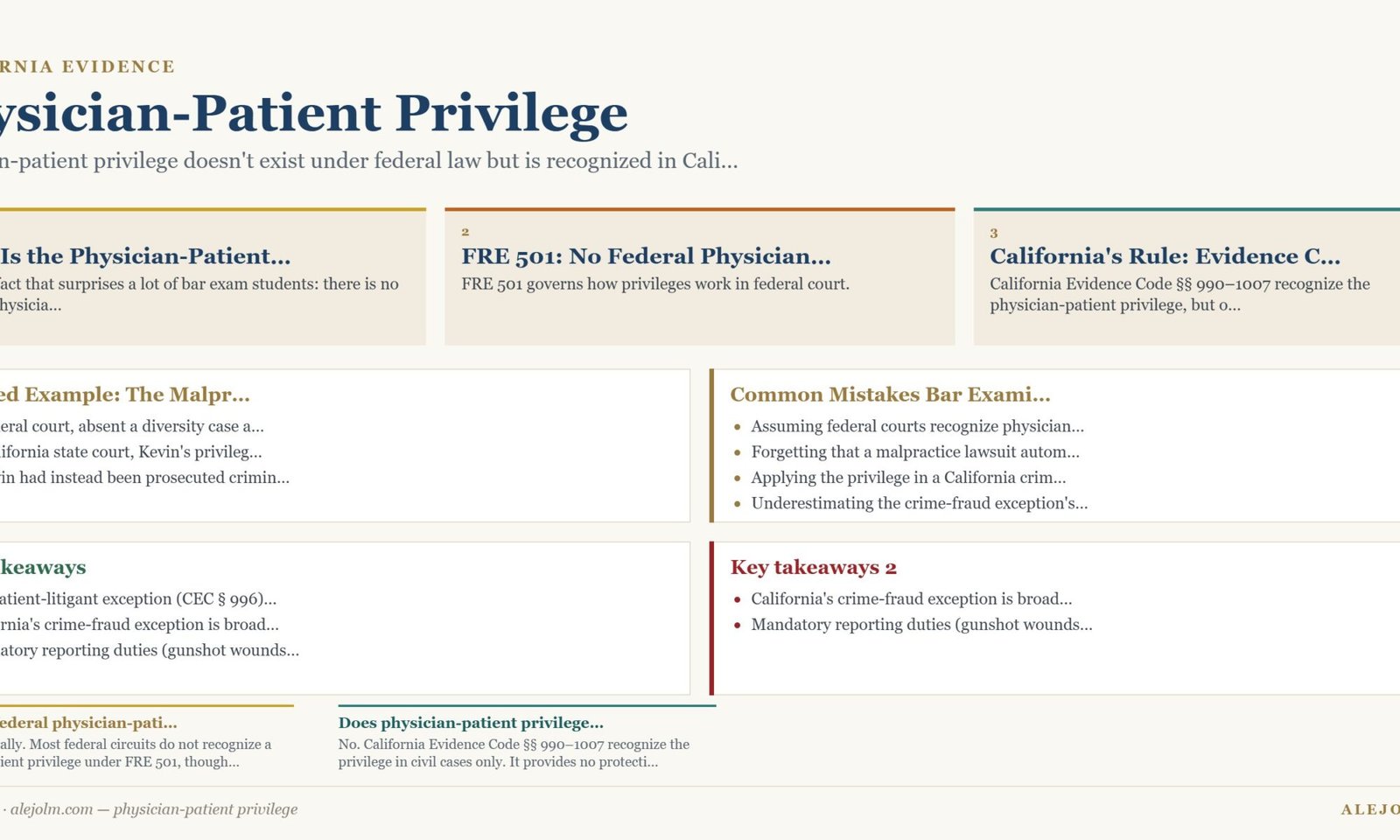
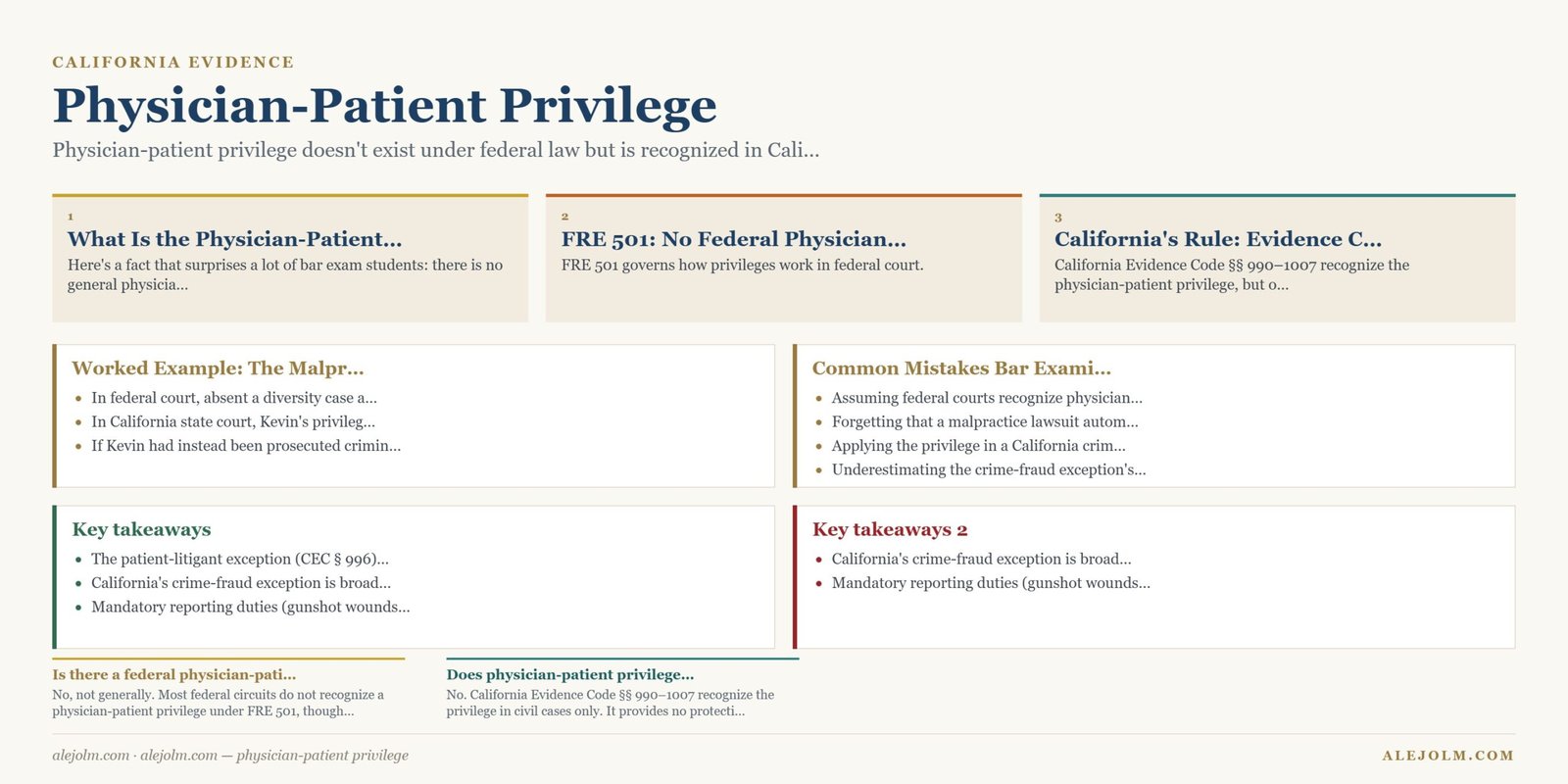
What Is the Physician-Patient Privilege?
Here’s a fact that surprises a lot of bar exam students: there is no general physician-patient privilege in federal court. Physician-patient privilege protects confidential communications made to a doctor for diagnosis or treatment, but federal law simply doesn’t recognize it, while California does — in civil cases only.
That gap between federal and state law is exactly the kind of issue the California Bar Exam loves to test, because assuming “privilege” always works the same way across jurisdictions is a fast way to lose points.
Physician-patient privilege, defined: the patient’s right to prevent disclosure of confidential communications made to a physician for the purpose of diagnosis or treatment — recognized under California Evidence Code §§ 990–1007 in civil cases, but not under the Federal Rules of Evidence.
FRE 501: No Federal Physician-Patient Privilege
FRE 501 governs how privileges work in federal court. In federal question cases, federal common law controls, and most federal circuits simply do not recognize a physician-patient privilege — unlike attorney-client, spousal, or clergy-penitent privilege, which are widely honored. In diversity cases, state privilege law applies instead. So if a diversity case is litigated in federal court and California law governs, California’s physician-patient privilege can suddenly become relevant even though the case is in federal court.
California’s Rule: Evidence Code § 990 in Civil Cases Only
California Evidence Code §§ 990–1007 recognize the physician-patient privilege, but only in civil cases. It doesn’t apply in California criminal prosecutions at all — meaning a defendant’s medical records can be discoverable in a criminal case in a way they couldn’t be in a civil one.
The patient holds the privilege and controls whether to waive it. Three exceptions matter most for exam purposes:
- Patient-litigant exception (CEC § 996): once a patient sues over a medical condition, or puts that condition at issue, the privilege is waived as to all related medical records and treatment.
- Crime-fraud exception (CEC § 995): broader than the attorney-client version — privilege is lost if the patient sought the physician’s services to aid a crime, fraud, escape after a crime, or even a tort.
- Mandatory reporting: California physicians must report gunshot wounds and certain contagious diseases regardless of privilege.
Federal vs. California: A Side-by-Side Comparison
| Issue | Federal Rule (FRE 501) | California (CEC §§ 990–1007) |
|---|---|---|
| Does the privilege exist? | Generally no — most circuits don’t recognize it | Yes, but civil cases only |
| Applies in criminal cases? | N/A (no federal privilege) | No — never applies in California criminal cases |
| Who holds the privilege? | N/A | The patient |
| Patient-litigant exception | N/A | Yes — suing over a medical condition waives it entirely |
| Crime-fraud exception scope | N/A | Broader — covers crime, fraud, escape, or tort |
| Diversity cases | State privilege law applies | — |
This table is the single most exam-tested contrast in this area: know that “privilege” is not a monolith, and that the same facts can come out differently depending on whether you’re in federal court, California civil court, or California criminal court.
Worked Example: The Malpractice Deposition
Dr. Reyes treats a patient, Kevin, for a shoulder injury. Kevin later sues Dr. Reyes for medical malpractice, alleging the surgery worsened his condition. During discovery, opposing counsel deposes Dr. Reyes and asks about Kevin’s full treatment history, including unrelated prior visits.
- In federal court, absent a diversity case applying California law, there is no physician-patient privilege — Dr. Reyes generally must answer.
- In California state court, Kevin’s privilege exists in theory, but the patient-litigant exception wipes it out the moment he sues over his medical condition. Dr. Reyes must testify about records relevant to the claimed injury.
- If Kevin had instead been prosecuted criminally for a related fraud claim and his medical records came up, no physician-patient privilege would protect them in California, because the privilege never applies in criminal cases.
Common Mistakes Bar Examiners Test
- Assuming federal courts recognize physician-patient privilege the way they recognize attorney-client privilege — they generally don’t.
- Forgetting that a malpractice lawsuit automatically triggers the patient-litigant exception and waives privilege to related records.
- Applying the privilege in a California criminal case — it simply doesn’t exist there.
- Underestimating the crime-fraud exception’s scope; it covers torts, not just crimes and fraud, under California law.
Frequently Asked Questions
Is there a federal physician-patient privilege?
No, not generally. Most federal circuits do not recognize a physician-patient privilege under FRE 501, though state privilege law may apply in diversity cases if the governing state (like California) recognizes one.
Does physician-patient privilege apply in California criminal cases?
No. California Evidence Code §§ 990–1007 recognize the privilege in civil cases only. It provides no protection in California criminal prosecutions.
What is the patient-litigant exception?
It’s an automatic waiver: once a patient sues over a medical condition or otherwise puts it at issue in litigation, the physician-patient privilege no longer protects related medical records and treatment communications.
Key Takeaways
- Federal law (FRE 501) generally does not recognize a physician-patient privilege, unlike attorney-client or spousal privilege.
- California Evidence Code §§ 990–1007 recognize the privilege, but only in civil cases — never in California criminal prosecutions.
- The patient-litigant exception (CEC § 996) automatically waives privilege once a patient sues over a medical condition.
- California’s crime-fraud exception is broader than the attorney-client version, reaching torts as well as crimes and fraud.
- Mandatory reporting duties (gunshot wounds, communicable diseases) override the privilege entirely.
This article is educational and is not legal advice. Consult a licensed California attorney about your situation.
Related guides
- psychotherapist-patient privilege
- hearsay rule basics
- non-hearsay statements not offered for truth
- witness impeachment in California