
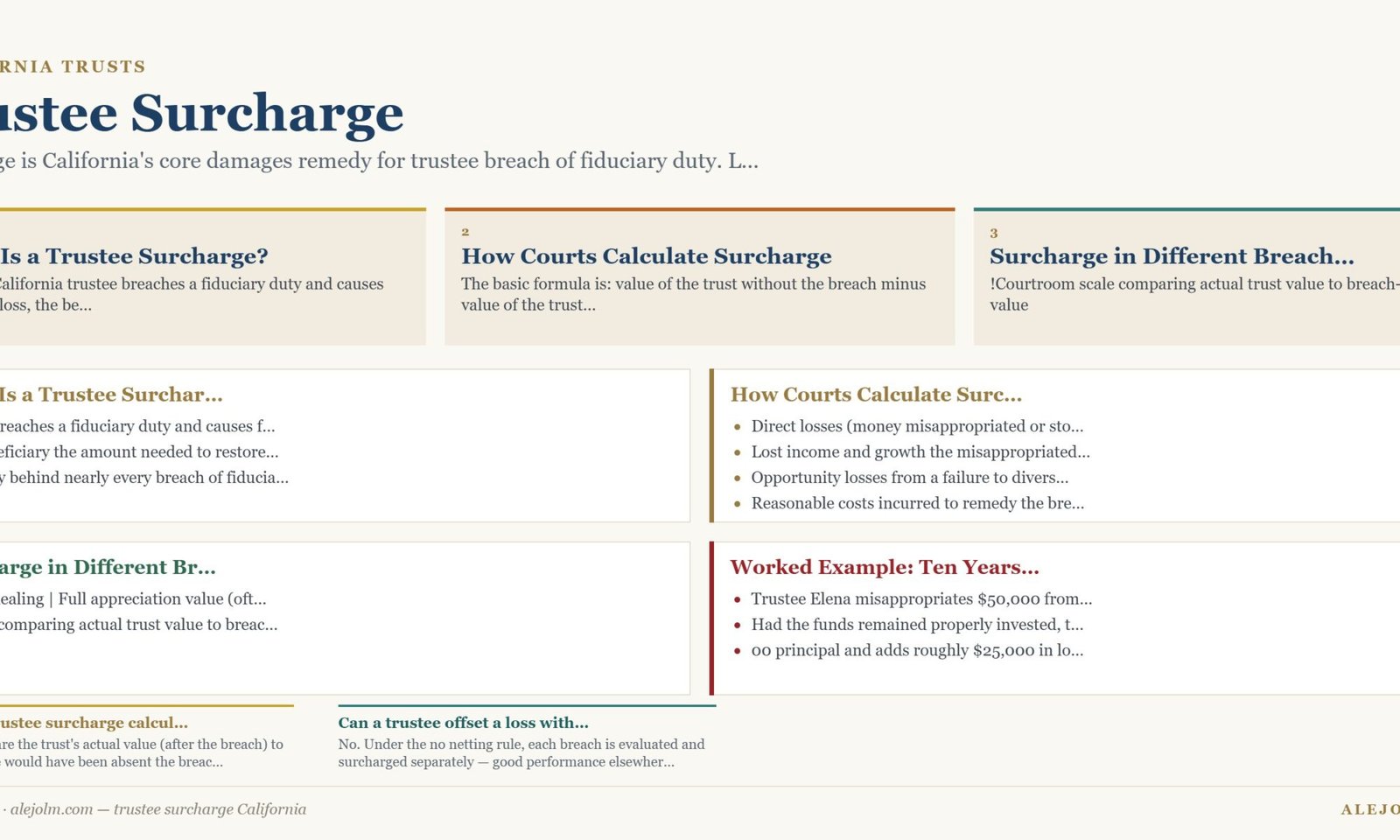
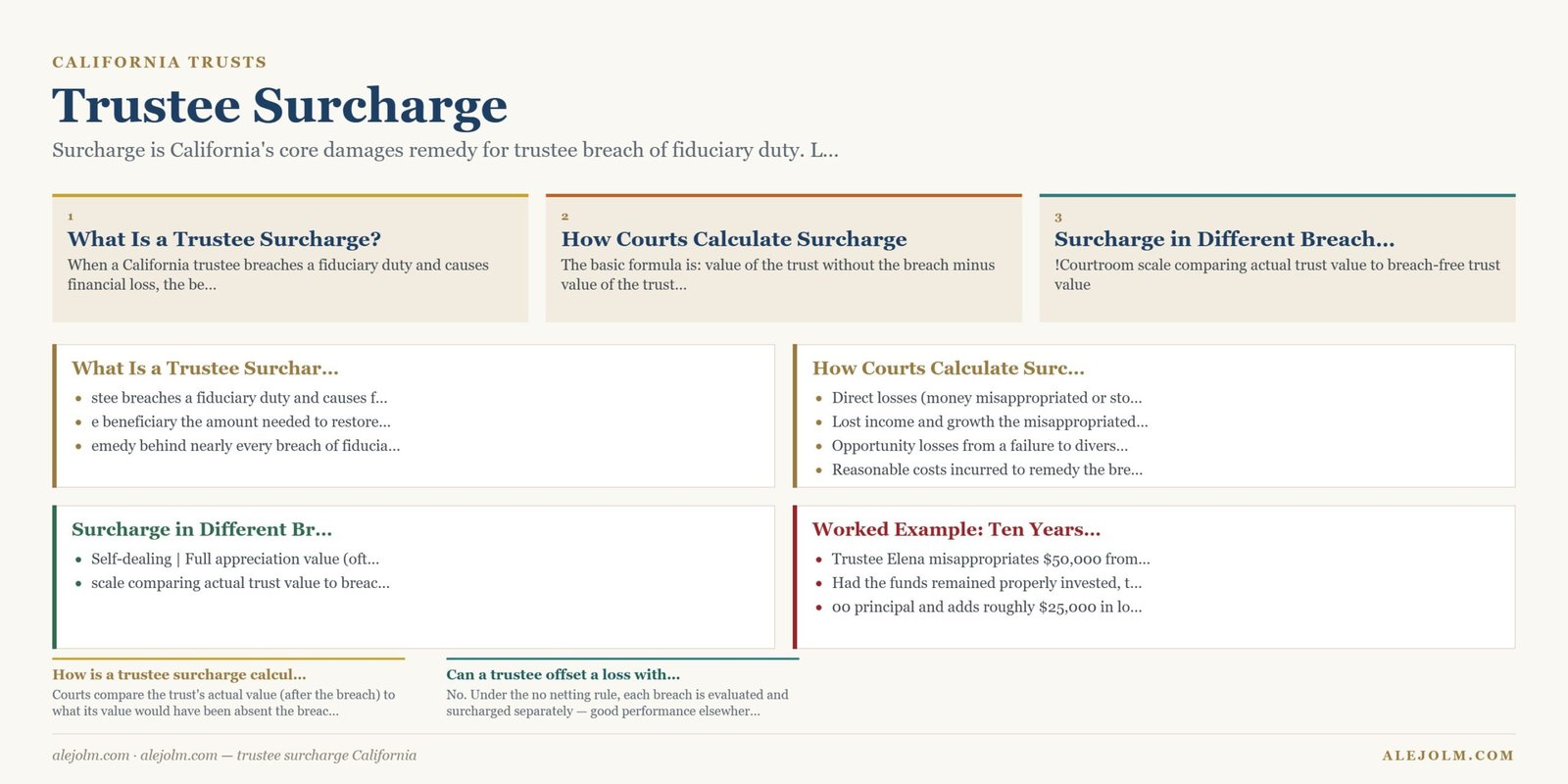
What Is a Trustee Surcharge?
When a California trustee breaches a fiduciary duty and causes financial loss, the beneficiary’s primary remedy has a specific name. A surcharge is an equitable money-damages remedy that requires a trustee to personally pay the beneficiary the amount needed to restore the trust to the position it would have occupied but for the breach. It’s the workhorse remedy behind nearly every breach of fiduciary duty trustee case that doesn’t involve tracing specific property.
If you remember one thing about surcharge for the bar exam, remember this: it’s calculated by comparison, not by punishment. The court asks what the trust should be worth, compares it to what the trust is worth because of the breach, and orders the trustee to pay the difference.
How Courts Calculate Surcharge
The basic formula is: value of the trust without the breach minus value of the trust with the breach. That comparison captures more than the money literally taken — it includes:
- Direct losses (money misappropriated or stolen outright)
- Lost income and growth the misappropriated funds would have earned
- Opportunity losses from a failure to diversify or invest prudently
- Reasonable costs incurred to remedy the breach
Surcharge in Different Breach Scenarios
| Breach Type | How Surcharge Is Calculated |
|---|---|
| Misappropriation | Amount taken + lost earnings that amount would have generated |
| Imprudent investment | Difference between actual return earned and prudent return that should have been earned |
| Failure to diversify | Actual decline in value + gap between concentrated and diversified portfolio performance |
| Self-dealing | Full appreciation value (often via constructive trust) or price differential if untraceable |
Worked Example: Ten Years of Misappropriation
Trustee Elena misappropriates $50,000 from a trust and uses it for personal expenses over ten years. Had the funds remained properly invested, they would have earned a conservative 5% annually. The surcharge calculation starts with the $50,000 principal and adds roughly $25,000 in lost compound growth over the decade — a total surcharge near $75,000.
Now suppose Elena’s other trust investments during those same ten years happened to return 15% annually, well above the trust’s typical benchmark. That strong performance does not offset the $75,000 surcharge for the misappropriation. This is the “no netting” rule in action: courts evaluate each breach independently, and a trustee cannot use good results elsewhere to excuse a distinct wrong.
The No Netting Rule
The no netting rule is a frequently tested trap. A trustee who has one excellent investment and one terrible investment cannot average them out and claim the trust suffered no net harm. Each breach is surcharged on its own terms. This rule exists because allowing netting would let a reckless or self-interested trustee gamble with trust assets, using occasional wins to paper over serious violations.
Defenses: Ratification
The main affirmative defense to surcharge is beneficiary ratification — the beneficiary knowingly accepted the breach. But ratification requires real informed consent, not just passive acceptance of distributions. A beneficiary who kept receiving regular payments without knowing about a hidden breach has not ratified anything; ratification requires the beneficiary to have known the material facts and still accepted the trustee’s conduct.
Who Actually Pays a Surcharge?
This is a detail students often miss: surcharge is paid out of the trustee’s own personal assets, not out of the trust corpus. That’s what makes it a genuine deterrent rather than a wash. If a trustee is bonded, a fidelity bond or errors-and-omissions insurance policy may cover the judgment. If the trustee is insolvent, though, a beneficiary can win the case on paper and still recover nothing — which is why beneficiaries sometimes pursue tracing and constructive trust remedies in parallel with surcharge, especially when specific property can still be identified.
Surcharge vs. Other Remedies
Surcharge is a personal money judgment, distinct from — but often sought alongside — other trust remedies. Constructive trust and tracing are in rem remedies that follow specific property rather than creating a personal debt. Removal is a structural remedy that replaces the trustee prospectively but doesn’t itself compensate the trust for past losses. A beneficiary facing an insolvent, dishonest trustee will often seek removal, surcharge, and tracing simultaneously, using whichever remedy actually produces recovery.
Common Mistakes to Avoid
Watch for three recurring exam traps: calculating surcharge on the stolen or mismanaged amount alone while ignoring lost earnings; applying the no-netting rule backwards by allowing gains to offset losses; and assuming that any acceptance of distributions equals ratification, when real ratification requires informed knowledge of the breach.
Frequently Asked Questions
How is a trustee surcharge calculated?
Courts compare the trust’s actual value (after the breach) to what its value would have been absent the breach, including lost earnings and opportunity costs, then order the trustee to pay the difference personally.
Can a trustee offset a loss with gains from a different investment?
No. Under the no netting rule, each breach is evaluated and surcharged separately — good performance elsewhere does not excuse a distinct breach of fiduciary duty.
Does the trust pay the surcharge out of its own assets?
No. Surcharge is a personal judgment against the trustee, paid from the trustee’s own assets, bond, or insurance — not from the trust corpus itself.
Key Takeaways
- Surcharge restores the trust to the value it would have had absent the breach, including lost earnings and opportunity costs.
- The no netting rule bars offsetting gains from one breach against losses from another.
- Ratification is a narrow defense requiring informed beneficiary consent, not mere passive acceptance.
- Surcharge is paid from the trustee’s personal assets, not the trust corpus — insolvency can defeat recovery.
- Surcharge often runs alongside tracing, constructive trust, and removal rather than replacing them.
This article is educational and is not legal advice. Consult a licensed California attorney about your situation.
Related guides
- trustee self-dealing in California
- prudent investor rule for California trustees
- trust tracing and lowest intermediate balance
- exculpatory clauses in California trusts
- trustee-duties