
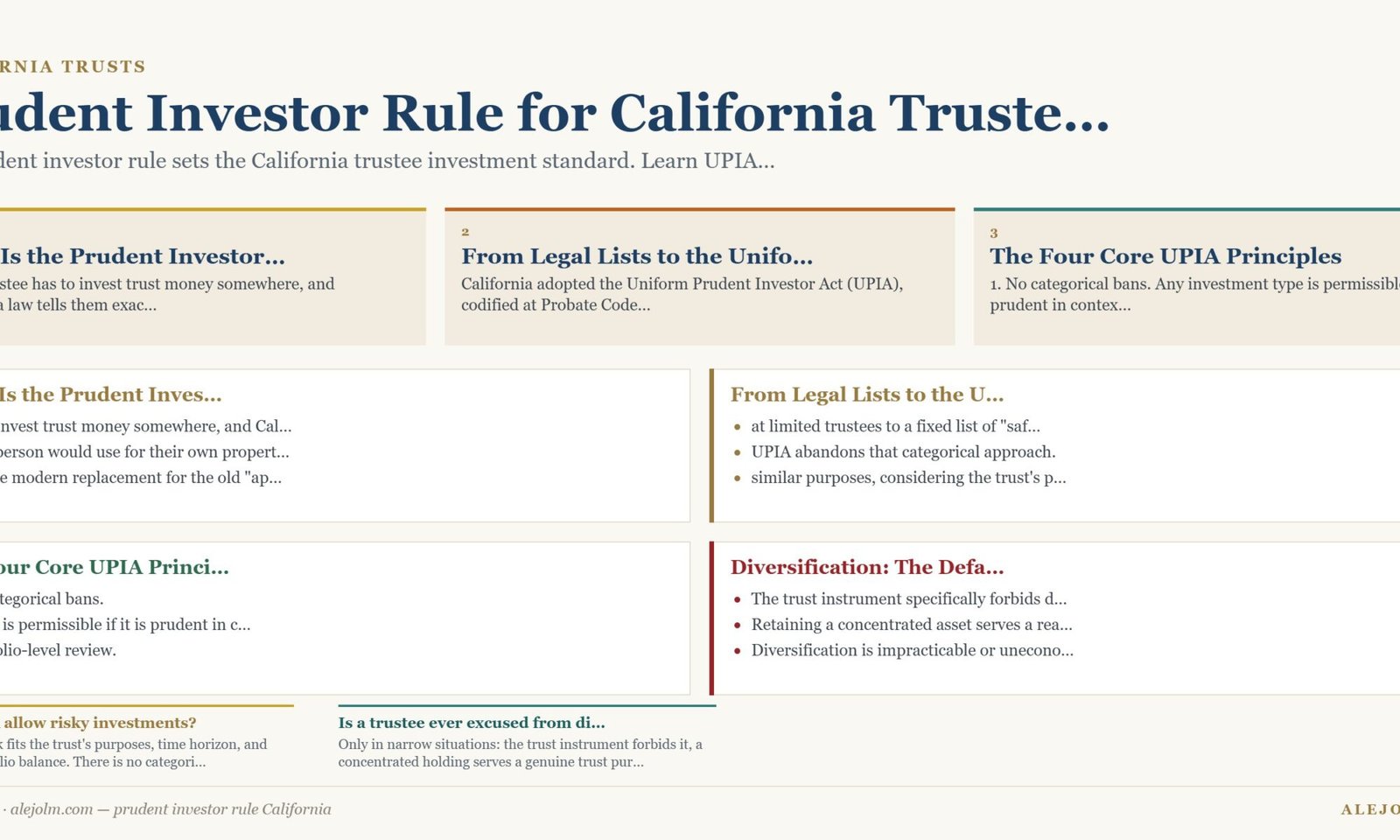
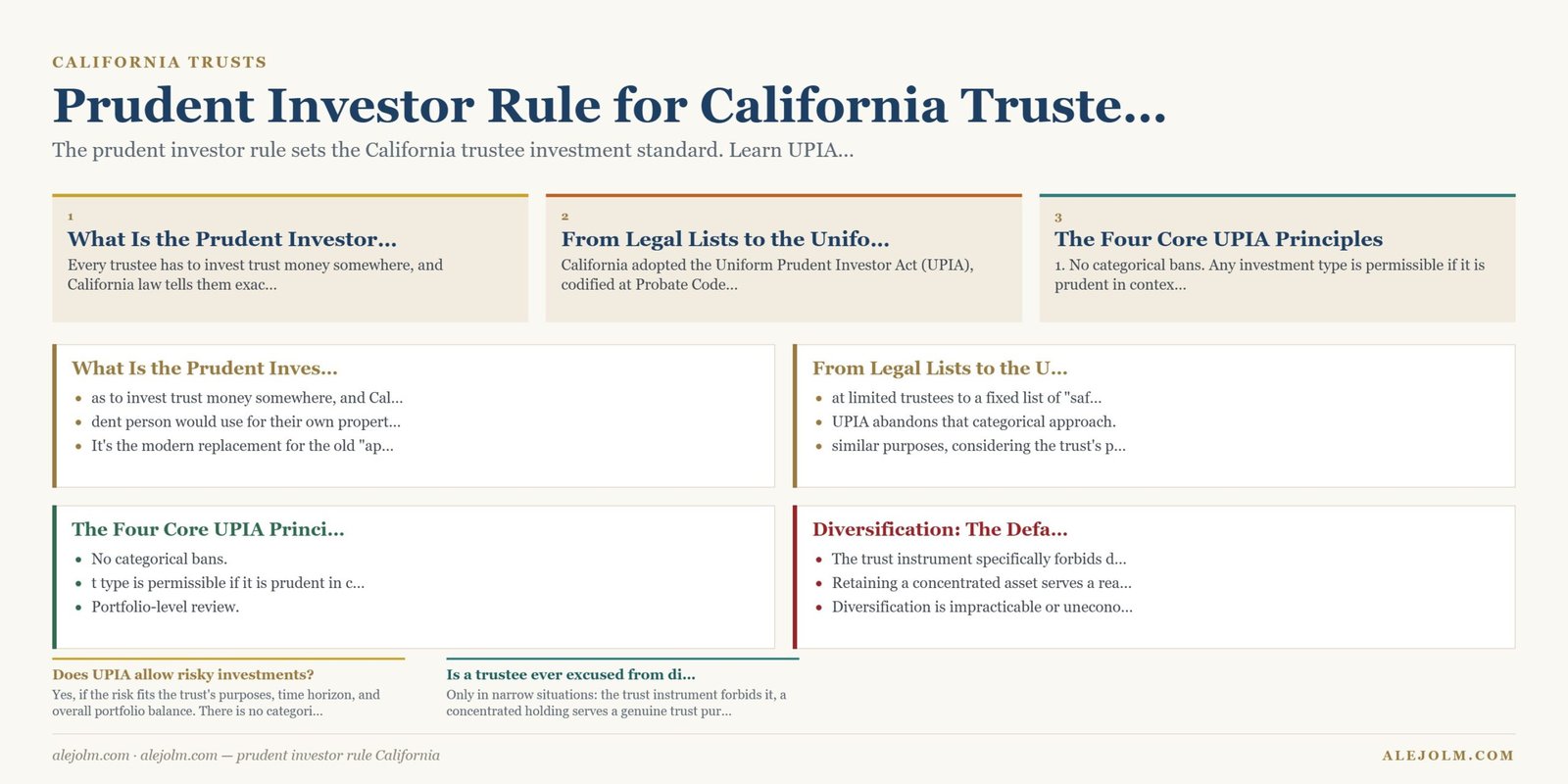
What Is the Prudent Investor Rule in California?
Every trustee has to invest trust money somewhere, and California law tells them exactly how careful they have to be about it. The prudent investor rule requires a trustee to invest and manage trust assets with the skill and caution a prudent person would use for their own property, judged as a whole portfolio rather than investment by investment. It’s the modern replacement for the old “approved list” system.
This is one of the most heavily tested pieces of trustee duties California doctrine, because it combines a flexible standard with a hard-edged diversification requirement that trips up nearly every unprepared exam taker.
From Legal Lists to the Uniform Prudent Investor Act
California adopted the Uniform Prudent Investor Act (UPIA), codified at Probate Code §§ 16045–16053, replacing the historically rigid rule that limited trustees to a fixed list of “safe” investments — government bonds, first mortgages, and little else.
UPIA abandons that categorical approach. Under Probate Code § 16040, the trustee’s duty of care is measured against how a prudent person would manage similar property for similar purposes, considering the trust’s purposes, terms, distribution requirements, and other circumstances.
The Four Core UPIA Principles
- No categorical bans. Any investment type is permissible if it is prudent in context — including stocks, real estate, and even higher-risk assets.
- Portfolio-level review. Courts evaluate the whole portfolio’s risk and return, not any single holding in isolation.
- Diversification is required, unless the trustee reasonably determines diversification is inappropriate.
- Ongoing monitoring is mandatory. Prudence isn’t a one-time judgment call at the trust’s creation.
Diversification: The Default Rule Everyone Forgets
Diversification is the default and the exceptions are narrow. A trustee must diversify unless:
- The trust instrument specifically forbids diversification
- Retaining a concentrated asset serves a real trust purpose (a family business, a long-held family property)
- Diversification is impracticable or uneconomical
Holding 100% of trust assets in a single stock, a single piece of real estate, or a single asset class is a breach unless one of these narrow exceptions applies. The remedy is surcharge: the difference between what the concentrated portfolio earned and what a properly diversified portfolio would have earned.
Worked Example: The All-Real-Estate Trust
Trustee Dana manages a $2 million trust for the benefit of two beneficiaries with a 20-year horizon. Dana invests the entire corpus in a single commercial building. No trust language authorizes concentration, and the beneficiaries never agreed to it.
Three years later, the local commercial market drops 25%, and the trust has lost $500,000. Because Dana never diversified, this is a straightforward breach of fiduciary duty trustee liability under the prudent investor rule — no exception saves a single-asset, single-property concentration held purely for convenience. The surcharge would include the actual decline plus the difference between the building’s return and what a diversified portfolio with a similar risk profile would have earned over the same period.
The Special Skills Standard
A professional trustee — a bank, trust company, or investment advisor — is held to a higher standard than an ordinary person. If a trustee holds themselves out as having investment expertise, they must actually perform at that level. Claimed expertise raises the bar; it never excuses poor performance. Conversely, a layperson trustee can’t be held to expert standards they never claimed, though they still can’t fall below the baseline prudent person standard — if they lack the skill, they must hire it.
Delegation of Investment Authority
The old common-law rule generally barred a trustee from delegating investment decisions, on the theory the settlor chose that specific trustee’s personal judgment. UPIA reverses this. A California trustee may now delegate investment and management functions to a qualified agent, provided the trustee exercises reasonable care in:
- Selecting the agent
- Setting the scope and terms of the delegation
- Periodically monitoring the agent’s performance
If the trustee satisfies all three duties, the trustee is not liable for the agent’s investment decisions — liability shifts to the agent, who owes the trust a direct duty of reasonable care. A trustee who delegates carelessly, without vetting or monitoring, remains on the hook.
| Old Rule (Legal List) | Modern Rule (UPIA) |
|---|---|
| Approved investment categories only | Any investment permissible if prudent |
| Each investment judged individually | Whole portfolio judged together |
| Delegation generally barred | Delegation permitted with care |
| Static, one-time prudence | Continuous monitoring required |
Common Mistakes to Avoid
The recurring trap is treating a single bad investment as automatic breach, or a single good investment as automatic compliance — courts look at the whole portfolio. Students also forget the ongoing monitoring duty, assume professional status is protective rather than a higher bar, and wrongly apply the old no-delegation rule to modern UPIA fact patterns.
Frequently Asked Questions
Does UPIA allow risky investments?
Yes, if the risk fits the trust’s purposes, time horizon, and overall portfolio balance. There is no categorical ban on any asset class; prudence is judged in context, not by asset type alone.
Is a trustee ever excused from diversifying?
Only in narrow situations: the trust instrument forbids it, a concentrated holding serves a genuine trust purpose, or diversification is impracticable. Absent one of these, concentration is a breach.
Can a trustee hire a financial advisor to manage investments?
Yes. UPIA permits delegation of investment functions if the trustee reasonably selects, scopes, and monitors the agent. Proper delegation shifts direct liability for investment decisions to the agent.
Key Takeaways
- California’s prudent investor rule (UPIA) judges trustee investments as a whole portfolio, not asset by asset.
- Diversification is mandatory unless a narrow exception applies.
- Trustees must continuously monitor and adjust — prudence isn’t a one-time decision.
- Professional trustees are held to a higher standard tied to their claimed expertise.
- Delegation of investment authority is permitted if the trustee selects, scopes, and monitors the agent carefully.
This article is educational and is not legal advice. Consult a licensed California attorney about your situation.
Related guides
- trustee self-dealing in California
- duty of impartiality for California trustees
- principal and income allocation in California trusts
- trustee surcharge remedy in California
- trustee-duties