
What Is Exoneration of Liens in a California Will?
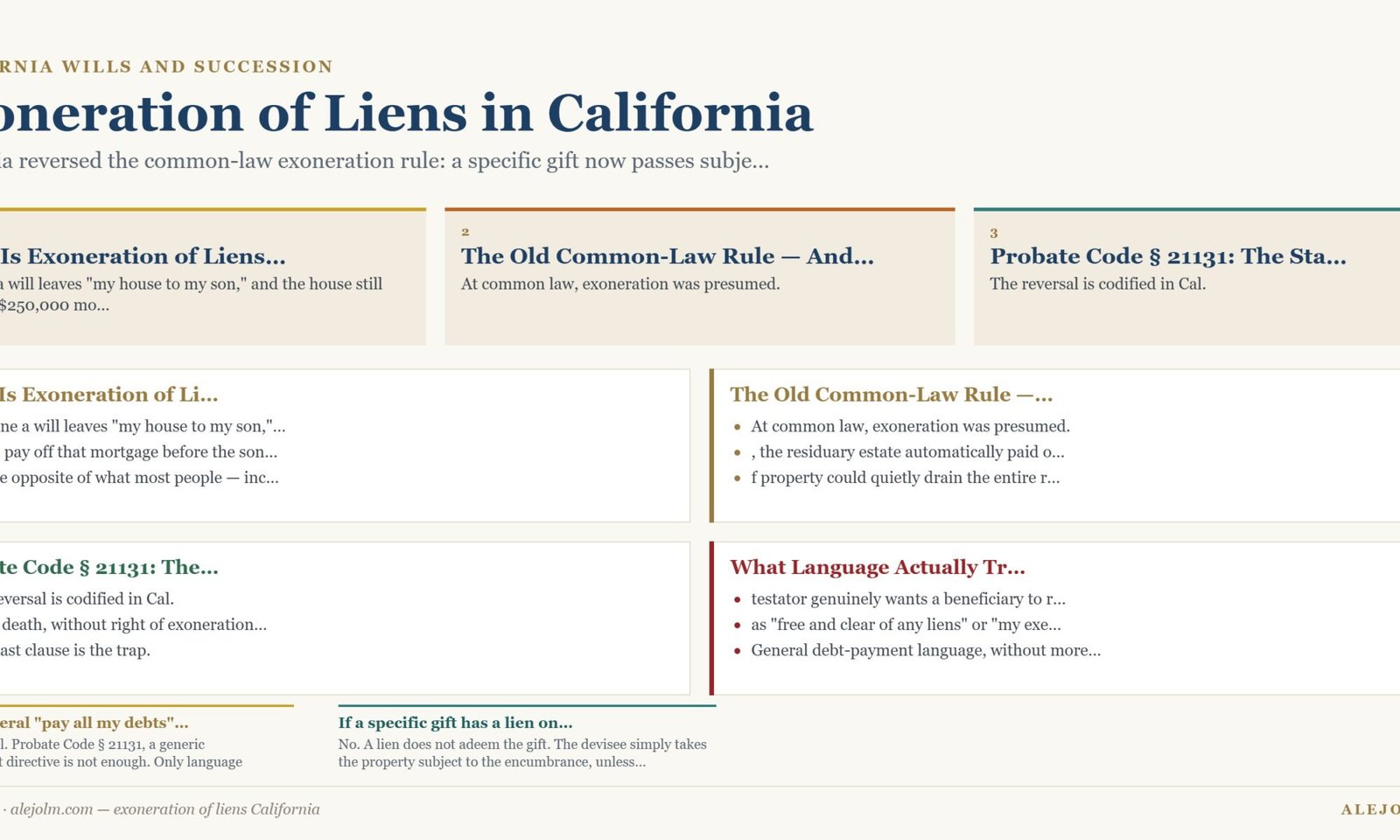
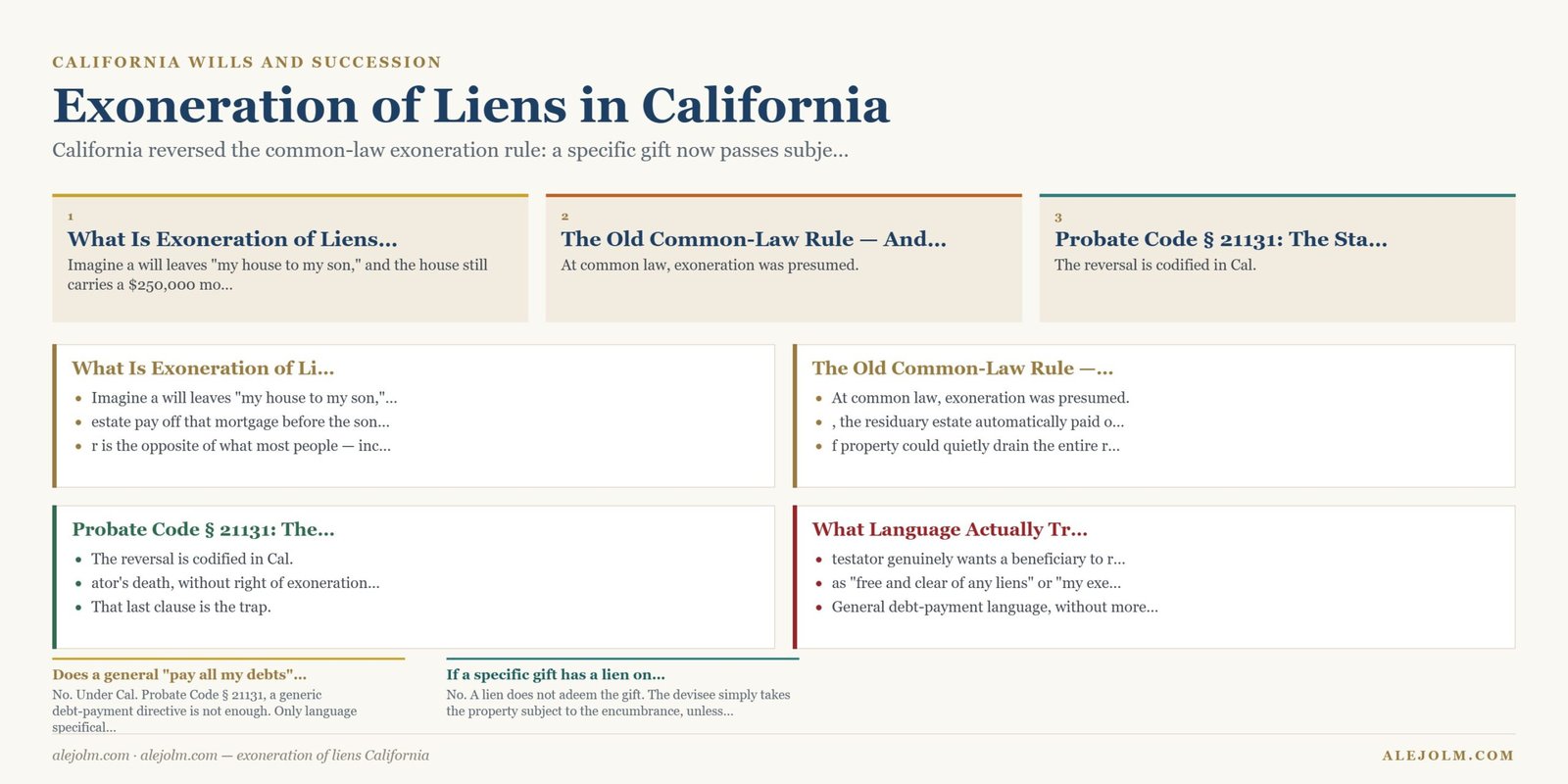
Imagine a will leaves “my house to my son,” and the house still carries a $250,000 mortgage at death. Does the estate pay off that mortgage before the son takes the house, or does the son inherit the house and the debt? This is the exoneration question, and California’s answer is the opposite of what most people — including many law students trained on the common-law default — assume.
Exoneration is the doctrine that would free a specific gift from an encumbrance, like a mortgage, by having the residuary estate pay it off. California has reversed the traditional presumption: today, a devisee takes a specific gift subject to the existing lien unless the will expressly says otherwise.
The Old Common-Law Rule — And Why California Rejected It
At common law, exoneration was presumed. If you specifically devised mortgaged property, the residuary estate automatically paid off the debt, and the beneficiary received clean, unencumbered title. That rule made sense in an era of simpler estates, but it also meant a single mortgage on one piece of property could quietly drain the entire residuary estate, unfairly shortchanging the residuary beneficiaries.
California legislators reversed course. Under modern California law, there’s no more implied or presumed exoneration. The devisee takes the property exactly as it sat at death — mortgage and all — unless the will spells out something different.
Probate Code § 21131: The Statute That Changed Everything
The reversal is codified in Cal. Probate Code § 21131, which states that a specific gift passes subject to any mortgage, deed of trust, or other lien existing at the testator’s death, without right of exoneration, regardless of a general directive in the instrument to pay debts.
That last clause is the trap. A lot of wills include boilerplate language like “I direct my executor to pay all my just debts.” Under § 21131, that generic phrase is not enough to trigger exoneration. Courts treat it as referring to ordinary administration expenses — not to a mortgage secured against one specific asset.
What Language Actually Triggers Exoneration
If a testator genuinely wants a beneficiary to receive property free and clear, the will has to say so specifically. Language referencing the lien or the encumbered property directly — such as “free and clear of any liens” or “my executor shall pay off the mortgage on my house” — is what’s required. General debt-payment language, without more, will not do the job.
| Scenario | Result under California law |
|---|---|
| Will is silent on the mortgage | Devisee takes subject to the lien; no exoneration |
| Will says “pay all my just debts” (boilerplate) | Still no exoneration — too generic under § 21131 |
| Will says “free and clear of any liens, paid by my residuary estate” | Exoneration applies — the residue pays off the lien |
Worked Example: The Boilerplate Trap
A will contains two separate clauses: one leaves “my house to my son,” and a wholly different clause elsewhere states, “I direct my executor to pay all my just debts and funeral expenses.” At death, the house carries a $250,000 mortgage.
Analysis: The son takes the house subject to the mortgage. The generic “pay all my just debts” clause does not satisfy § 21131’s requirement of language specifically referencing the lien or the encumbered property. The son must either pay down the mortgage himself or accept the house encumbered by it — the residuary estate has no obligation to step in.
Variant: Suppose instead the will read, “I leave my house to my son, free of liens, to be paid by my residuary estate.” Analysis: This is the exception. The express, specific language overrides California’s default no-exoneration rule, and the residuary estate must pay off the mortgage so the son receives the house debt-free.
California Bar Exam Angle
This is a frequently inverted “gotcha” topic. Examinees trained instinctively on the traditional common-law default will often assume exoneration applies automatically — and get the answer backwards. In a California fact pattern, always start from the opposite assumption: no exoneration, unless the will contains express, specific language about the lien or the encumbered property.
FAQ
Does a general “pay all my debts” clause exonerate a mortgage on a specific gift in California?
No. Under Cal. Probate Code § 21131, a generic debt-payment directive is not enough. Only language specifically referencing the lien or the encumbered property triggers exoneration.
If a specific gift has a lien on it, does the gift fail?
No. A lien does not adeem the gift. The devisee simply takes the property subject to the encumbrance, unless the will expressly directs the residue to pay it off.
Is California’s exoneration rule the same as the common-law rule?
No — it’s the opposite. Common law presumed exoneration automatically. California Probate Code § 21131 reverses that: the modern default is no exoneration unless the will expressly says otherwise.
Key Takeaways
- California reversed the common-law exoneration presumption; the modern default is no exoneration.
- Under Cal. Probate Code § 21131, a devisee takes a specific gift subject to any mortgage or lien existing at death.
- A general “pay all my just debts” clause is not enough to trigger exoneration — the will must specifically reference the lien or the encumbered property.
- A lien on a specific gift does not cause ademption; the beneficiary simply takes the property encumbered.
- Always assume no exoneration in a California fact pattern unless you spot express, specific will language directing the residue to pay off the debt.
This article is educational and is not legal advice. Consult a licensed California attorney about your situation.