
What Are the Types of Gifts in a California Will?
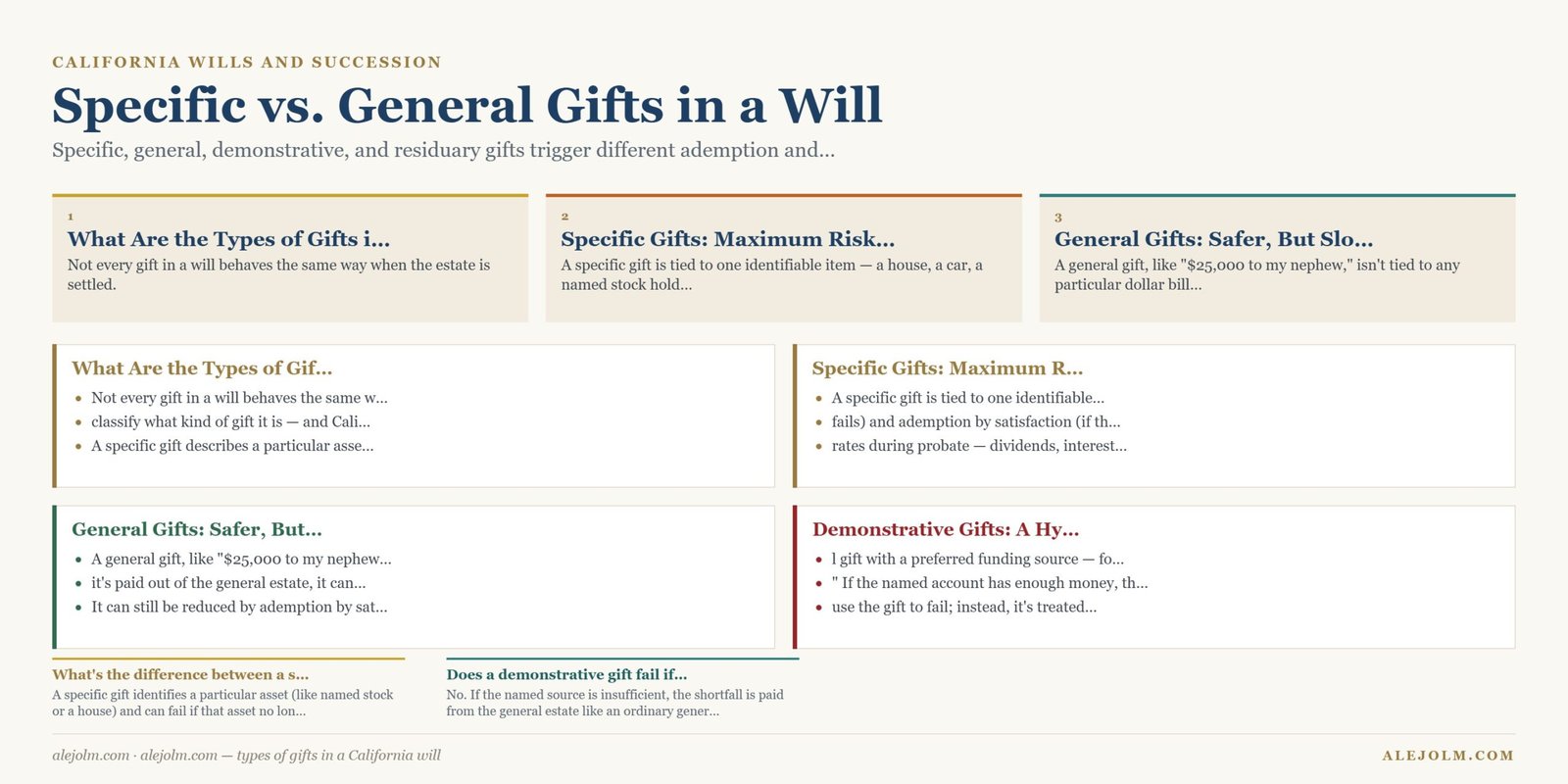
Not every gift in a will behaves the same way when the estate is settled. Before you can answer whether a gift survives, shrinks, or earns interest, you first have to classify what kind of gift it is — and California recognizes four categories with meaningfully different rules.
A specific gift describes a particular asset (“my shares of Beta Corp”). A general gift is payable from general estate funds, typically a dollar amount. A demonstrative gift is a general gift meant to be paid primarily from a named source. A residuary gift catches everything left over after the other gifts are satisfied.
Getting this classification right is a threshold step on nearly every wills question that touches ademption, abatement, or probate-period income — get the category wrong, and the rest of your analysis collapses.
Specific Gifts: Maximum Risk, Maximum Reward
A specific gift is tied to one identifiable item — a house, a car, a named stock holding, a piece of jewelry. Because the gift is so specific, it is exposed to both major failure doctrines: ademption by extinction (if the item is sold, destroyed, or given away before death, the gift typically fails) and ademption by satisfaction (if the testator already gave that asset to the beneficiary during life).
The upside is income: a specific gift is entitled to all post-death income the asset generates during probate — dividends, interest, rents — from the date of death forward, not just from distribution.
General Gifts: Safer, But Slower to Pay Interest
A general gift, like “$25,000 to my nephew,” isn’t tied to any particular dollar bill or account. Because it’s paid out of the general estate, it can’t be adeemed by extinction — there’s no specific item to disappear. It can still be reduced by ademption by satisfaction if the testator made a qualifying lifetime advancement.
General gifts earn statutory interest, but not immediately — interest begins accruing one year after the testator’s death, reflecting the assumption that ordinary estate administration should wrap up within that window.
Demonstrative Gifts: A Hybrid With a Safety Net
A demonstrative gift is a general gift with a preferred funding source — for example, “$20,000 from my First Bank savings account to my sister.” If the named account has enough money, the gift is paid from it. If the account falls short, the shortfall doesn’t cause the gift to fail; instead, it’s treated like an ordinary general gift and paid from the rest of the estate.
This hybrid treatment is what makes demonstrative gifts a favorite California Bar Exam trap — students often assume that an insufficient named source means the whole gift adeems, which is wrong.
Residuary Gifts: What’s Left Over
A residuary gift — “the rest of my estate to my children” — picks up everything the will doesn’t otherwise dispose of. Ademption doesn’t apply to residuary gifts because there’s no specific asset to lose. Residuary beneficiaries also don’t earn separate probate-period interest; they simply receive whatever remains once every other gift and debt is settled.
| Gift type | Example language | Ademption exposure | Probate-period income |
|---|---|---|---|
| Specific | “my shares of Beta Corp” | Extinction and satisfaction | All post-death income from the asset |
| General | “$25,000 to my nephew” | Satisfaction only | Statutory interest starting one year after death |
| Demonstrative | “$20,000 from my First Bank account” | Hybrid — shortfall pays like a general gift | Income from the source, or general-gift rule if insufficient |
| Residuary | “the rest of my estate” | Not applicable | None — takes whatever remains |
Worked Example: The Underfunded Bank Account
Consider a will that reads: “I leave $20,000, to be paid first from my savings account at First Bank, to my nephew.” At the testator’s death, that account holds only $5,000.
Analysis: This is a demonstrative gift — a general dollar amount tied to a named, preferred source. The $5,000 in the account satisfies part of the gift. The remaining $15,000 shortfall doesn’t cause the gift to adeem; instead, it’s paid from the general estate exactly like an ordinary general gift would be. The nephew still receives the full $20,000, just from two different sources.
Why This Matters Beyond the Bar Exam
This isn’t only academic. If you’re drafting or reading a California will, knowing how a gift is classified tells you what happens if the named asset is sold before death, how long a beneficiary has to wait for a distribution, and whether interest accrues while the estate winds through probate. Executors use this classification to decide payment order when the estate runs short — which connects directly to California’s abatement rules.
California Bar Exam Angle
Classification questions are frequently the hidden first step in a longer fact pattern about ademption or abatement. Before analyzing whether a gift failed or shrank, always ask: what type of gift is this? The same set of facts — an asset sold before death, income earned during a long probate — produces very different answers depending on whether you’re looking at a specific gift or a general one.
FAQ
What’s the difference between a specific gift and a general gift in a California will?
A specific gift identifies a particular asset (like named stock or a house) and can fail if that asset no longer exists at death. A general gift is a dollar amount payable from the general estate and cannot be adeemed by extinction, only reduced by lifetime advancements.
Does a demonstrative gift fail if the named account runs out of money?
No. If the named source is insufficient, the shortfall is paid from the general estate like an ordinary general gift — the gift does not adeem for lack of funds in the specified account.
When does a residuary beneficiary start earning interest on their gift?
Never, in the way specific and general gifts do. Residuary beneficiaries simply receive whatever remains in the estate after specific, general, and demonstrative gifts and all debts are paid — there is no separate interest entitlement.
Key Takeaways
- California recognizes four gift categories: specific, general, demonstrative, and residuary — each with different rules.
- Specific gifts risk both ademption by extinction and by satisfaction, but earn all post-death income from the asset.
- General gifts can only be reduced by satisfaction and earn statutory interest starting one year after death.
- Demonstrative gifts are hybrids: an insufficient named source triggers general-gift treatment for the shortfall rather than failure of the gift.
- Residuary gifts aren’t subject to ademption and receive no separate interest — they take whatever is left.
This article is educational and is not legal advice. Consult a licensed California attorney about your situation.
Related guides
- abatement in California wills
- exoneration of liens in California
- life estate and remainder in a will