
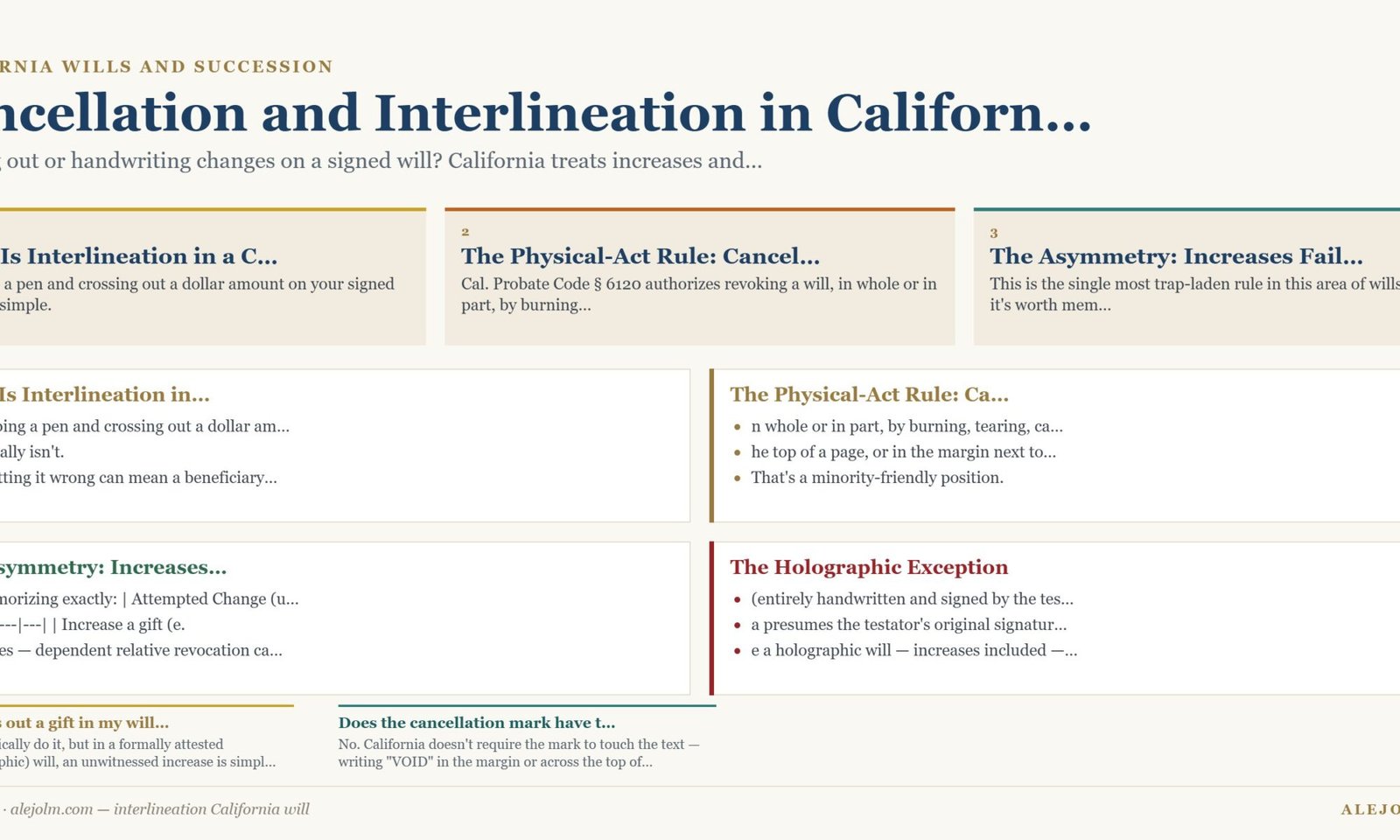
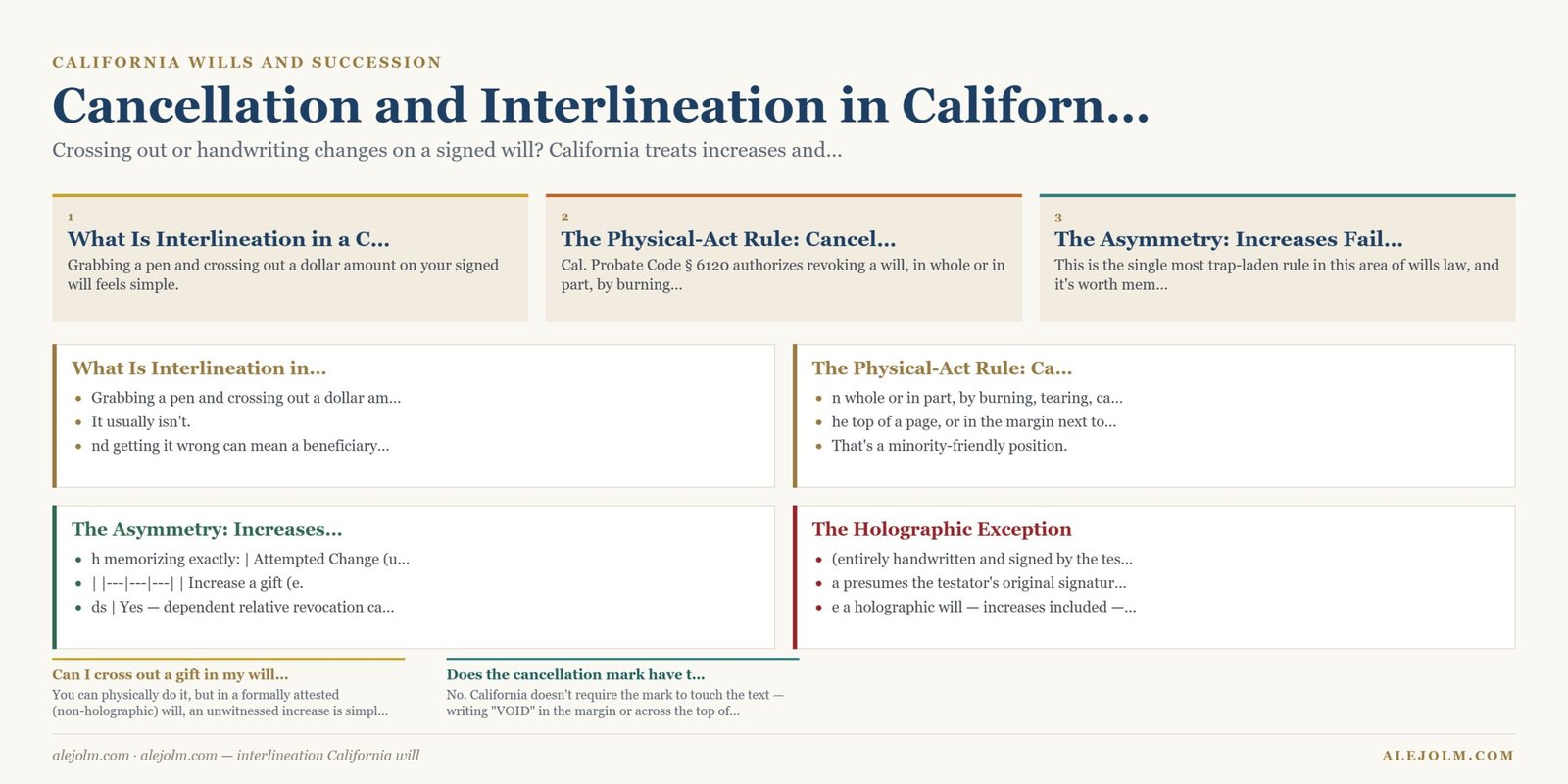
What Is Interlineation in a California Will?
Grabbing a pen and crossing out a dollar amount on your signed will feels simple. It usually isn’t. California draws a sharp — and asymmetrical — line between crossing something out and writing something in, and getting it wrong can mean a beneficiary receives nothing at all instead of what the testator actually wrote.
Interlineation is writing new text into an already-executed will — above, below, or between existing lines — without re-signing or re-witnessing the document. Cancellation (including obliteration) is the opposite: crossing out, defacing, or marking through a clause, such as writing “VOID” across it. Both are informal edits, and California treats them very differently depending on what they try to do.
The Physical-Act Rule: Cancellation Doesn’t Need to Touch the Words
Cal. Probate Code § 6120 authorizes revoking a will, in whole or in part, by burning, tearing, canceling, obliterating, or destroying it, done with intent to revoke. California courts have held that a cancellation mark doesn’t need to physically touch the will’s text to be effective — an “X” or “VOID” written across the top of a page, or in the margin next to a clause, works fine as long as intent to revoke is otherwise clear.
That’s a minority-friendly position. Several other states require the cancellation mark to actually strike through or deface the text itself. If you’re working a multistate bar-exam fact pattern rather than a purely California one, don’t assume the no-touching rule automatically applies — flag the jurisdiction.
The Asymmetry: Increases Fail Differently Than Decreases
This is the single most trap-laden rule in this area of wills law, and it’s worth memorizing exactly:
| Attempted Change (unwitnessed, non-holographic will) | What Happens | Is DRR Available? |
|---|---|---|
| Increase a gift (e.g., “$10,000” changed to “$15,000”) | Increase is invalid; original amount stands | Yes — dependent relative revocation can preserve testator intent if relevant |
| Decrease a gift (e.g., “$10,000” changed to “$2,000”) | Decrease is invalid, and the entire gift lapses | No — DRR does not rescue the original amount |
| Canceling one co-beneficiary’s share to boost another’s | Prohibited outright; the canceled share passes to residue or intestacy | — |
Why the asymmetry? An unwitnessed increase is exactly the kind of unsupervised enhancement the Wills Act’s formalities exist to prevent, so courts simply ignore it and enforce the original, validly executed amount. An unwitnessed decrease is different: California treats it as a partial cancellation of that gift, which is itself a form of revocation under § 6120 — and once a gift is canceled, the testator’s last validly expressed word on that clause disappears with it. Dependent relative revocation doesn’t apply because the handwritten decrease, though ineffective to reduce the gift, still represents the testator’s most recent intent to change that clause — not a mistaken belief that would trigger DRR.
The Holographic Exception
If the will is holographic (entirely handwritten and signed by the testator, with no witnesses required), the rules loosen considerably. California presumes the testator’s original signature is re-adopted at the time of any later handwritten interlineation. That means a testator can genuinely update a holographic will — increases included — through additional handwriting, without executing a formal codicil.
There’s a second escape hatch that applies even to a formally attested (non-holographic) will: if the new handwritten language, standing entirely on its own, satisfies every element of a valid holographic codicil (material terms and signature all in the testator’s own handwriting), it can take effect as an independent codicil, rather than as a failed alteration of the original document.
Worked Example: The Niece’s Disappointing Discovery
Testator Elena’s formally attested will states: “I leave $10,000 to my niece, Sofia.” Two years later, upset after an argument, Elena crosses out “$10,000” and writes “$2,000” in the margin, without re-signing or having witnesses present. Elena dies without further changes.
Does Sofia get $2,000, $10,000, or nothing? The interlineation is a decrease, and it’s invalid because it was never re-executed with witnesses. Under the asymmetrical rule, that doesn’t mean Sofia falls back to the original $10,000 — the entire gift lapses. Sofia takes nothing from that clause; the $10,000 (or $2,000, or any figure) drops into the residuary clause or, if there isn’t one, passes by intestacy.
Now flip the facts: Elena instead crosses out “$10,000” and writes “$15,000,” intending to increase Sofia’s gift. That increase is invalid too — but here, the original $10,000 gift survives untouched, because an invalid increase simply gets disregarded rather than treated as a cancellation of the whole clause. Sofia gets $10,000.
Confirming What You’re Even Looking At
Before applying the increase/decrease framework, confirm what kind of act actually occurred. Cancellation is governed directly by § 6120’s physical-act revocation rule — intent plus a qualifying act (burning, tearing, canceling, obliterating, destroying). Interlineation is different: it’s not one of § 6120’s enumerated revocatory acts at all. It’s an attempted, unwitnessed amendment, which is why it fails unless it’s re-executed or independently qualifies as a holographic codicil.
Frequently Asked Questions
Can I cross out a gift in my will and write in a new amount without a lawyer?
You can physically do it, but in a formally attested (non-holographic) will, an unwitnessed increase is simply disregarded and an unwitnessed decrease can wipe out the entire gift. To change a gift amount reliably, execute a formal codicil or new will.
Does the cancellation mark have to cross out the actual words in California?
No. California doesn’t require the mark to touch the text — writing “VOID” in the margin or across the top of a page is effective if your intent to revoke is otherwise clear. Some other states do require the mark to touch the text, so this can matter on multistate facts.
What if my will is entirely handwritten?
Holographic wills get more flexibility. California presumes a testator’s signature is re-adopted for later handwritten interlineations, so genuine updates — including increases — can take effect without a formal codicil.
Key Takeaways
- Cancellation in California doesn’t need to physically touch the will’s words — a “VOID” in the margin can be enough if intent to revoke is clear.
- An invalid increase by interlineation is disregarded; the original gift amount stands.
- An invalid decrease by interlineation causes the entire gift to lapse — dependent relative revocation does not rescue the original figure.
- Holographic wills get special treatment: the testator’s signature is presumed re-adopted for later handwritten changes.
- A handwritten addition can independently qualify as a valid holographic codicil, even inside a formally attested will.
This article is educational and is not legal advice. Consult a licensed California attorney about your situation.
Related guides
- duplicate original wills
- will reformation and mistake in a will
- lost or mutilated wills
- will execution requirements