
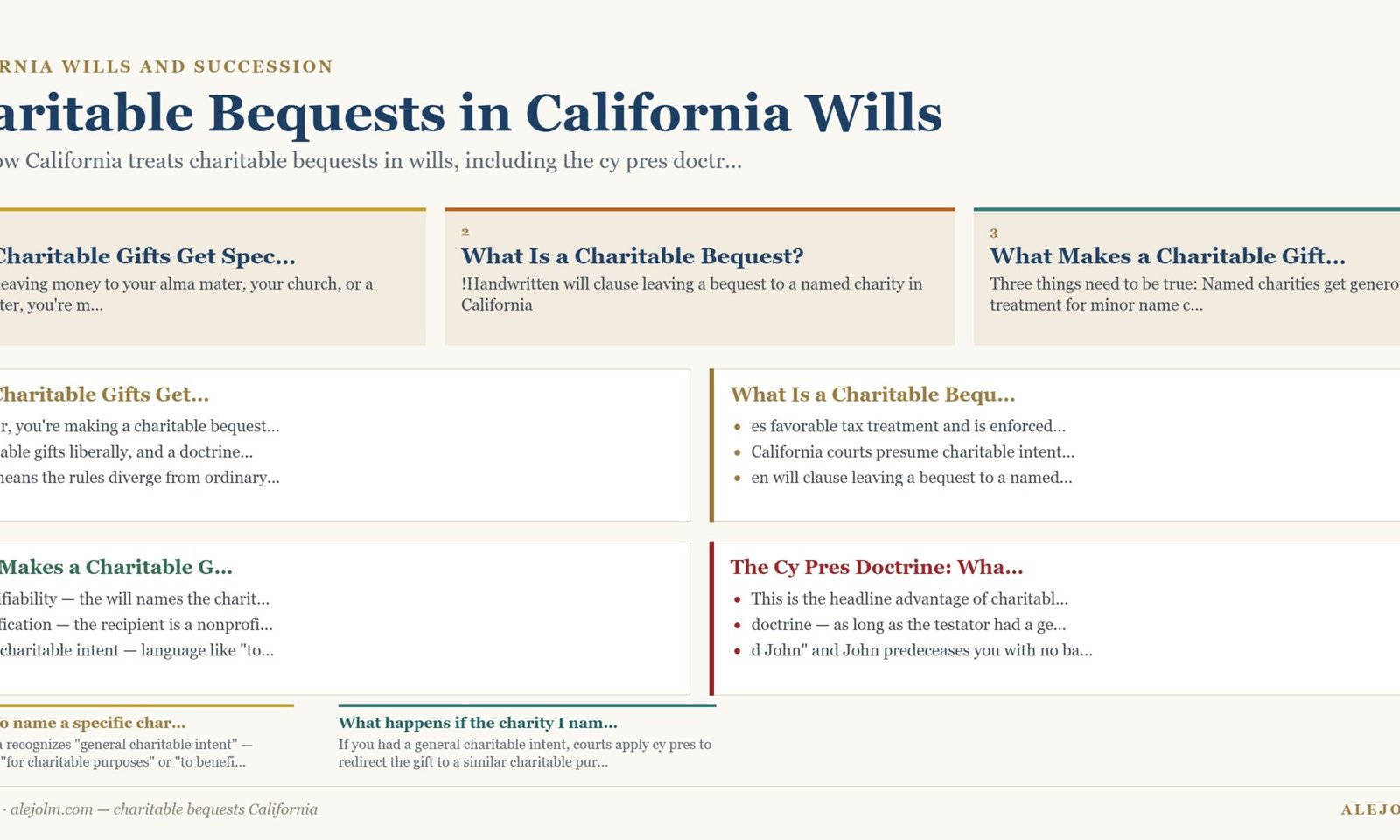

Why Charitable Gifts Get Special Treatment in California
If you’re leaving money to your alma mater, your church, or a local shelter, you’re making a charitable bequest — and California law is unusually generous about protecting it. Courts read charitable gifts liberally, and a doctrine called cy pres can save a gift that would otherwise fail completely.
That’s good news for testators, but it also means the rules diverge from ordinary gifts to individuals in ways the California Bar Exam tests heavily. Here’s what makes a charitable bequest valid, and what happens when the charity you named no longer exists.
What Is a Charitable Bequest?
A charitable bequest is a gift in a will to a qualifying nonprofit, religious, or educational organization, which receives favorable tax treatment and is enforced even where a similar gift to an individual might fail for vagueness. California courts presume charitable intent and interpret ambiguous charitable language in favor of validity.
What Makes a Charitable Gift Valid
Three things need to be true:
- Identifiability — the will names the charity, or describes a general charitable purpose clearly enough to identify one.
- Qualification — the recipient is a nonprofit, typically tax-exempt under IRC Section 501(c)(3), or a qualifying religious institution.
- Clear charitable intent — language like “to Charity” or “for charitable purposes” is enough; you don’t need magic words.
Named charities get generous treatment for minor name changes too. A gift “to the Red Cross” still reaches the American Red Cross even if the organization’s formal name has shifted over the decades.
The Cy Pres Doctrine: What Happens If the Charity Closes
This is the headline advantage of charitable gifts. If the named charity no longer exists, or the specific purpose becomes impossible, a court can redirect the gift to a similar charitable purpose under the cy pres doctrine — as long as the testator had a general charitable intent, not a narrow, one-recipient-only intent.
Compare that to a gift to an individual: if you leave $50,000 “to my friend John” and John predeceases you with no backup named, the gift simply lapses to the residuary or to intestacy. No court substitutes a new friend. Charities get a second chance that individuals don’t.
Cy Pres vs. Equitable Deviation — Don’t Confuse Them
These two doctrines get mixed up constantly on the bar exam:
| Doctrine | What It Changes | Statute |
|---|---|---|
| Cy pres | The charitable purpose, when it becomes impossible or impracticable | Common-law doctrine |
| Equitable deviation | Administrative or investment terms, purpose stays the same | Probate Code § 15409 |
A trust that says “invest only in railroad bonds,” written when that made sense, calls for equitable deviation once railroad bonds stop being viable — the purpose (say, funding scholarships) is untouched. A trust to “cure yellow fever,” written before the disease was eradicated, calls for cy pres — the purpose itself needs redirecting.
No Mortmain Restriction in California
Some older legal systems restricted “deathbed” gifts to charity, on the theory a dying person might be pressured by religious guilt. California’s mortmain statute was repealed decades ago. There is no special rule limiting a charitable bequest made shortly before death — a last-minute gift to charity is scrutinized under ordinary undue-influence and capacity rules, not a charity-specific one. This is a commonly tested negative: don’t assume a deathbed gift to charity is automatically suspect.
Worked Example: The Nephew and the Red Cross
Elena’s will states: “I leave my house to my nephew Marco, unless Marco predeceases me, in which case it goes to Riverside Animal Rescue.” It also states: “$10,000 to the Red Cross.” Marco dies before Elena. By the time Elena dies, the Red Cross has legally renamed itself the American Red Cross, and the organization confirms it’s the same successor entity.
Analysis: Marco’s gift lapses because he predeceased Elena, but the will names an express alternative — Riverside Animal Rescue — so the house goes there instead of falling into a general lapse analysis. The $10,000 gift is unaffected by the Red Cross’s name change; California courts read the reference liberally and treat the American Red Cross as the intended, identifiable recipient. Result: house to Riverside Animal Rescue, $10,000 to the American Red Cross.
Tax Benefits of Charitable Bequests
Charitable gifts carry a real financial incentive. Under IRC Section 2055, a bequest to a qualifying charity gets an unlimited federal estate tax deduction — it’s subtracted dollar-for-dollar from the taxable estate. Leave $1,000,000 to charity out of a $4,000,000 estate, and only $3,000,000 is taxable. Gifts to political organizations or non-qualifying entities don’t get this treatment, so the underlying recipient’s tax status matters.
Conditional and Split Charitable Gifts
You can condition a charitable gift — “$100,000 to the university, for marine biology scholarships” — and courts will enforce a reasonable condition. If it becomes impossible (the program shuts down), cy pres redirects it to something similar. You can also split a gift, like a life estate to a family member with the remainder to charity: “my house to my niece for life, remainder to the Red Cross.” The charity’s remainder interest gets the same favorable rules, including cy pres if the named charity later fails.
Frequently Asked Questions
Do I have to name a specific charity in my California will?
No. California recognizes “general charitable intent” — language like “for charitable purposes” or “to benefit the poor” is sufficient, even without naming a specific organization.
What happens if the charity I named goes out of business before I die?
If you had a general charitable intent, courts apply cy pres to redirect the gift to a similar charitable purpose. If your intent was narrowly limited to that one organization only, the gift may fail instead.
Is a charitable gift made right before death legally risky in California?
Not specifically. California repealed its mortmain restriction long ago. A deathbed charitable gift is evaluated under the same capacity and undue-influence rules as any other gift, with no extra suspicion attached just because it’s charitable.
Key Takeaways
- A valid charitable bequest needs an identifiable, qualified charity and clear charitable intent — general charitable purpose language is enough.
- The cy pres doctrine lets courts redirect a failed charitable gift to a similar purpose, an advantage individual gifts don’t have.
- Cy pres changes the charitable purpose; equitable deviation (Probate Code § 15409) changes only administrative or investment terms.
- California has no live mortmain statute — deathbed charitable gifts aren’t presumptively suspect.
- Charitable bequests get an unlimited federal estate tax deduction under IRC Section 2055.
This article is educational and is not legal advice. Consult a licensed California attorney about your situation.
Related guides
- will execution requirements
- incorporation by reference in California wills
- codicils and republication
- pretermitted child in California