
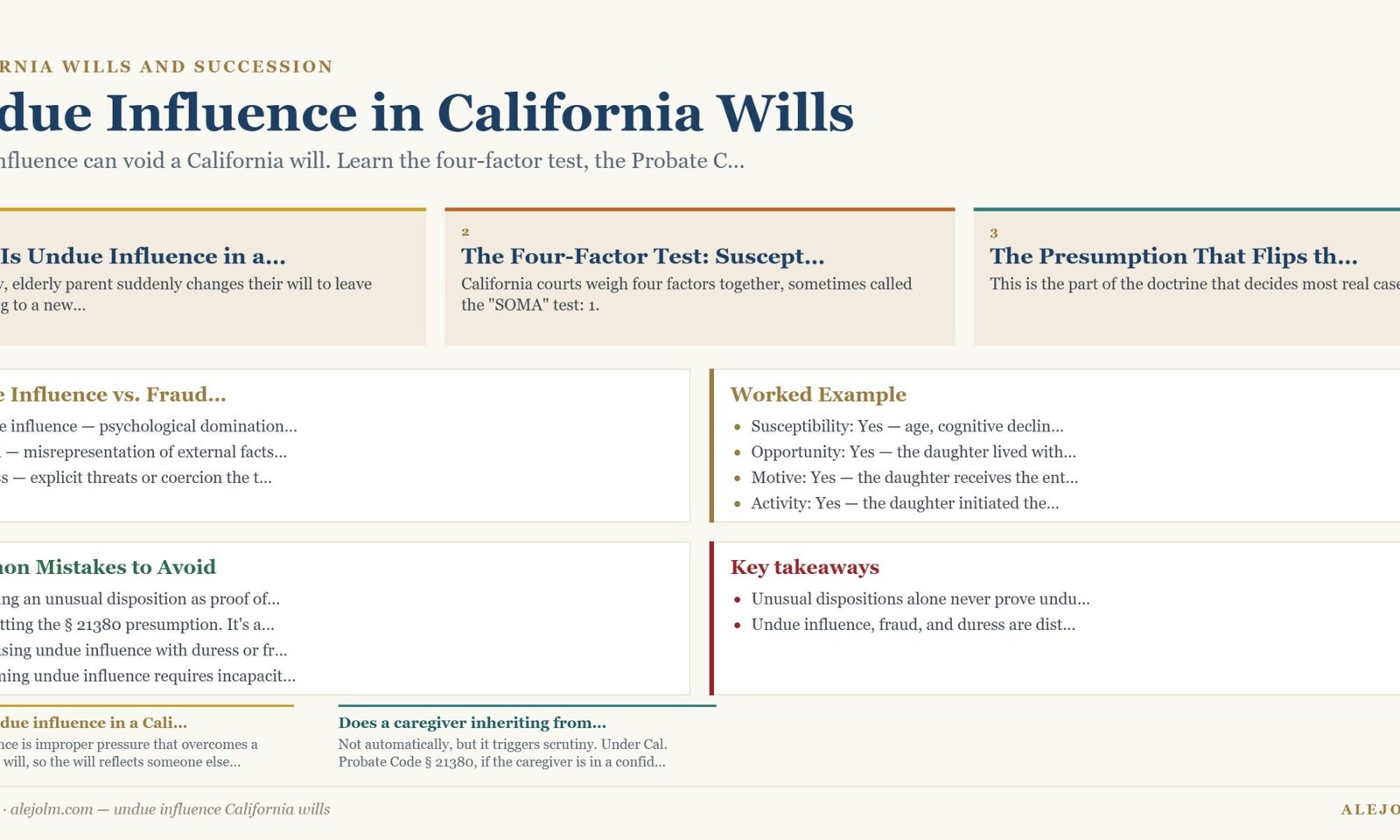
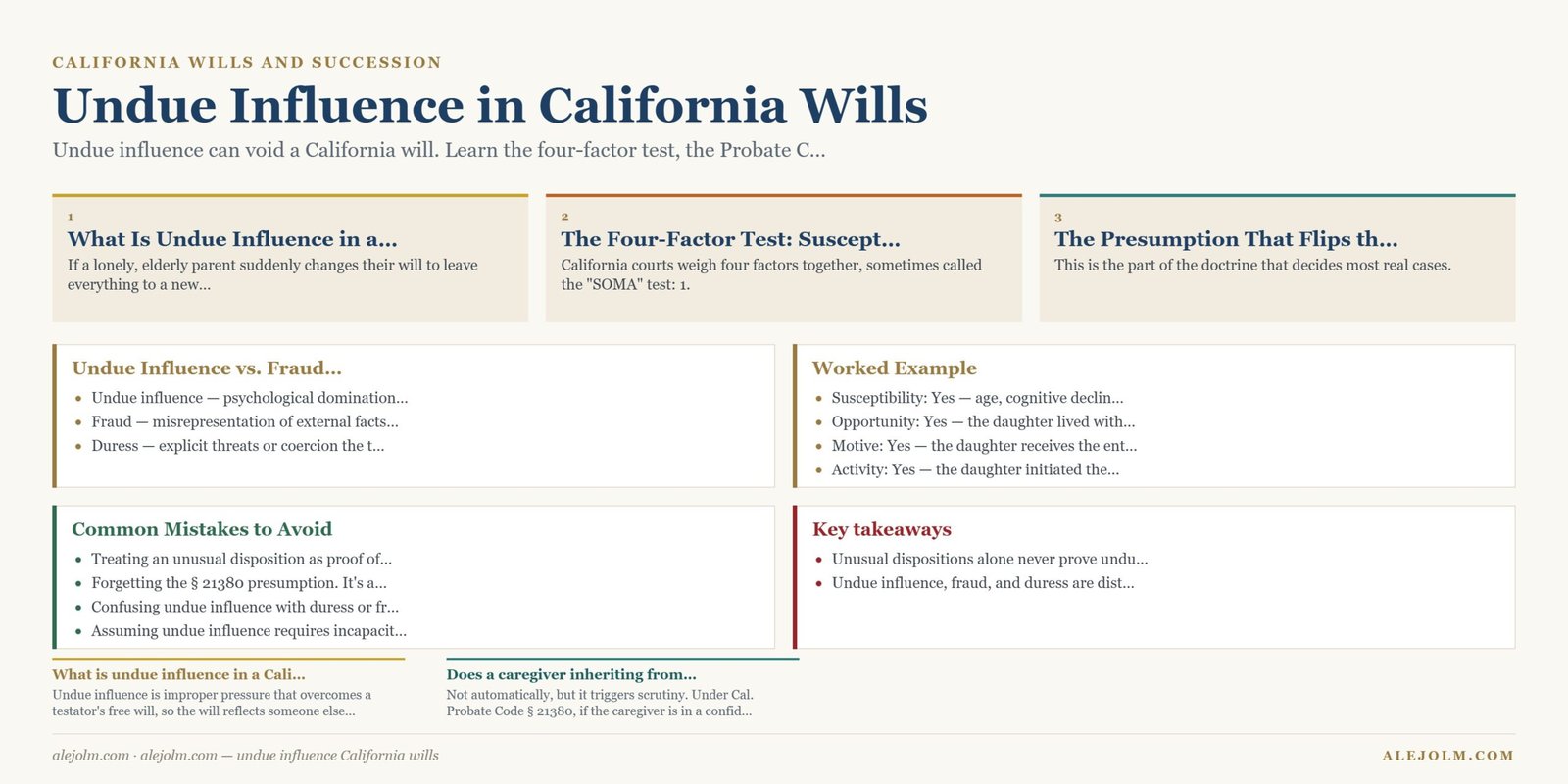
What Is Undue Influence in a California Will?
If a lonely, elderly parent suddenly changes their will to leave everything to a new caregiver — cutting out children who were there for decades — something may be wrong. That “something” often has a name in California law: undue influence. It’s one of the most heavily litigated will-contest grounds in the state, and it’s tested constantly on the California Bar Exam, usually side-by-side with fraud and testamentary capacity.
Undue influence, defined: improper pressure exerted on a testator that overpowers their free will, so that the will they sign reflects the influencer’s wishes rather than their own genuine intent — even though the testator may have full mental capacity.
The Four-Factor Test: Susceptibility, Opportunity, Motive, Activity
California courts weigh four factors together, sometimes called the “SOMA” test:
- Susceptibility — the testator’s vulnerability: advanced age, isolation, recent bereavement, cognitive decline, illness, or dependence.
- Opportunity — the influencer had access to the testator, especially alone or during vulnerable moments.
- Motive — the influencer stood to gain financially or by displacing other heirs.
- Activity — what the influencer actually did: initiating changes, choosing the attorney, being present at execution, isolating the testator from family.
No single factor decides the case. A live-in caregiver who suggests the testator change the will, arranges the drafting attorney, and is the only person present at signing, for an isolated and recently widowed 95-year-old, checks every box.
The Presumption That Flips the Burden
This is the part of the doctrine that decides most real cases. Under Cal. Probate Code § 21380, when a beneficiary who stands in a confidential relationship with the testator (caregiver, attorney, spiritual advisor, or certain fiduciaries) receives a substantial benefit under the will, a presumption of fraud or undue influence arises automatically. Once triggered, the burden flips: the beneficiary must rebut the presumption with clear and convincing evidence that the gift was freely given, the testator had independent advice, and the decision was informed.
Notably, § 21380(b) exempts certain relatives and cohabitants from this presumption — California is targeting predatory non-family caretakers and drafters, not ordinary family bequests to a spouse or child.
| Scenario | Who Bears the Burden | Standard |
|---|---|---|
| No confidential relationship / no substantial benefit | Challenger proves undue influence | Clear and convincing evidence |
| Confidential relationship + substantial benefit (§ 21380) | Beneficiary must rebut the presumption | Clear and convincing evidence |
Undue Influence Doesn’t Require an Unfair Result
Here’s the twist that trips up nearly everyone, including law students: an unusual disposition alone is never proof of undue influence. Testators have an absolute right to exclude family, favor one child over another, or leave everything to a stranger or a charity. If a testator of sound mind independently chooses to disinherit their children in favor of a cause they believe in, that’s not undue influence — it’s testamentary freedom. The unusual disposition only prompts closer inquiry; it doesn’t, by itself, prove the testator’s will was overborne.
Undue Influence vs. Fraud vs. Duress
These three grounds all void a will under Cal. Probate Code § 6104, but they attack different things:
- Undue influence — psychological domination and control that overrides free will, often subtle and built over time.
- Fraud — misrepresentation of external facts that the testator relies on.
- Duress — explicit threats or coercion the testator is aware of and fears.
A caregiver who says “if you don’t leave me the house, I’ll put you in a nursing home” is duress. One who systematically isolates the testator and tells them their family doesn’t care is undue influence. One who lies about a specific fact — “your son is in prison” — is fraud.
Worked Example
Facts: Testator, age 88, recently widowed, lives with her daughter. Her prior will split the estate equally among her three children. She suddenly executes a new will leaving everything to the daughter she lives with. The testator has declining cognitive function and depends on that daughter for her medications. The will was drafted by a lawyer friend of the daughter, at the daughter’s request, and signed with only the daughter present as witness — no independent witnessing.
Analysis:
- Susceptibility: Yes — age, cognitive decline, isolation, recent loss of spouse.
- Opportunity: Yes — the daughter lived with her, controlled her medications, and was present at signing.
- Motive: Yes — the daughter receives the entire estate.
- Activity: Yes — the daughter initiated the will change, chose the attorney, and controlled execution.
- A presumption of undue influence likely arises given the confidential caregiver relationship plus substantial benefit. The daughter would need clear and convincing evidence — independent legal advice, testator’s own uncoerced statements — to rebut it. Likely result: undue influence found, and the will (or the offending provision) is void.
Common Mistakes to Avoid
- Treating an unusual disposition as proof of undue influence. It only invites scrutiny — testators can be “eccentric.”
- Forgetting the § 21380 presumption. It’s a powerful, exam-favorite burden-shift for confidential relationships with substantial benefit.
- Confusing undue influence with duress or fraud. Each has distinct elements and evidence.
- Assuming undue influence requires incapacity. It doesn’t — a testator can have full testamentary capacity and still be a victim of undue influence.
FAQ
What is undue influence in a California will?
Undue influence is improper pressure that overcomes a testator’s free will, so the will reflects someone else’s wishes instead of the testator’s true intent. California courts weigh susceptibility, opportunity, motive, and activity to decide whether it occurred.
Does a caregiver inheriting from a client automatically mean undue influence?
Not automatically, but it triggers scrutiny. Under Cal. Probate Code § 21380, if the caregiver is in a confidential relationship with the testator and receives a substantial benefit, a presumption of undue influence arises, and the caregiver must rebut it with clear and convincing evidence.
Can I contest a will just because the disposition seems unfair?
No. Testators are legally free to disinherit family or favor one beneficiary. Unfairness alone isn’t undue influence — you need evidence the testator’s free will was actually overborne, such as isolation, dependence, and active procurement of the will by the beneficiary.
Key Takeaways
- Undue influence overrides testamentary capacity — a testator can be fully competent and still be a victim.
- California courts weigh susceptibility, opportunity, motive, and activity together; no single factor controls.
- Cal. Probate Code § 21380 presumes undue influence for confidential relationships with a substantial benefit, shifting the burden to the beneficiary.
- Unusual dispositions alone never prove undue influence — testators have a right to be eccentric.
- Undue influence, fraud, and duress are distinct grounds that require different evidence.
This article is educational and is not legal advice. Consult a licensed California attorney about your situation.
Related guides
- testamentary capacity in California
- fraud in California wills
- contesting a will in California
- California will execution requirements