
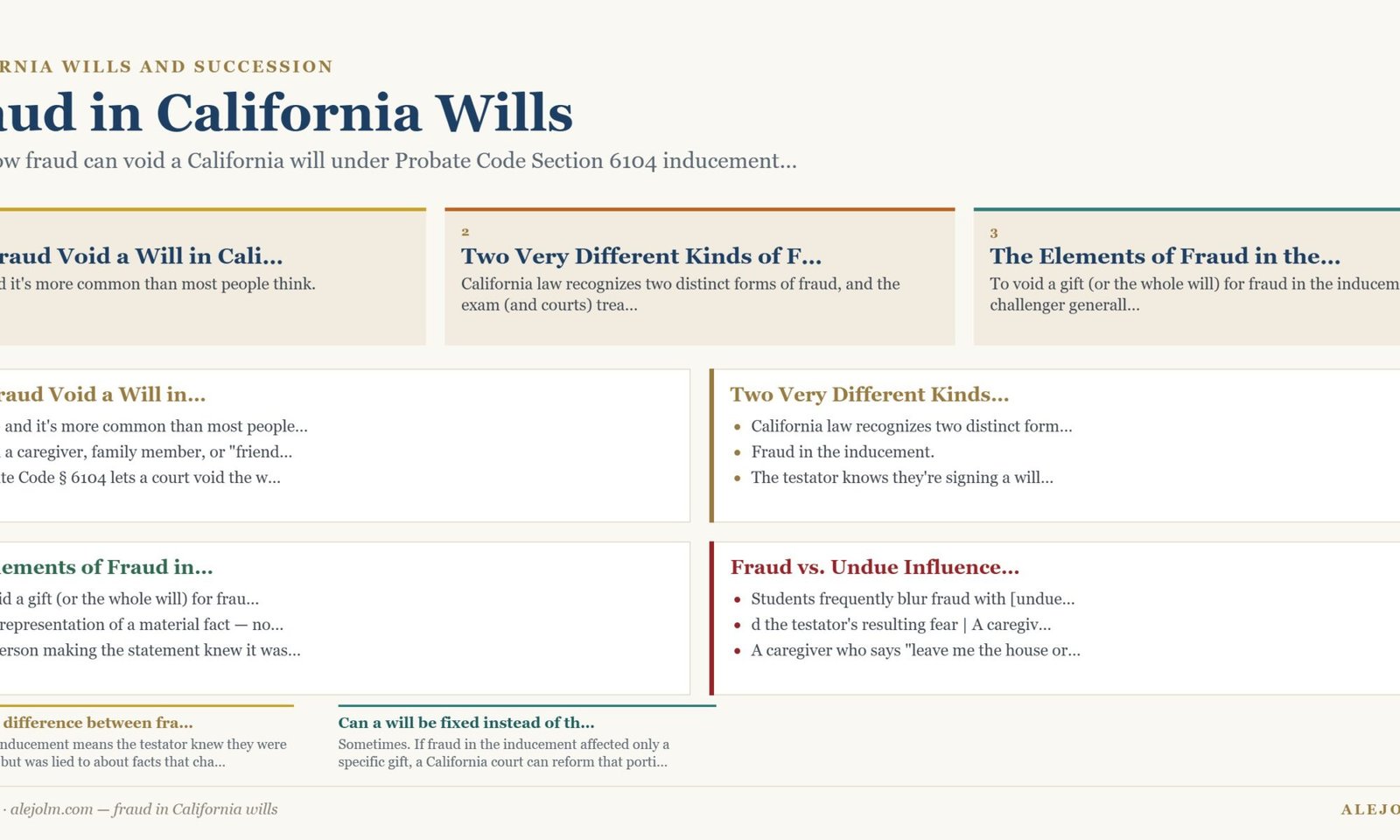

Can Fraud Void a Will in California?
Yes — and it’s more common than most people think. When a caregiver, family member, or “friend” lies to a testator to steer an inheritance, Cal. Probate Code § 6104 lets a court void the will, or the affected part of it. For California Bar Exam candidates, fraud is one of the classic will-contest grounds, usually paired with undue influence in the same hypo. For everyday readers, it’s a reminder that a will signed under false pretenses isn’t the final word.
Fraud in a will, defined: when someone knowingly misrepresents a material fact to a testator, intending the testator to rely on it, and the testator does rely on it — inducing them to execute a will, revoke one, or include or exclude a particular beneficiary they otherwise wouldn’t have.
Two Very Different Kinds of Fraud
California law recognizes two distinct forms of fraud, and the exam (and courts) treat them very differently.
Fraud in the inducement. The testator knows they’re signing a will, but someone lied to them about facts that changed their decision. Classic example: a caregiver tells the testator, “your daughter never visits and doesn’t care about you,” when in reality the daughter visits every week and the caregiver has been intercepting her calls. If the testator excludes the daughter because of that lie, the exclusion is voidable for fraud.
Fraud in the execution. This is more severe. The testator doesn’t even know they’re signing a will — they’re told it’s a power of attorney, a deed, or some other document. Because the testator never intended to make a will at all, the document is void regardless of what it says.
The Elements of Fraud in the Inducement
To void a gift (or the whole will) for fraud in the inducement, a challenger generally must show:
- A misrepresentation of a material fact — not an opinion, not a prediction.
- The person making the statement knew it was false (or acted with reckless disregard for the truth).
- Intent that the testator rely on it.
- The testator actually relied on it.
- The misrepresentation directly caused the specific testamentary decision.
That last element — causation — is where a lot of fraud claims fail. If a caregiver lied about a beneficiary but the testator included that beneficiary anyway, there’s no fraud as to that gift; the lie didn’t actually change anything.
Fraud vs. Undue Influence: Don’t Mix Them Up
Students frequently blur fraud with undue influence, but they’re built on different facts:
| Doctrine | What’s Being Attacked | Typical Evidence |
|---|---|---|
| Fraud | False external facts | The lie, its falsity, and testator’s reliance on it |
| Undue influence | Psychological pressure/domination | Susceptibility, opportunity, motive, activity of the influencer |
| Duress | Explicit threats or coercion | Threats and the testator’s resulting fear |
A caregiver who says “your family abandoned you” (a lie) is committing fraud. A caregiver who says “leave me the house or I’ll put you in a nursing home” is duress. A caregiver who gradually isolates the testator and pressures them without an explicit threat or a specific lie is undue influence. All three void a will under § 6104, but a challenger has to plead and prove the right one — or all three, if the facts support it.
Unilateral Mistake: Usually No Relief
What if nobody lied — the testator simply had it wrong? As a default rule, a testator’s unilateral mistake is not grounds to void or reform a will. If a testator writes a bequest to a beneficiary they mistakenly believe is alive, and no one deceived them, the gift simply lapses when it turns out the beneficiary predeceased them. The law won’t second-guess the testator’s own factual errors absent fraud.
There’s an important carve-out, though: mistake in the content of the will itself — a typo, a clerical error, a misdescription of a beneficiary or property — is treated differently from a mistake about outside facts. California allows courts to reform an unambiguous will if clear and convincing evidence shows both a drafting mistake and what the testator actually intended. Cal. Probate Code § 6111.5 also eases the evidentiary path by allowing extrinsic evidence to determine whether fraud or mistake affected the will.
Worked Example
Facts: A testator’s will leaves her house to her nephew, based on her caregiver’s false statement that “your nephew is the only relative who visits you.” In reality, her daughter visits frequently, but the caregiver has been keeping her away and hiding the visits. The testator has no idea her daughter has been coming by.
Analysis: The caregiver misrepresented a material fact (the daughter’s visits). The testator relied on it, believing her daughter didn’t care. The caregiver intended to deceive her in order to shape the disposition. And the false statement directly caused the testator to exclude her daughter from the will. Result: the will is voidable for fraud in the inducement. A court may void the exclusion entirely or reform the will to include the daughter, based on what the testator would likely have wanted absent the lie.
Common Mistakes to Avoid
- Treating inducement fraud and execution fraud as the same thing. Execution fraud voids the will outright, regardless of content; inducement fraud usually only taints the affected gift.
- Assuming a testator’s own mistaken belief is enough to void a will. It isn’t, absent fraud or a drafting error in the document itself.
- Skipping the causation element. Fraud only voids the gift the lie actually caused — not the entire estate plan by default.
- Confusing opinions with facts. “I think your son will let you down” isn’t fraud; “your son is in prison” (when false) is.
FAQ
What’s the difference between fraud in the inducement and fraud in the execution?
Fraud in the inducement means the testator knew they were signing a will but was lied to about facts that changed their decision. Fraud in the execution means the testator was tricked about what document they were even signing. Execution fraud is more severe and voids the entire will.
Can a will be fixed instead of thrown out because of fraud?
Sometimes. If fraud in the inducement affected only a specific gift, a California court can reform that portion of the will to reflect what the testator likely intended without the lie, rather than voiding the entire document.
Is a testator’s own mistaken belief enough to challenge a will?
Generally no. Unilateral mistake by the testator, without any fraud, is not a ground to void or reform a will. The exception is a genuine drafting error or misdescription in the will’s language, which California courts may reform with clear and convincing evidence of the testator’s actual intent.
Key Takeaways
- Cal. Probate Code § 6104 voids wills procured by fraud, duress, menace, or undue influence.
- Fraud in the inducement requires a material lie, reliance, intent to deceive, and direct causation of the disposition.
- Fraud in the execution — deception about the nature of the document itself — voids the will outright.
- A testator’s own unilateral mistake about outside facts generally gets no relief, unlike a drafting error in the will’s text.
- Fraud, undue influence, and duress are separate grounds requiring different proof.
This article is educational and is not legal advice. Consult a licensed California attorney about your situation.
Related guides
- testamentary capacity in California
- undue influence in California wills
- contesting a will in California
- California will execution requirements