
What Are a Prosecutor’s Special Ethical Duties?
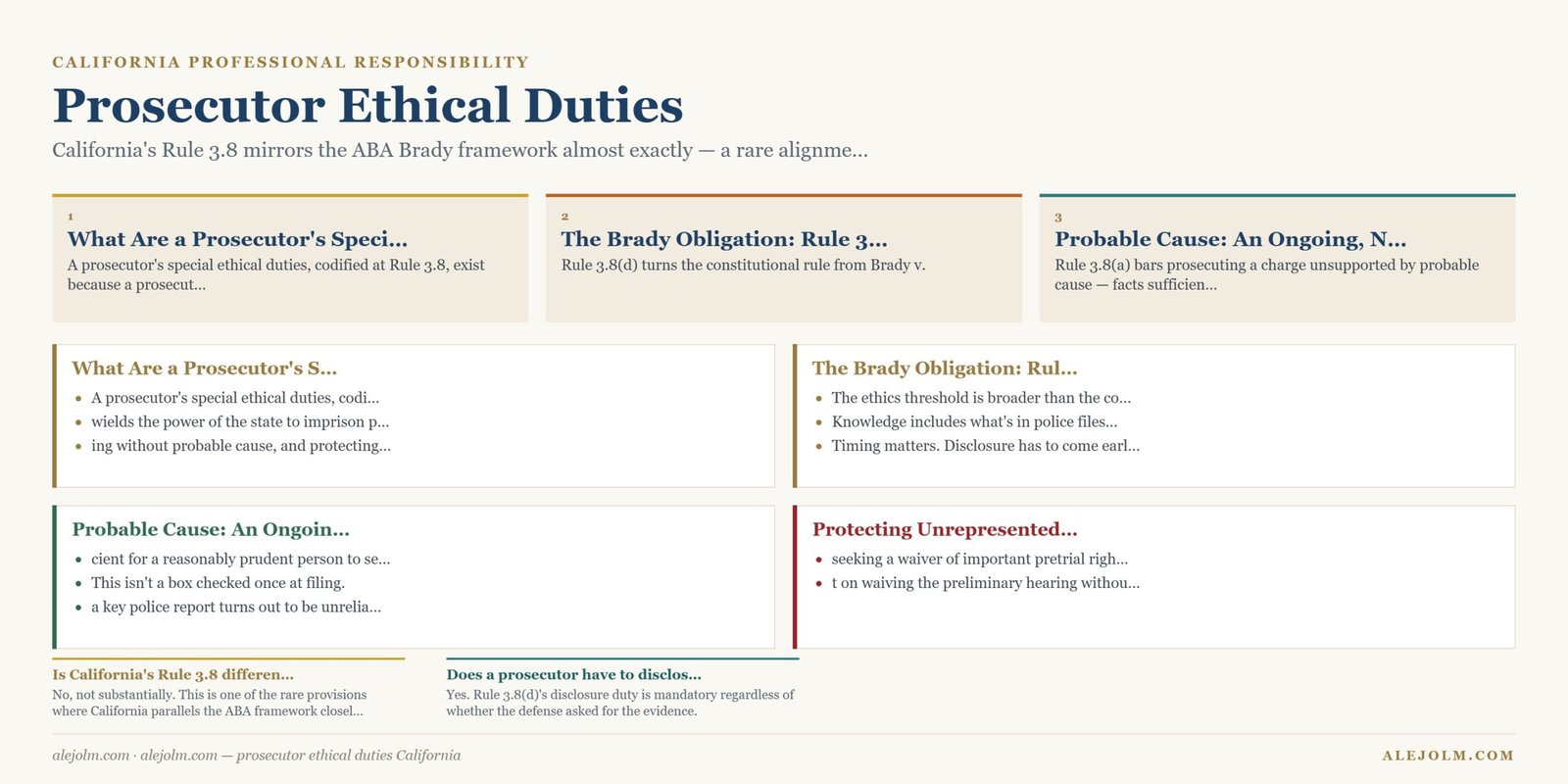
A prosecutor’s special ethical duties, codified at Rule 3.8, exist because a prosecutor wields the power of the state to imprison people and is supposed to seek justice, not just rack up convictions. That includes disclosing evidence that helps the defendant, refraining from charging without probable cause, and protecting an unrepresented accused from unknowing waivers of important rights.
Here’s the California-specific twist bar takers need to know: unlike confidentiality, candor to the tribunal, or fee agreements, Rule 3.8 is one of the few areas where California’s rule tracks the ABA almost exactly. No major divergence exists — which itself is testable, because students conditioned to hunt for a split can waste time looking for one that isn’t there.
The Brady Obligation: Rule 3.8(d)
Rule 3.8(d) turns the constitutional rule from Brady v. Maryland into a freestanding ethics duty. A prosecutor must timely disclose all evidence known to the prosecutor that tends to negate guilt or mitigate the offense — regardless of a defense request, and regardless of the prosecutor’s good faith.
- The ethics threshold is broader than the constitutional materiality standard. Constitutional Brady violations require a reasonable probability of a different outcome; the ethics rule requires disclosure of anything tending to negate guilt, full stop.
- Knowledge includes what’s in police files, crime labs, and other investigative agencies connected to the case — a prosecutor can’t claim ignorance by staying willfully uninformed.
- Timing matters. Disclosure has to come early enough for the defense to actually use it — a report handed over only after conviction doesn’t satisfy the duty just because it technically arrived before all appeals ran.
Probable Cause: An Ongoing, Not One-Time, Requirement
Rule 3.8(a) bars prosecuting a charge unsupported by probable cause — facts sufficient for a reasonably prudent person to seriously entertain the possibility the defendant committed the crime. This isn’t a box checked once at filing. If the evidence underlying probable cause later collapses — say, a key police report turns out to be unreliable — the prosecutor has a duty to reassess and potentially dismiss.
Protecting Unrepresented Defendants
Rules 3.8(b) and (c) require the prosecutor to make sure the accused knows about and has an opportunity to obtain counsel, and bar the prosecutor from seeking a waiver of important pretrial rights (like a preliminary hearing) from someone who isn’t represented. A prosecutor can’t offer an unrepresented defendant a deal contingent on waiving the preliminary hearing without first making sure the defendant understands what’s being given up.
Trial Publicity: Rule 3.8(f)
A prosecutor can’t make extrajudicial statements likely to heighten public condemnation of the accused, and has an affirmative duty to prevent law enforcement from making statements the prosecutor couldn’t ethically make. Factual statements — the charge, a general outline of evidence — are fine; opinionated statements calling the defendant “a known violent criminal” before trial are not.
Post-Conviction Duties: Rules 3.8(g)–(h)
| Trigger | Prosecutor’s Duty |
|---|---|
| New, credible, material evidence creating a reasonable likelihood the defendant is innocent | Disclose to the court and defendant, and investigate |
| Clear and convincing evidence the convicted defendant did not commit the offense | Seek to remedy the conviction through proper post-conviction channels |
These duties acknowledge that convictions can rest on evidence later shown to be unreliable, and they don’t expire at sentencing. A prosecutor who learns of DNA evidence or a witness recantation years after conviction still has an ethical obligation to act on it.
Worked Example: The Coached Witness Report
Prosecutor knows of a police report suggesting the sole witness who identified Defendant as the shooter may have been coached by police. Prosecutor has two other eyewitnesses and believes the case is strong enough to proceed without turning over the report.
Analysis: Yes, Rule 3.8(d) is violated. The coaching report is exculpatory because it attacks the reliability of a key identification, and it could affect the trial outcome. The strength of Prosecutor’s other evidence doesn’t excuse nondisclosure — the duty applies without a defense request and regardless of the prosecutor’s belief the outcome wouldn’t change. Disclosure also has to be timely enough for the defense to use it effectively; producing it only post-conviction would independently violate the duty.
FAQ
Is California’s Rule 3.8 different from the ABA Model Rule?
No, not substantially. This is one of the rare provisions where California parallels the ABA framework closely, with no major divergence in the Brady or probable-cause standards.
Does a prosecutor have to disclose evidence the defense never requested?
Yes. Rule 3.8(d)’s disclosure duty is mandatory regardless of whether the defense asked for the evidence.
Do a prosecutor’s ethical duties end once a defendant is convicted?
No. Rules 3.8(g)–(h) impose ongoing duties to disclose and investigate credible new evidence of innocence, even after sentencing.
Key Takeaways
- Rule 3.8 is one of the few professional responsibility topics where California and the ABA align almost exactly.
- The ethics-based Brady duty under Rule 3.8(d) is broader than the constitutional materiality standard.
- Probable cause must be reassessed if the evidence supporting it later falls apart — it’s not a one-time filing requirement.
- Prosecutors must protect unrepresented defendants from unknowing waivers of pretrial rights.
- Post-conviction duties to disclose and investigate innocence evidence continue indefinitely.
This article is educational and is not legal advice. Consult a licensed California attorney about your situation.
Related guides
- Candor to the Tribunal: California’s Rule 3.3 Split
- Candor and Fairness in Litigation Rules
- Frivolous Claims in California