
What Is the Duty of Candor to the Tribunal?
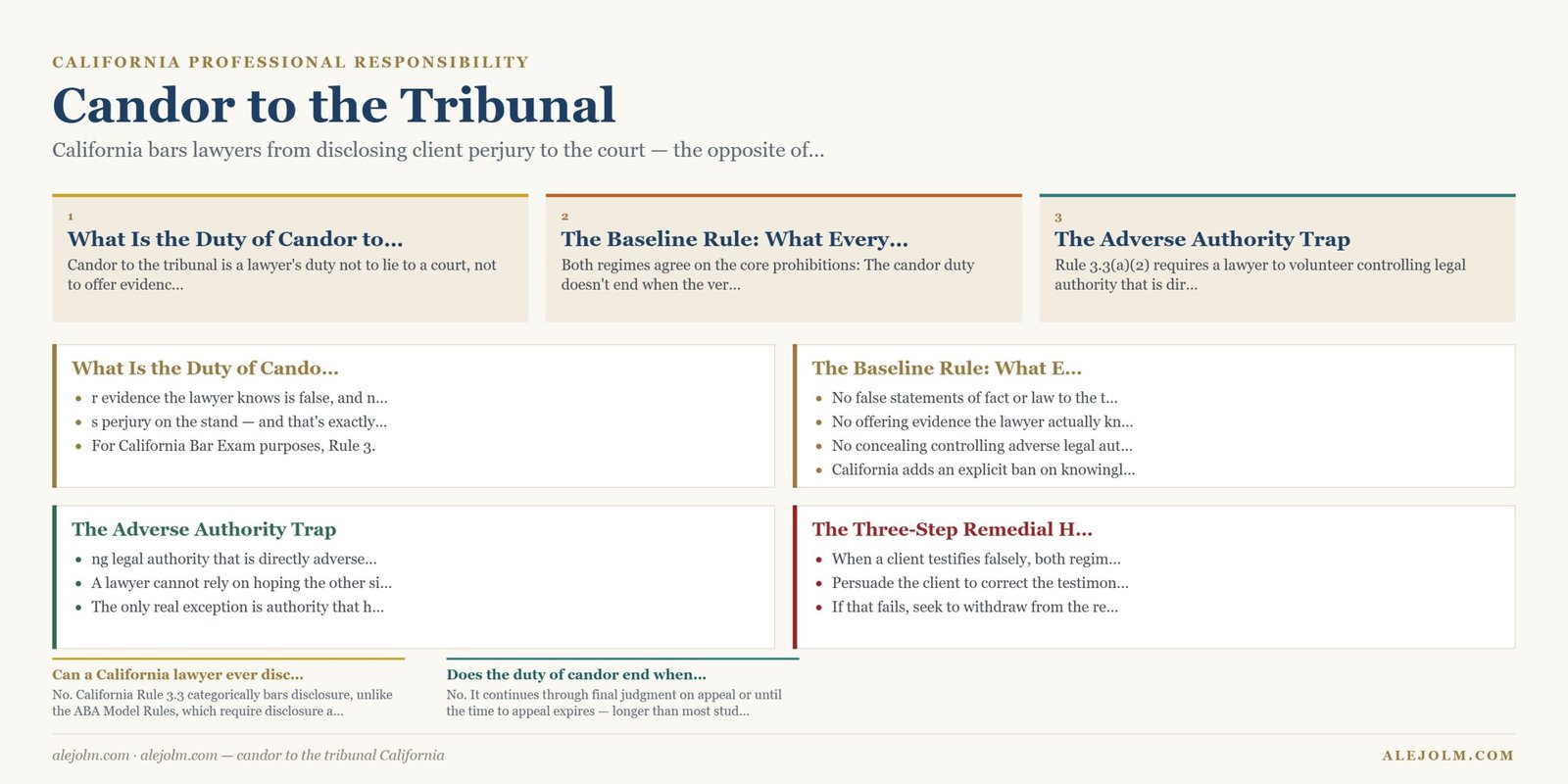
Candor to the tribunal is a lawyer’s duty not to lie to a court, not to offer evidence the lawyer knows is false, and not to hide controlling legal authority that hurts the client’s case. It sounds simple until a client commits perjury on the stand — and that’s exactly where California and the ABA Model Rules go in opposite directions.
For California Bar Exam purposes, Rule 3.3 is one of the most heavily tested “spot the split” topics in the entire subject, because California doesn’t just tweak the ABA approach — it reverses it.
The Baseline Rule: What Every Lawyer Must Do
Both regimes agree on the core prohibitions:
- No false statements of fact or law to the tribunal.
- No offering evidence the lawyer actually knows is false.
- No concealing controlling adverse legal authority, even if opposing counsel never cited it.
- California adds an explicit ban on knowingly misquoting any statute or case to the court — a distinct violation from simply failing to cite adverse law.
The candor duty doesn’t end when the verdict comes in. It lasts until final judgment on appeal, or until the time to appeal has expired — a duration window that trips up students who assume the obligation ends at trial.
The Adverse Authority Trap
Rule 3.3(a)(2) requires a lawyer to volunteer controlling legal authority that is directly adverse to the client’s position — even if opposing counsel never found it. A lawyer cannot rely on hoping the other side is a bad researcher. The only real exception is authority that has been overruled or is meaningfully distinguishable on its facts.
The Three-Step Remedial Hierarchy for False Testimony
When a client testifies falsely, both regimes require the same first two steps:
- Persuade the client to correct the testimony voluntarily.
- If that fails, seek to withdraw from the representation.
- As a last resort — here the paths diverge completely.
California vs. ABA: Who Wins, Candor or Confidentiality?
| Issue | ABA Model Rule 3.3 | California Rule 3.3 |
|---|---|---|
| Last-resort option if withdrawal fails | Lawyer must disclose false evidence to the tribunal | Lawyer may never disclose false evidence |
| Which duty controls | Candor overrides confidentiality | Confidentiality overrides candor |
| Alternative to disclosure | Not applicable — disclosure is required | Narrative testimony is permitted instead |
| Misquoting legal authority | Covered generally under false statements | Explicitly and separately prohibited |
Under the ABA rule, a lawyer who can’t persuade the client and can’t withdraw must tell the judge that false evidence was offered — even though that disclosure will likely end the lawyer’s role in the case and doom the client. Under California’s rule, the lawyer can never make that disclosure. Instead, the California lawyer counsels the client to correct the testimony, seeks withdrawal if that fails, and — if withdrawal isn’t available — lets the client testify in narrative form rather than through normal question-and-answer, so the lawyer isn’t actively “putting on” testimony known to be false.
Narrative Testimony: California’s Middle-Ground Fix
Narrative testimony doesn’t erase the ethical problem; it manages it. The lawyer cannot ask leading questions built around the false testimony, cannot rely on it in closing argument, and cannot otherwise vouch for it. The lawyer simply steps back and lets the client speak in a single, uninterrupted narrative — a workaround that keeps the lawyer from actively lying to the court without forcing the lawyer to betray the client.
Misquoting Authority: A California-Specific Violation
California Rule 3.3 separately bars knowingly misquoting a statute or case — taking language out of context, misstating a holding, or citing an authority that’s been overruled or limited. A lawyer who accurately cites Smith v. Jones but claims it holds the opposite of what it actually says has committed a distinct candor violation, separate from failing to disclose adverse authority in the first place. Bar examiners like to combine both traps in a single fact pattern.
Worked Example: The Wire Transfer Contradiction
Lawyer represents a defendant in a fraud case. At a prior deposition, the client told Lawyer he received a wire transfer but “misplaced the record.” At trial, the client testifies under oath that he never received the transfer at all — a direct contradiction Lawyer knows is false.
In California: Lawyer must counsel the client to correct the testimony. If the client refuses, Lawyer seeks to withdraw (a permissive ground, since the client used Lawyer’s services in connection with the false statement). Lawyer cannot disclose the perjury to the court and may use narrative testimony instead, without relying on the false statement in closing argument.
Under the ABA: the first two steps are identical. But if withdrawal isn’t available or would severely prejudice the client, Lawyer must disclose the false testimony to the tribunal — even knowing it will likely end Lawyer’s role in the case.
FAQ
Can a California lawyer ever disclose a client’s perjury to the judge?
No. California Rule 3.3 categorically bars disclosure, unlike the ABA Model Rules, which require disclosure as a last resort.
Does the duty of candor end when the trial ends?
No. It continues through final judgment on appeal or until the time to appeal expires — longer than most students assume.
Is misquoting a case the same violation as hiding adverse authority?
No. California treats them as two separate violations: failing to disclose controlling adverse authority, and affirmatively misquoting authority the lawyer does cite.
Key Takeaways
- Both regimes require disclosing controlling adverse legal authority and prohibit knowingly false statements to the court.
- The ABA requires disclosure of client perjury as a last resort; California prohibits that disclosure entirely.
- California’s fallback is narrative testimony, paired with mandatory withdrawal attempts.
- California separately and expressly bans misquoting statutes or case law to the tribunal.
- The candor duty extends through final judgment on appeal, not just through trial.
This article is educational and is not legal advice. Consult a licensed California attorney about your situation.
Related guides
- Candor and Fairness in Litigation Rules
- Prosecutor Ethical Duties in California
- Attorney Withdrawal Rules in California