
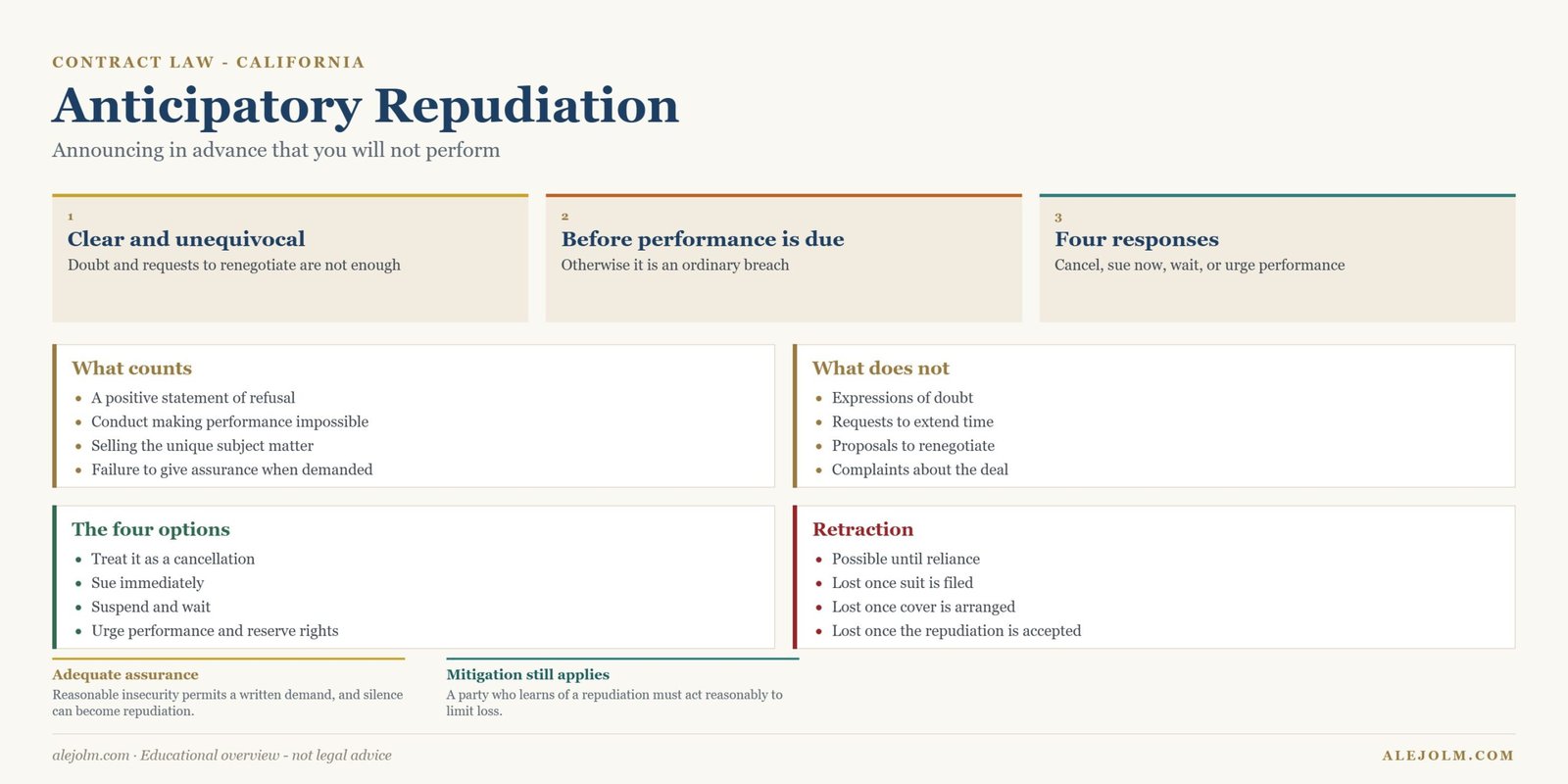
Anticipatory repudiation occurs when a party makes clear, before performance falls due, that it will not perform. California recognises the principle in the Civil Code, which allows the other party to treat the announcement as a breach and to act on it immediately rather than waiting for the due date to pass.
Two questions decide most disputes. Was the statement or conduct genuinely unequivocal, or merely a complaint or a request to renegotiate? And what did the innocent party do next, since the response determines whether the repudiation can still be withdrawn. This guide covers both, along with the right to demand adequate assurance in a sale of goods.
What counts as a repudiation
The refusal must be positive and unconditional. A statement that the party is worried about meeting the date, or a request for more time, does not repudiate anything. Conduct can repudiate as effectively as words: selling to a third party the unique item promised to the buyer, or dismantling the plant required to perform, leaves nothing ambiguous.
Adequate assurance in sales of goods
Where reasonable grounds for insecurity arise, the Commercial Code allows a party to demand in writing adequate assurance of due performance and to suspend its own performance in the meantime. If assurance is not provided within a reasonable time, not exceeding thirty days, the failure itself is treated as a repudiation. That mechanism converts suspicion into a usable remedy.
The four responses
- Treat it as a cancellation. Accept the repudiation, terminate and claim damages.
- Sue immediately. Bring the claim without waiting for the performance date.
- Suspend and wait. Hold your own performance and see whether the date passes.
- Urge performance. Continue to press for performance while reserving all rights.
- Cover or resell. Arrange a substitute transaction to limit the loss.
- Do nothing indefinitely. Rarely wise, since the duty to mitigate continues to run.
Retraction of a repudiation
A repudiating party may change its mind and reinstate the contract, but only while the other side has not relied on the repudiation. Three events close the door: acceptance of the repudiation as a cancellation, a material change of position such as arranging a substitute transaction, and the commencement of proceedings. After any of those, the retraction is too late.
| Response by the innocent party | Can the repudiation be retracted | Practical effect |
|---|---|---|
| Says nothing yet | Yes | Contract remains alive |
| Urges performance | Yes | Rights reserved |
| Accepts the cancellation | No | Contract at an end |
| Arranges cover | No | Damages measured by cover |
| Files suit | No | Claim proceeds |
A worked example
A supplier tells a Los Angeles manufacturer three weeks before the delivery date that it has sold the entire production run to another customer and will not be delivering. The manufacturer immediately buys substitute material at a higher price and sues. The repudiation was unequivocal, the cover transaction fixed the loss, and the supplier cannot now retract and insist on performing at the contract price.
Change the manufacturer response. Suppose it says nothing, waits, and the supplier writes a week later confirming that it will deliver after all. Because nothing had been done in reliance, the retraction is effective, the contract is reinstated and the manufacturer must accept the delivery.
Anticipatory repudiation in California and Los Angeles County in 2026
Supply chain volatility has made the adequate assurance mechanism increasingly important in Los Angeles County trade. Where a counterparty is missing shipments, filing late accounts or the subject of credible insolvency reports, a written demand for assurance is often more useful than a threat, because it creates a defined thirty day window after which the position is clear.
Construction and development contracts raise the same issue when a party announces that it cannot fund the next phase. The safest course is to record the repudiation in writing, state which of the four responses you are adopting, and reserve rights explicitly, since the choice made determines whether a later retraction can revive the deal.
- Get the repudiation in writing. Confirm a conversation by email the same day.
- Choose a response and say so. Ambiguity leaves the retraction door open.
- Use the assurance demand. It is the best tool for genuine but unproven insecurity.
- Mitigate promptly. The duty to limit loss begins as soon as you know.
- Do not overreact to grumbling. Treating a complaint as repudiation risks putting you in breach.
- Preserve evidence of cover. It fixes the measure of damages.
For 2026, confirm the current California authority on repudiation, retraction and adequate assurance directly with current authority, since these continue to develop.
Common mistakes to avoid
- Treating doubt as repudiation. The refusal must be clear and unconditional.
- Cancelling too fast. A wrongful termination turns the innocent party into the breaching one.
- Waiting too long. Delay can breach the duty to mitigate.
- Forgetting that full performers must sometimes wait. A party with nothing left to do may have to await the due date.
- Failing to reserve rights. Urging performance without a reservation can look like affirmation.
- Ignoring the assurance route. It resolves uncertainty far more cleanly than guessing.
Frequently asked questions
Can I sue before the performance date?
Yes, where the other party has clearly and unconditionally refused to perform. That is the essence of anticipatory repudiation.
Is asking to renegotiate a repudiation?
No. A request to change the terms, or an expression of difficulty, does not amount to a refusal to perform.
Can the other side take it back?
Only until you rely on it. Once you accept the cancellation, arrange a substitute transaction or file suit, the retraction is ineffective.
What is a demand for adequate assurance?
In a sale of goods, a written request for reassurance where reasonable grounds for insecurity exist. Failure to respond within a reasonable time, not more than thirty days, is treated as a repudiation.
Do I still have to mitigate?
Yes. Once you know performance will not be forthcoming, you must take reasonable steps to limit your loss.
Related guides
- Material breach
- Remedies for breach of contract
- The duty to mitigate
- Substantial performance
- Expectation damages
- Conditions precedent
- Impossibility and frustration
- Installment contracts
Next steps
If a counterparty has told you it will not perform, decide your response before replying, because the reply itself has legal consequences. Our guides to remedies for breach and the duty to mitigate explain what follows each choice.
For primary sources, read California Civil Code section 1440 and the civil jury instructions published by the Judicial Council of California.