

What Are Inchoate Crimes Under California Law?
If you’re studying inchoate crimes in California for the Bar Exam, you’re really studying three separate statutes — attempt, solicitation, and conspiracy — that share one organizing logic: each punishes conduct aimed at a crime before the target harm actually happens. Treat this topic as the umbrella that ties those three doctrines together and tells you how they interact.
Inchoate crimes, in one sentence: attempt, solicitation, and conspiracy punish conduct directed toward committing a crime before the underlying harm occurs, and each one is a specific-intent crime under California law regardless of the mens rea required for the target offense.
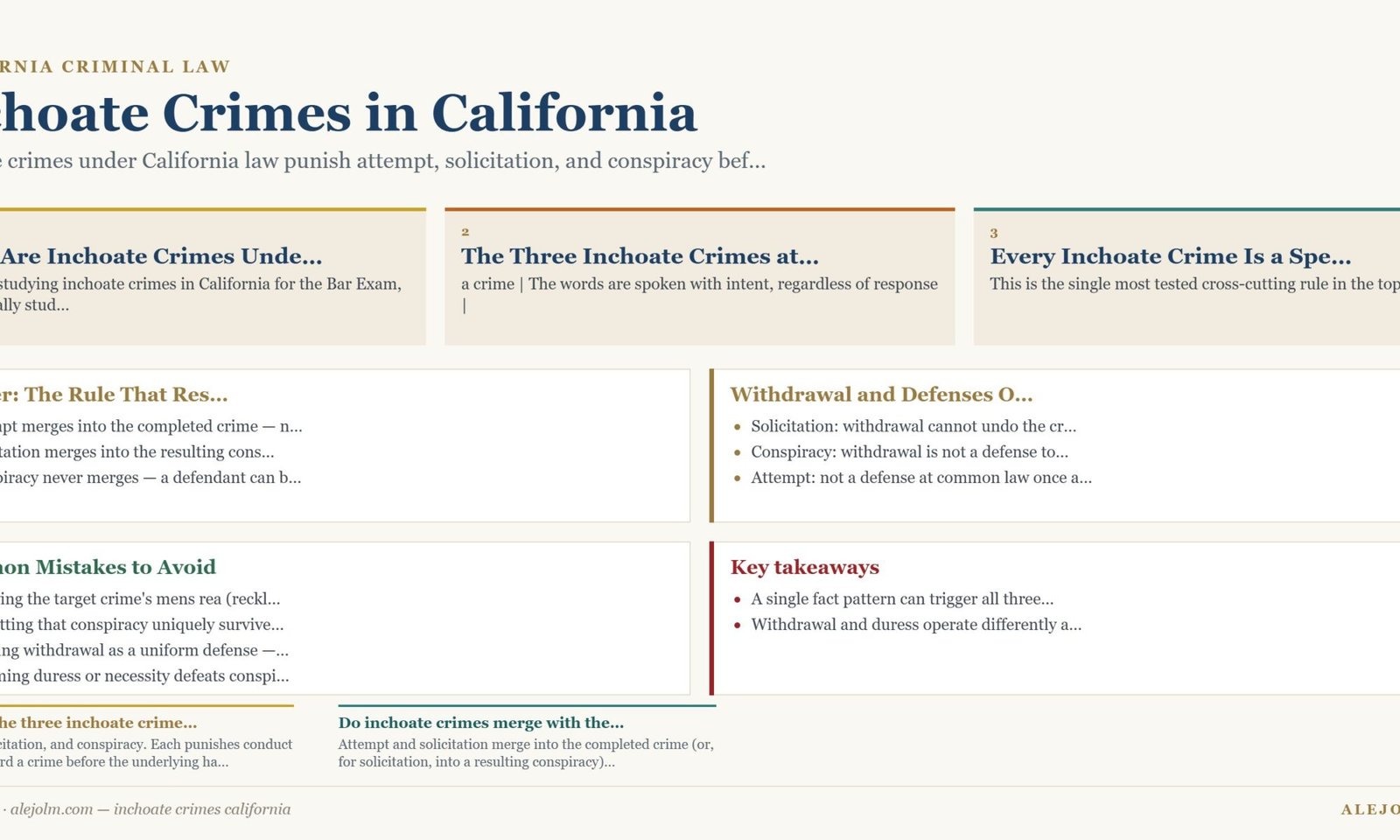
The Three Inchoate Crimes at a Glance
| Crime | California statute | Core act | Complete when |
|---|---|---|---|
| Attempt | Penal Code § 21a, § 664 | A direct but ineffectual act toward the crime | The direct act is taken with specific intent |
| Solicitation | Penal Code § 653f | Inviting, requesting, or commanding another to commit |
a crime | The words are spoken with intent, regardless of response |
| Conspiracy | Penal Code § 182 | Agreement between two or more genuine parties, plus an overt act | The overt act occurs (California requires one) |
|---|
Every Inchoate Crime Is a Specific-Intent Crime
This is the single most tested cross-cutting rule in the topic. Attempt, solicitation, and conspiracy all require specific intent — purpose or knowledge — even when the underlying target crime does not. A defendant can be guilty of attempting a crime that itself only requires recklessness or negligence for the completed offense (like vehicular manslaughter), because the attempt variant always demands intent to bring about the criminal result, not just the completed crime’s lesser mens rea.
Students frequently conflate the target crime’s mens rea with the inchoate offense’s mens rea requirement. Keep them separate: ask what mental state the inchoate crime itself demands, not what the finished crime would require.
Merger: The Rule That Resolves Most Exam Questions
Merger governs which of these convictions can stand together, and one clean rule resolves nearly every fact pattern:
- Attempt merges into the completed crime — no separate conviction for both.
- Solicitation merges into the resulting conspiracy (if accepted) or into the completed crime (if carried out).
- Conspiracy never merges — a defendant can be convicted of both conspiracy and the completed offense.
This asymmetry is exactly why prosecutors like charging conspiracy: it survives independently even after the target crime is fully carried out, and it opens the door to Pinkerton liability for co-conspirators’ foreseeable crimes.
How the Three Crimes Layer Together
Bar exams love multi-actor fact patterns that stack all three doctrines. Consider the typical sequence: A solicits B to commit a crime; B agrees, forming a conspiracy; A and B then take a direct act toward the crime; police intervene before completion. That single scenario can generate solicitation, conspiracy, and attempt liability simultaneously — but merger determines which convictions actually survive:
- Solicitation merges into the conspiracy once B agrees, so only conspiracy is charged on that theory.
- Conspiracy does not merge, so it remains available even if attempt is also charged.
- Attempt merges into the completed crime only if the crime is actually finished; if police intervene first, attempt stands on its own alongside conspiracy.
Withdrawal and Defenses Operate Differently Across the Three
Withdrawal is not a uniform defense across inchoate crimes, and treating it as one is a common exam trap:
- Solicitation: withdrawal cannot undo the crime itself (already complete once spoken), though it may cut off later accomplice liability.
- Conspiracy: withdrawal is not a defense to the conspiracy charge, but effective withdrawal — communicated to all co-conspirators, with adequate time to abandon the plan — can cut off Pinkerton liability for later crimes.
- Attempt: not a defense at common law once a direct act occurs; some jurisdictions and the Model Penal Code recognize complete and voluntary renunciation.
Duress and necessity are also generally unavailable as defenses to conspiracy, even where they would excuse the underlying target crime — a defendant pressured into joining an agreement cannot simply invoke duress to escape conspiracy liability.
Worked Example: Bar Exam Inchoate Crimes Hypo
Facts: Wei asks Tam to help him burn down a rival restaurant, offering to split the insurance payout. Tam agrees, and the two buy gasoline together the next day. Police arrest them in the restaurant’s parking lot before any fire is set.
Analysis: Wei’s request to Tam is solicitation, but it merges into a conspiracy the moment Tam agrees. The conspiracy is complete because California requires (and the facts supply) an overt act — buying the gasoline. Because Wei and Tam took a direct but ineffectual act toward the arson (arriving at the scene with fuel), they may also be charged with attempted arson. Since the arson itself was never completed, there is no completed-crime merger issue; Wei and Tam can be convicted of both conspiracy to commit arson and attempted arson, because conspiracy never merges and attempt has nothing to merge into here.
Common Mistakes to Avoid
- Applying the target crime’s mens rea (recklessness, negligence) to the inchoate offense instead of requiring specific intent.
- Forgetting that conspiracy uniquely survives alongside a completed-crime conviction, unlike attempt and solicitation.
- Treating withdrawal as a uniform defense — its effect differs sharply across attempt, solicitation, and conspiracy.
- Assuming duress or necessity defeats conspiracy liability the same way it might defeat the underlying target crime.
- Missing that a single exchange (solicitation accepted) can generate liability under two theories that must then be merged correctly.
FAQ
What are the three inchoate crimes tested on the California Bar Exam?
Attempt, solicitation, and conspiracy. Each punishes conduct directed toward a crime before the underlying harm occurs, and each requires specific intent under California law.
Do inchoate crimes merge with the completed offense in California?
Attempt and solicitation merge into the completed crime (or, for solicitation, into a resulting conspiracy). Conspiracy never merges — a defendant can be convicted of both conspiracy and the completed crime.
Does withdrawal eliminate liability for an inchoate crime?
It depends which one. Withdrawal generally does not undo attempt or solicitation liability once complete, but effective, fully communicated withdrawal from a conspiracy can cut off liability for co-conspirators’ later, foreseeable crimes.
Key Takeaways
- Inchoate crimes — attempt, solicitation, and conspiracy — punish conduct toward a crime before the harm occurs.
- All three require specific intent under California law, regardless of the target crime’s mens rea.
- Attempt and solicitation merge into the completed crime; conspiracy never merges.
- A single fact pattern can trigger all three doctrines, requiring careful merger analysis to determine which convictions survive.
- Withdrawal and duress operate differently across the three crimes — never assume a defense available to one applies to all.
This article is educational and is not legal advice. Consult a licensed California attorney about your situation.
Related guides
- California Penal Code 664 criminal attempt
- California Penal Code 653f solicitation
- California Penal Code 182 conspiracy