
What Is Forgery Under California Penal Code 470?
Anyone typing “California Penal Code 470” into a search bar is usually trying to answer one question: does a fake document become a crime the moment it’s created, or only once someone uses it? California’s answer, like the common law’s, is the former — and that timing rule is the single most tested feature of this crime.
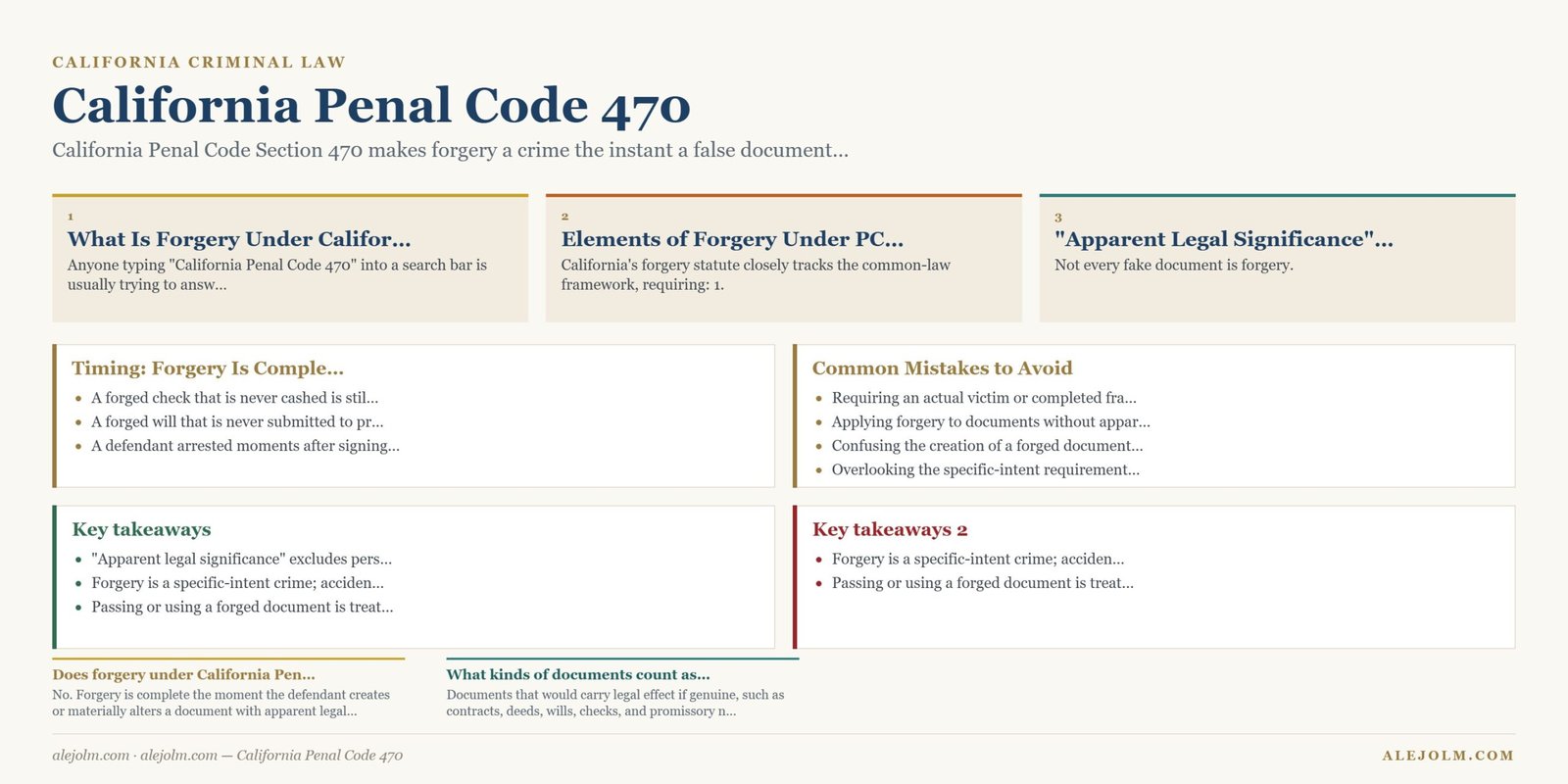
Forgery, in one sentence: under Penal Code § 470, forgery is the creation or material alteration of a document with apparent legal significance, made false, with intent to defraud — a specific-intent crime complete the instant the document is made, regardless of whether anyone is actually deceived.
Elements of Forgery Under PC 470
California’s forgery statute closely tracks the common-law framework, requiring:
- Creating or materially altering a document;
- The document has apparent legal significance — meaning it would have legal effect if genuine (contracts, deeds, checks, wills, and California’s § 470 specifically enumerates dozens of instrument types);
- The document is made false — it misrepresents its authorship, authenticity, or terms; and
- The defendant acted with intent to defraud.
| Element | Common law | California (PC 470) |
|---|---|---|
| Document type | Apparent legal significance required | Same, but § 470 enumerates a long, specific list of covered instruments |
| Completion point | Creation/alteration with fraudulent intent | Same — no use or actual victim required |
| Mens rea | Specific intent to defraud | Specific intent to defraud |
| Separate “uttering” crime | Distinguished from forgery in some jurisdictions | California criminalizes both forgery and passing/uttering under related sections |
“Apparent Legal Significance”: The Gatekeeping Requirement
Not every fake document is forgery. The instrument must be one that, if genuine, would carry legal weight — think contracts, deeds, wills, checks, promissory notes, and official certificates. A forged love letter or a fabricated diary entry, however deceptive, falls outside forgery because it has no legal effect even if authentic.
California Penal Code § 470 removes much of the ambiguity by listing specific document types covered — wills, deeds, contracts, checks, stock certificates, and public and corporate seals, among others. On a bar exam fact pattern, always confirm the forged item appears on (or clearly resembles) this kind of list before applying forgery liability.
Timing: Forgery Is Complete at Creation, Not Use
This is the highest-yield rule in the whole topic. Forgery does not require that anyone actually be defrauded, and it does not require the document ever be used. The crime is complete the moment the defendant creates or alters the false document with fraudulent intent.
- A forged check that is never cashed is still forgery.
- A forged will that is never submitted to probate is still forgery.
- A defendant arrested moments after signing a false deed, before recording it, is still guilty.
California treats passing or using a forged document — sometimes called “uttering” — as a related but analytically distinct act, often prosecuted under companion provisions dealing with possession or passing of forged instruments (such as § 475). Some fact patterns support convictions on both the creation and the passing, since the underlying conduct is different.
The Specific-Intent Requirement
Because forgery is a specific-intent crime, a defendant who creates a false document without any purpose to defraud is not guilty. Signing a friend’s name to a birthday card as a joke, with no intent that anyone rely on it as authentic, is not forgery — there is no intent to defraud.
Conversely, intent to defraud does not require a likelihood of success. A defendant who creates a forged document confident it will fool nobody can still be guilty, because the crime turns on the defendant’s purpose, not the sophistication of the fake.
Worked Example: Bar Exam Forgery Hypo
Facts: Marco, without authorization, signs his business partner’s name to a promissory note purporting to obligate the partnership to repay Marco a large personal “loan.” Marco plans to present the note to a bank as collateral next month, but he is arrested for an unrelated matter before doing so. The note is found, unused, in his desk drawer.
Analysis: Marco is guilty of forgery under California Penal Code § 470. The promissory note has apparent legal significance (it purports to create a binding financial obligation), Marco created a document that falsely appears to reflect his partner’s authorized act, and he did so with intent to defraud the bank. The crime was complete the instant Marco signed the false note with fraudulent intent — his failure to ever present it to the bank is irrelevant to the forgery charge, though it would matter for a separate charge based on using or passing the document.
Common Mistakes to Avoid
- Requiring an actual victim or completed fraud before finding forgery liability — none is required.
- Applying forgery to documents without apparent legal significance, like personal letters or diaries.
- Confusing the creation of a forged document with the later, separate act of using or passing it.
- Overlooking the specific-intent requirement and assuming any false legal-looking document is automatically forgery.
- Treating a material alteration of an existing document as somehow less serious than creating a document from scratch — both qualify equally.
FAQ
Does forgery under California Penal Code 470 require the document to be used?
No. Forgery is complete the moment the defendant creates or materially alters a document with apparent legal significance and intent to defraud — actual use or a deceived victim is not required.
What kinds of documents count as having “apparent legal significance”?
Documents that would carry legal effect if genuine, such as contracts, deeds, wills, checks, and promissory notes. Personal writings with no legal effect, like letters or diaries, do not qualify.
Is forgery the same crime as uttering a forged instrument in California?
No. Forgery is the creation or alteration of the false document; uttering (passing or using it) is analytically distinct, and California prosecutes both creation and passing, sometimes under different statutory sections.
Key Takeaways
- California Penal Code § 470 criminalizes creating or materially altering a document with apparent legal significance, made false, with intent to defraud.
- The crime is complete at creation — no victim, use, or successful deception is required.
- “Apparent legal significance” excludes personal, non-legal writings even if deceptive.
- Forgery is a specific-intent crime; accidental or joking false documents do not qualify.
- Passing or using a forged document is treated as a separate act from creating it.
This article is educational and is not legal advice. Consult a licensed California attorney about your situation.
Related guides
- arson under California Penal Code 451
- extortion under California Penal Code 518
- California Penal Code 664 criminal attempt