
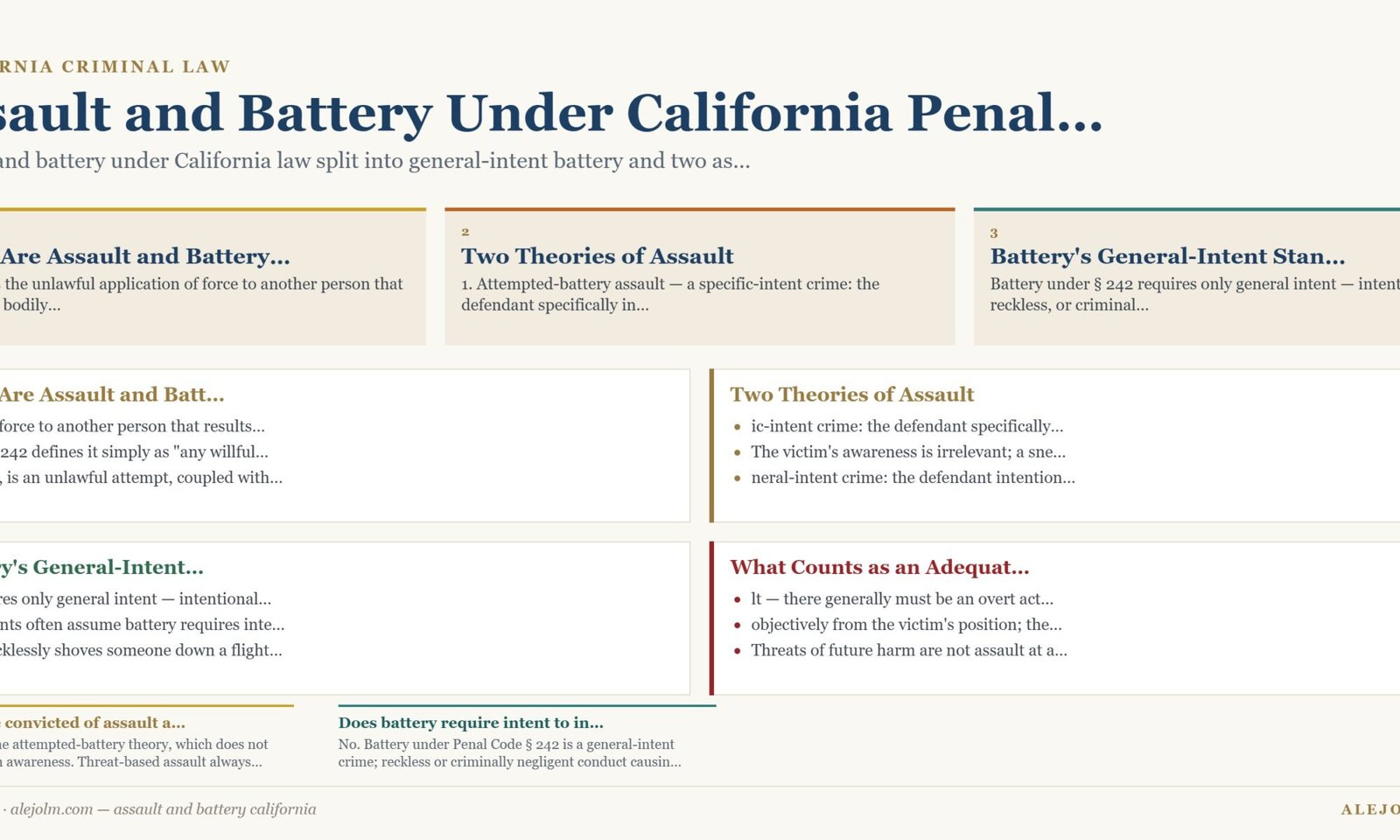
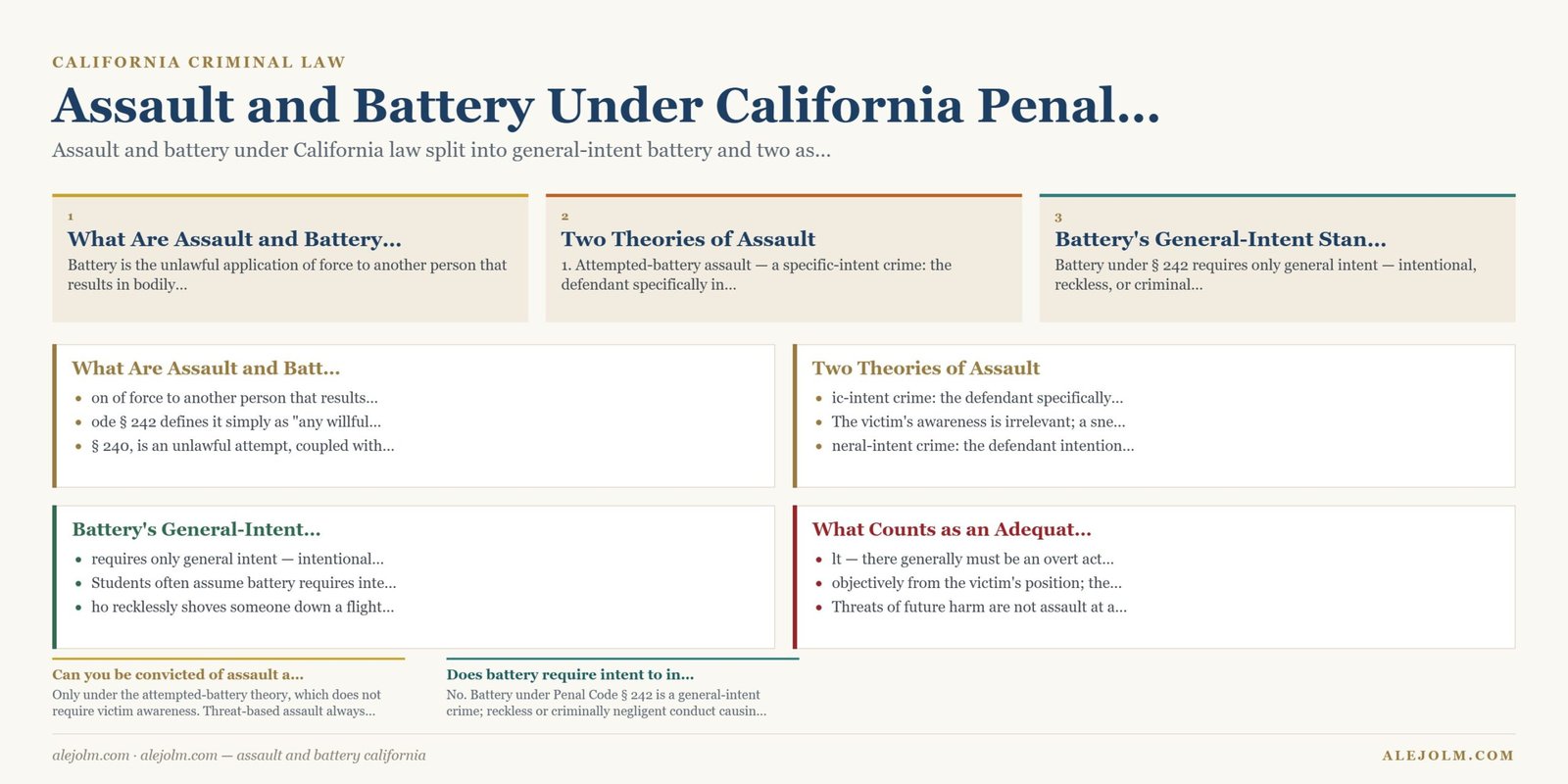
What Are Assault and Battery Under California Law?
Battery is the unlawful application of force to another person that results in bodily injury or offensive contact; it is a general-intent crime. California Penal Code § 242 defines it simply as “any willful and unlawful use of force or violence upon the person of another.” Assault, defined in Penal Code § 240, is an unlawful attempt, coupled with a present ability, to commit a violent injury on another person. Both offenses are constantly tested on the California Bar Exam, and both hide traps for students who treat them as a single, undifferentiated crime.
At common law, assault can be charged under two separate theories, and California’s statutory language tracks the attempted-battery version most closely while courts also recognize the threat-based variant. Knowing both theories — and which one a given fact pattern supports — is the key to this topic.
Two Theories of Assault
- Attempted-battery assault — a specific-intent crime: the defendant specifically intends to commit a battery and takes a substantial step toward it. The victim’s awareness is irrelevant; a sneak attack from behind still counts.
- Threat-based assault — a general-intent crime: the defendant intentionally causes the victim to reasonably apprehend imminent bodily harm. The victim must actually perceive the threat — you cannot commit this form of assault against someone asleep or unaware, though you can still batter them.
This distinction resolves the classic “sleeping victim” fact pattern: attempted-battery assault survives because it doesn’t depend on the victim’s state of mind, while threat-based assault fails for lack of apprehension.
Battery’s General-Intent Standard
Battery under § 242 requires only general intent — intentional, reckless, or criminally negligent conduct causing unlawful contact. Students often assume battery requires intent to injure; it does not. A defendant who recklessly shoves someone down a flight of stairs has committed battery even if he intended only minor harm.
Battery also covers indirect contact — throwing an object at someone, siccing an animal on them, or pushing a third party into the victim all qualify, because the doctrine focuses on the resulting harmful or offensive contact, not the mechanics of delivery.
What Counts as an Adequate Threat
Words alone almost never suffice for threat-based assault — there generally must be an overt act, like brandishing a weapon or raising a fist, accompanying the words. Reasonable apprehension is judged objectively from the victim’s position; the defendant’s actual ability to carry out the threat is irrelevant. Threats of future harm are not assault at all (extortion may apply instead).
Conditional threats split into two categories: “your money or your life” is sufficient because the defendant has no legal right to impose that condition, while “leave my property or I’ll have you arrested” is insufficient because the defendant does have a legal right to compel the underlying act.
Consent as a Defense
Consent is a recognized defense to both offenses. Implied consent covers ordinary incidental contact in crowded public places; express consent to an athletic contest covers contact within the rules of the game — but never contact outside those rules. In State v. Shelley, a punch thrown during a basketball game, after the whistle had blown and play had stopped, supported a battery conviction despite the victim’s general consent to physical play. Consent to a sport is contextual, not unlimited.
Comparing Battery and the Two Assault Theories
| Offense | Mens rea | Victim awareness required? |
|---|---|---|
| Battery (Penal Code § 242) | General intent | No |
| Attempted-battery assault | Specific intent | No |
| Threat-based assault | General intent | Yes |
Worked Example: The Bar Exam Fact Pattern
Vic is asleep on a park bench. Dan sneaks up intending to punch him, but a jogger tackles Dan just before the blow lands. Separately, at a pickup basketball game, Chris elbows Pat hard in the face well after the whistle blew and play had stopped.
Analysis: Dan committed attempted-battery assault — he had specific intent to commit a battery and took a substantial step (approaching with a raised fist) toward completion; Vic’s sleep and lack of awareness are irrelevant under this theory, though Dan could not be convicted of threat-based assault since Vic never perceived any threat. Chris committed battery: the elbow was intentional harmful contact, and consent is no defense because the elbow occurred after play had stopped, outside the scope of the game’s expected contact, just as in State v. Shelley.
Common Law and MPC Contrasts
Model Penal Code § 211.1 consolidates assault grading around a purposely-knowingly-recklessly mens rea framework and does not preserve the common law’s rigid attempted-battery/threat-based split as two named theories. California, like most common-law jurisdictions, keeps assault and battery as two separate statutory crimes (§§ 240 and 242) rather than merging them into a single graded offense as the MPC does — a distinction bar candidates studying multiple jurisdictions should keep straight.
Frequently Asked Questions
Can you be convicted of assault against someone who was asleep?
Only under the attempted-battery theory, which does not require victim awareness. Threat-based assault always requires that the victim actually perceive the threat, so it fails against a sleeping or unaware victim.
Does battery require intent to injure the victim?
No. Battery under Penal Code § 242 is a general-intent crime; reckless or criminally negligent conduct causing harmful or offensive contact is enough, even without intent to cause the resulting injury.
Is consent a complete defense to battery during a sports game?
No. Consent to an athletic contest covers contact within the rules of the game, but not contact outside those rules — a deliberate blow after play has stopped remains battery.
Key Takeaways
- California Penal Code § 240 defines assault; Penal Code § 242 defines battery, and they are analyzed as separate crimes.
- Attempted-battery assault is specific intent and does not require victim awareness; threat-based assault is general intent and requires it.
- Battery requires only general intent — recklessness or criminal negligence causing harmful or offensive contact is enough.
- Words alone almost never support threat-based assault absent an accompanying overt act.
- Consent to a sport covers contact within the rules, not contact that exceeds them.
This article is educational and is not legal advice. Consult a licensed California attorney about your situation.
Related guides
- California mayhem law under Penal Code 203
- California kidnapping law under Penal Code 207
- the IRAC method for bar exam essays
- Miranda rights and custodial statements