
Three Kinds of Listing Agreements
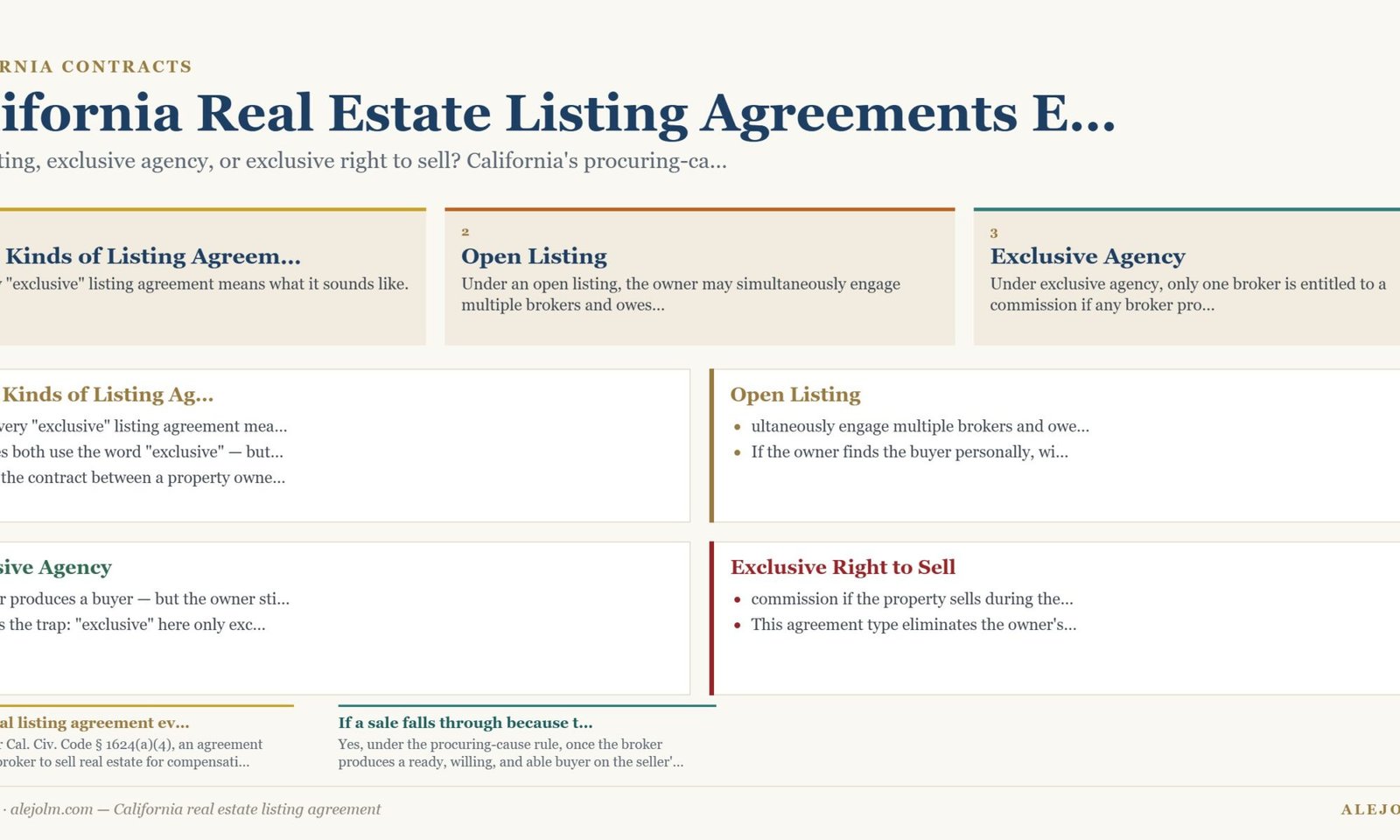
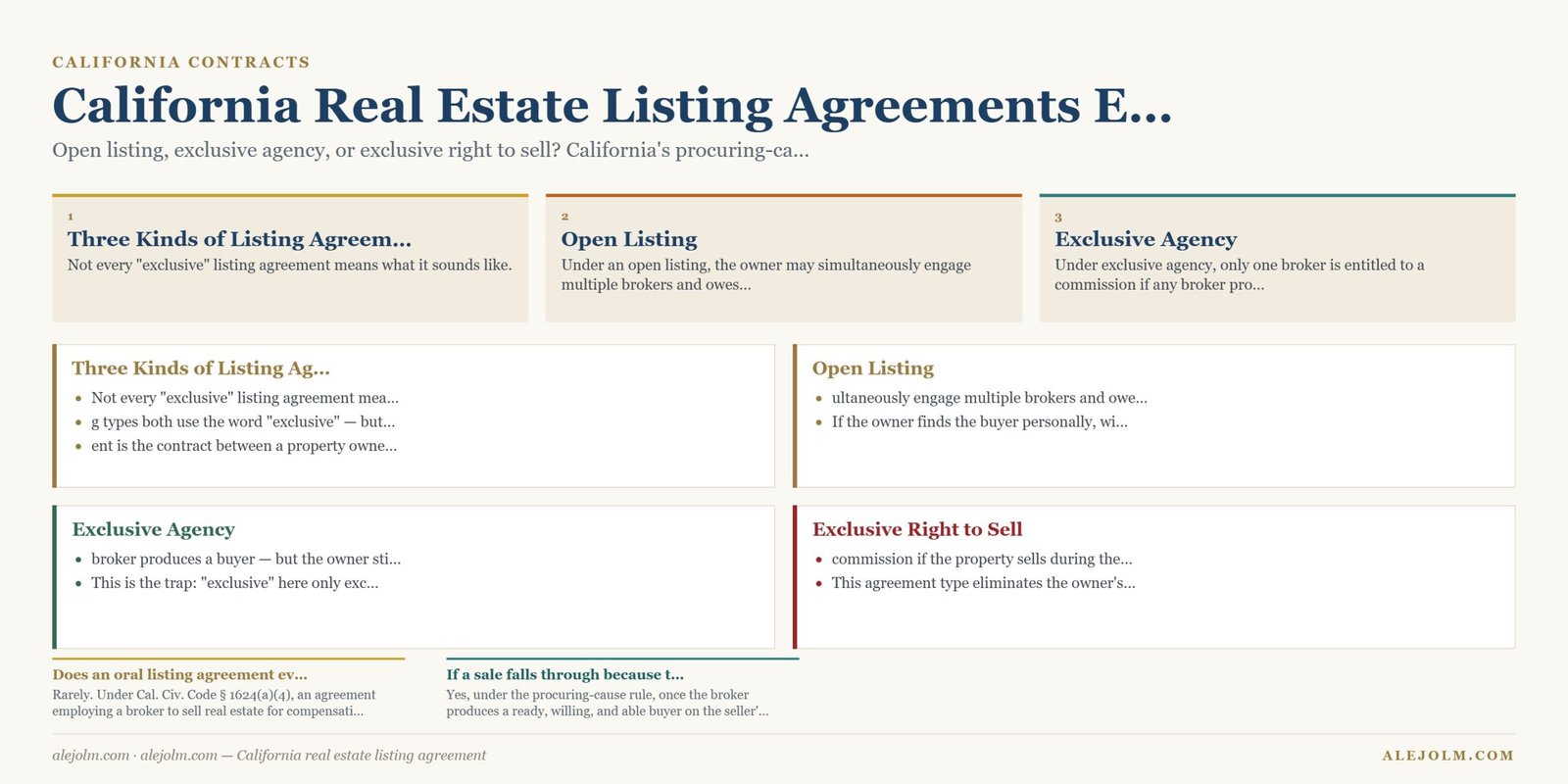
Not every “exclusive” listing agreement means what it sounds like. California Bar essays deliberately exploit the fact that two of the three listing types both use the word “exclusive” — but only one of them strips the seller’s right to sell commission-free.
A listing agreement is the contract between a property owner and a real estate broker authorizing the broker to find a buyer. It comes in three varieties, and the variety chosen determines exactly when the owner owes a commission.
Open Listing
Under an open listing, the owner may simultaneously engage multiple brokers and owes a commission only to whichever broker actually procures the buyer. If the owner finds the buyer personally, with no broker’s help at all, no commission is owed to anyone.
Exclusive Agency
Under exclusive agency, only one broker is entitled to a commission if any broker produces a buyer — but the owner still keeps the right to sell the property personally, commission-free. This is the trap: “exclusive” here only excludes other brokers, not the owner.
Exclusive Right to Sell
Under exclusive right to sell, the listing broker earns a commission if the property sells during the listing period, no matter who finds the buyer — even the owner. This agreement type eliminates the owner’s self-sale exception entirely.
Comparison Table
| Listing type | Multiple brokers allowed? | Owner sells personally, no commission? | Broker paid if any broker sells? |
|---|---|---|---|
| Open listing | Yes | Yes | No — only the procuring broker |
| Exclusive agency | No | Yes | Yes — the exclusive broker |
| Exclusive right to sell | No | No | Yes, regardless of who sells |
When Is the Commission Earned? The Procuring-Cause Rule
Under the majority “procuring cause” rule, reflected in Restatement (Second) of Agency § 445 and applied by California courts, a broker earns the commission the moment the broker produces a buyer who is ready, willing, and able to buy on the seller’s terms — even if the sale later falls through because the seller backs out or fails to close. The commission is earned at the procuring moment, not at closing.
California’s Statute of Frauds Overlay: Cal. Civ. Code § 1624
Here’s a California-specific wrinkle that many general Bar prep materials gloss over. Most states apply the Statute of Frauds to a listing agreement only if its duration exceeds one year, treating it like any other services contract. California goes further. Under Cal. Civ. Code § 1624(a)(4), an agreement authorizing or employing an agent or broker to purchase or sell real estate for compensation must be in writing to be enforceable — regardless of the listing’s duration. A 30-day oral listing agreement, unenforceable in California for lack of a writing, might be perfectly enforceable elsewhere under the ordinary one-year SOF rule. Always flag this distinction on a California-specific essay.
Broker Licensing: Cal. Bus. & Prof. Code § 10131
A person acting as a real estate broker in California — negotiating the sale, lease, or exchange of real property for compensation — must be licensed under Cal. Bus. & Prof. Code § 10131. An unlicensed person generally cannot sue to collect a real-estate commission in California, an additional wrinkle beyond the generic contract-formation and Statute of Frauds analysis.
Worked Hypothetical
Facts: Owner signs a six-month exclusive-agency listing agreement with Broker to sell her Sacramento house. Two months in, Owner’s neighbor mentions interest in buying, and Owner sells directly to the neighbor without any involvement from Broker. Assume the same facts, except the agreement had instead been an exclusive-right-to-sell agreement.
Analysis: Under the exclusive-agency agreement, Broker earns no commission: that agreement type guarantees Broker is the only broker entitled to a fee if any broker sells, but it expressly preserves Owner’s right to sell personally without owing anything — exactly what happened. Under the alternative exclusive-right-to-sell agreement, Broker does earn the commission, because that structure eliminates the self-sale exception entirely, entitling Broker to a fee whenever the property sells during the term, including Owner’s own direct sale.
Frequently Asked Questions
Does an oral listing agreement ever work in California?
Rarely. Under Cal. Civ. Code § 1624(a)(4), an agreement employing a broker to sell real estate for compensation must be in writing regardless of duration — an oral listing agreement is generally unenforceable in California.
If a sale falls through because the seller changes her mind, is commission still owed?
Yes, under the procuring-cause rule, once the broker produces a ready, willing, and able buyer on the seller’s terms, the commission is earned — the seller’s later refusal to close doesn’t undo that.
Can an unlicensed person collect a real estate commission in California?
No. Cal. Bus. & Prof. Code § 10131 requires licensure to act as a real estate broker, and unlicensed brokerage activity generally cannot be enforced through a lawsuit for commission.
Key Takeaways
- Open listing: only the procuring broker is paid; owner pays nothing if she finds the buyer herself.
- Exclusive agency: only one broker can earn a fee, but the owner can still sell commission-free.
- Exclusive right to sell: the broker is paid no matter who finds the buyer, including the owner.
- Cal. Civ. Code § 1624(a)(4) requires any compensated real-estate listing agreement to be in writing — no one-year duration exception in California.
- Commission is earned at the procuring-cause moment, not at closing.
This article is educational and is not legal advice. Consult a licensed California attorney about your situation.
Related guides
- statute of frauds
- land sale contracts in California
- third-party beneficiaries in California contracts