
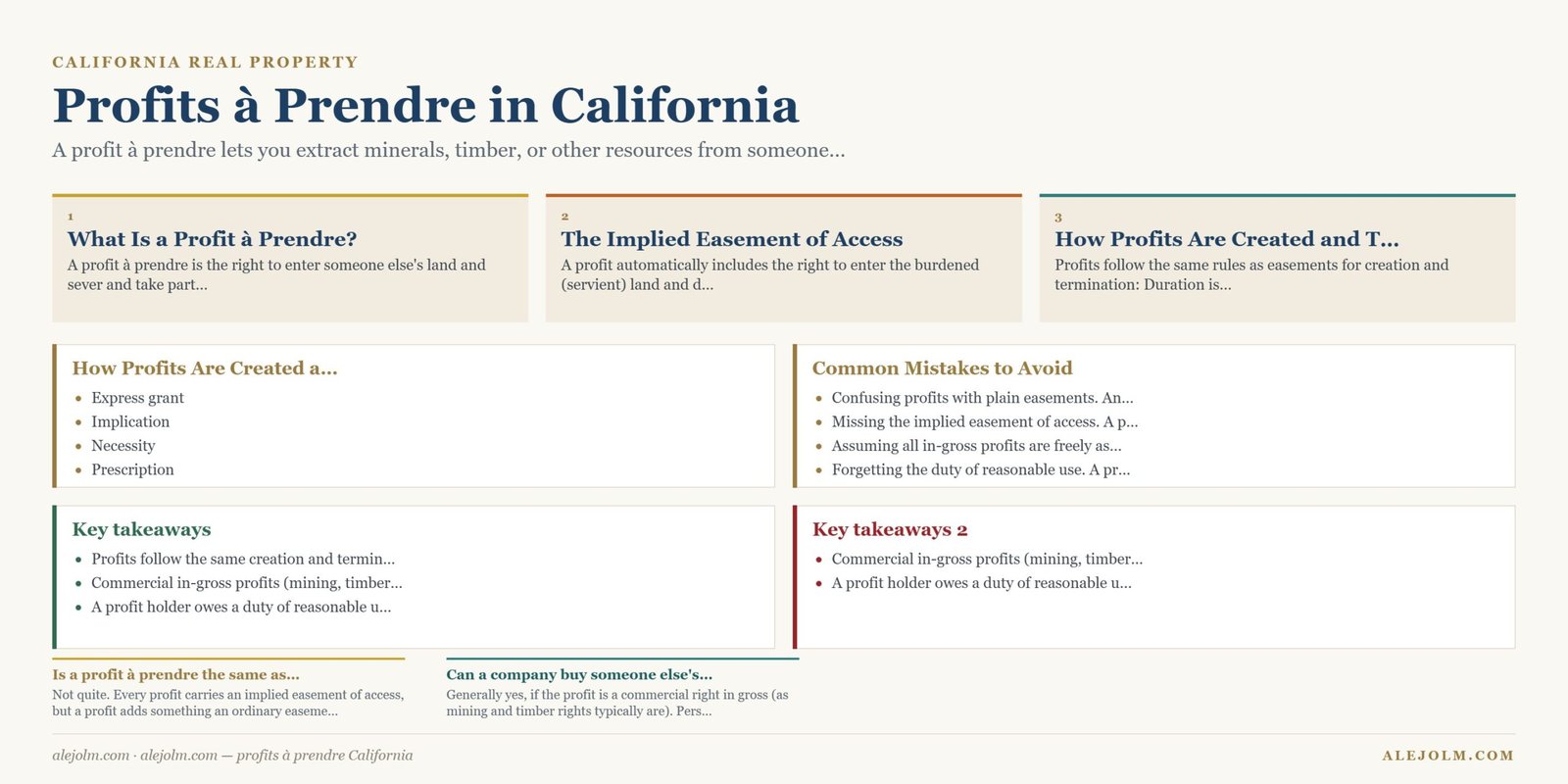
What Is a Profit à Prendre?
A profit à prendre is the right to enter someone else’s land and sever and take part of the land itself or its natural resources — minerals, timber, oil, game, fish, soil, sand, and gravel among them. It’s a hybrid interest: part non-possessory right to use the land, part right to actually remove and own what’s taken from it.
If you’re dealing with mineral leases, timber rights, or any resource-extraction agreement in California, this doctrine is the legal foundation underneath the deal, and it borrows heavily from easement law.
Profit à prendre, defined in one sentence: it’s a non-possessory interest granting the right to enter land and extract natural resources, automatically carrying an implied easement of access, and generally following the same creation and termination rules as easements.
The Implied Easement of Access
A profit automatically includes the right to enter the burdened (servient) land and do whatever is reasonably necessary to exercise the extraction right. A timber-rights holder doesn’t need a separate, additional easement to build access roads or bring in equipment — that access right is built into the profit itself.
This matters because it means a profit holder can do more than just extract; they can build the infrastructure needed to get the job done, so long as they act reasonably and don’t exceed what extraction actually requires.
How Profits Are Created and Terminated
Profits follow the same rules as easements for creation and termination:
- Express grant
- Implication
- Necessity
- Prescription
- Estoppel
Duration is presumptively perpetual unless the grant states otherwise. This symmetry with easement law is deliberate — courts treat a profit as an easement-plus, where the “plus” is the ownership right in whatever gets extracted.
Appurtenant vs. In Gross, and Transferability
A profit can be appurtenant (benefiting a specific parcel of land) or in gross (benefiting a person or entity personally, unconnected to any particular parcel).
| Profit Type | Benefits | Transferable? |
|---|---|---|
| Appurtenant | A specific parcel of land | Passes automatically with the dominant land |
| In gross, commercial (mining, timber) | A person/entity | Generally assignable |
| In gross, personal (hunting/fishing) | A person/entity | May be non-assignable, depending on jurisdiction and grant terms |
The commercial/personal split for in-gross profits is a frequent exam trap: a mining company’s profit is almost always assignable because it’s a commercial asset, while an individual’s personal hunting or fishing right may not transfer at all, depending on how it was granted.
Worked Example
Farmer Delgado grants Miner a profit to extract minerals from the subsoil of his land. Two years later, Miner sells his entire mining operation, including the profit, to BigCorp Extraction. Delgado objects, arguing the profit was personal to Miner and cannot be transferred without his consent.
Analysis: If the profit was granted as a commercial right in gross (which mining rights typically are), it’s generally assignable — BigCorp can step into Miner’s shoes and exercise the profit without needing Delgado’s separate consent, unless the original grant expressly restricted transfer. Only if the grant was genuinely personal to Miner (unusual for a commercial mining arrangement) would the assignment fail. In practice, mining and timber rights are treated as assignable commercial assets.
The Duty Not to Waste the Servient Land
A profit holder must exercise the extraction right reasonably and cannot negligently damage or destroy the underlying land beyond what extraction genuinely requires. A timber operator can fell trees and remove them but can’t recklessly strip the land bare or leave it valueless when a more careful approach would have accomplished the same extraction goal. This implied duty of reasonable use protects the landowner’s remaining interest in the property.
Recording, Mortgages, and Co-Ownership
Because a profit reduces the value of the burdened land and increases risk for anyone lending against it, recording matters just as it does for easements. An unrecorded profit can be defeated by a subsequent bona fide purchaser who records first. A lender evaluating a mortgage on land burdened by a recorded profit will typically discount the collateral’s value to account for the extraction right, or in some cases require the profit holder to subordinate to the mortgage.
In co-ownership situations, a profit granted by one co-owner (or affecting the property generally) tends to burden the whole property regardless of which co-owner holds what share, since the land itself — not any single co-owner’s fractional interest — is what’s being mined, logged, or otherwise extracted from.
Common Mistakes to Avoid
- Confusing profits with plain easements. An easement is a right to use land; a profit adds the right to extract and take resources from it.
- Missing the implied easement of access. A profit holder doesn’t need a separate easement to build roads or bring equipment needed for extraction.
- Assuming all in-gross profits are freely assignable. Personal in-gross profits (hunting, fishing) may not be, while commercial ones (mining, timber) generally are.
- Forgetting the duty of reasonable use. A profit holder can’t waste or needlessly destroy the servient land beyond what extraction requires.
FAQ
Is a profit à prendre the same as an easement?
Not quite. Every profit carries an implied easement of access, but a profit adds something an ordinary easement doesn’t: the right to sever and take ownership of resources like minerals, timber, or game from the land.
Can a company buy someone else’s mineral rights?
Generally yes, if the profit is a commercial right in gross (as mining and timber rights typically are). Personal in-gross profits, like an individual hunting right, may not be assignable depending on the jurisdiction and how the grant was worded.
How long does a profit à prendre last?
Profits are presumptively perpetual unless the grant states a specific duration or termination event, and they can end through the same methods that terminate easements, including express release or abandonment.
Key Takeaways
- A profit à prendre combines a non-possessory land-use right with the right to extract and own natural resources.
- It automatically carries an implied easement of access for work necessary to the extraction.
- Profits follow the same creation and termination rules as easements: grant, implication, necessity, prescription, and estoppel.
- Commercial in-gross profits (mining, timber) are generally assignable; personal in-gross profits (hunting, fishing) may not be.
- A profit holder owes a duty of reasonable use and cannot waste the underlying servient land.
Related guides
- licenses vs. easements in California
- equitable servitudes and CC&Rs in California
- tenancy in common ownership rules
Sources and further reading
- Cal. Civ. Code § 801 (easements of profit)
- Cal. Pub. Res. Code § 3106 (mineral/oil and gas extraction regulation)
This article is educational and is not legal advice. Consult a licensed California attorney about your situation.