
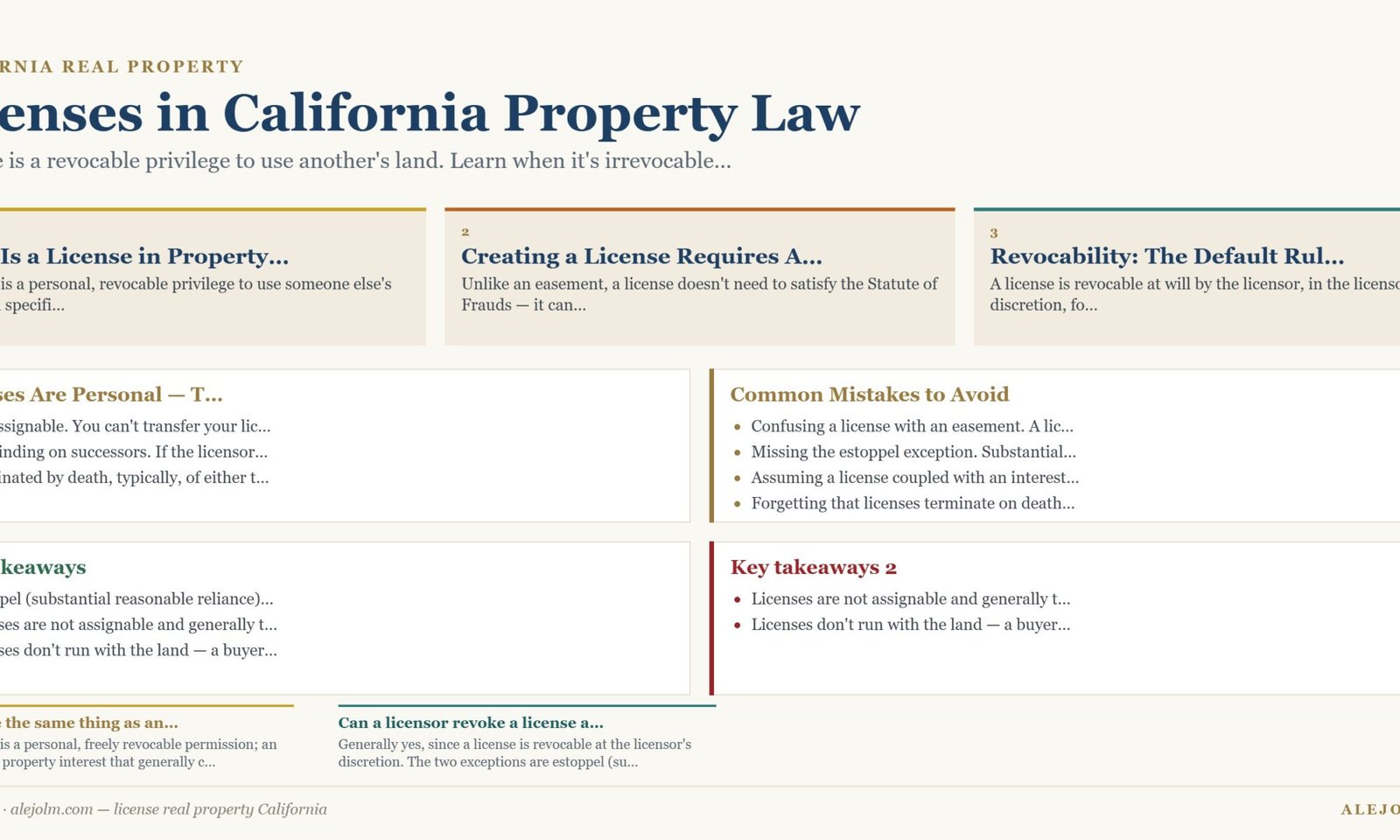
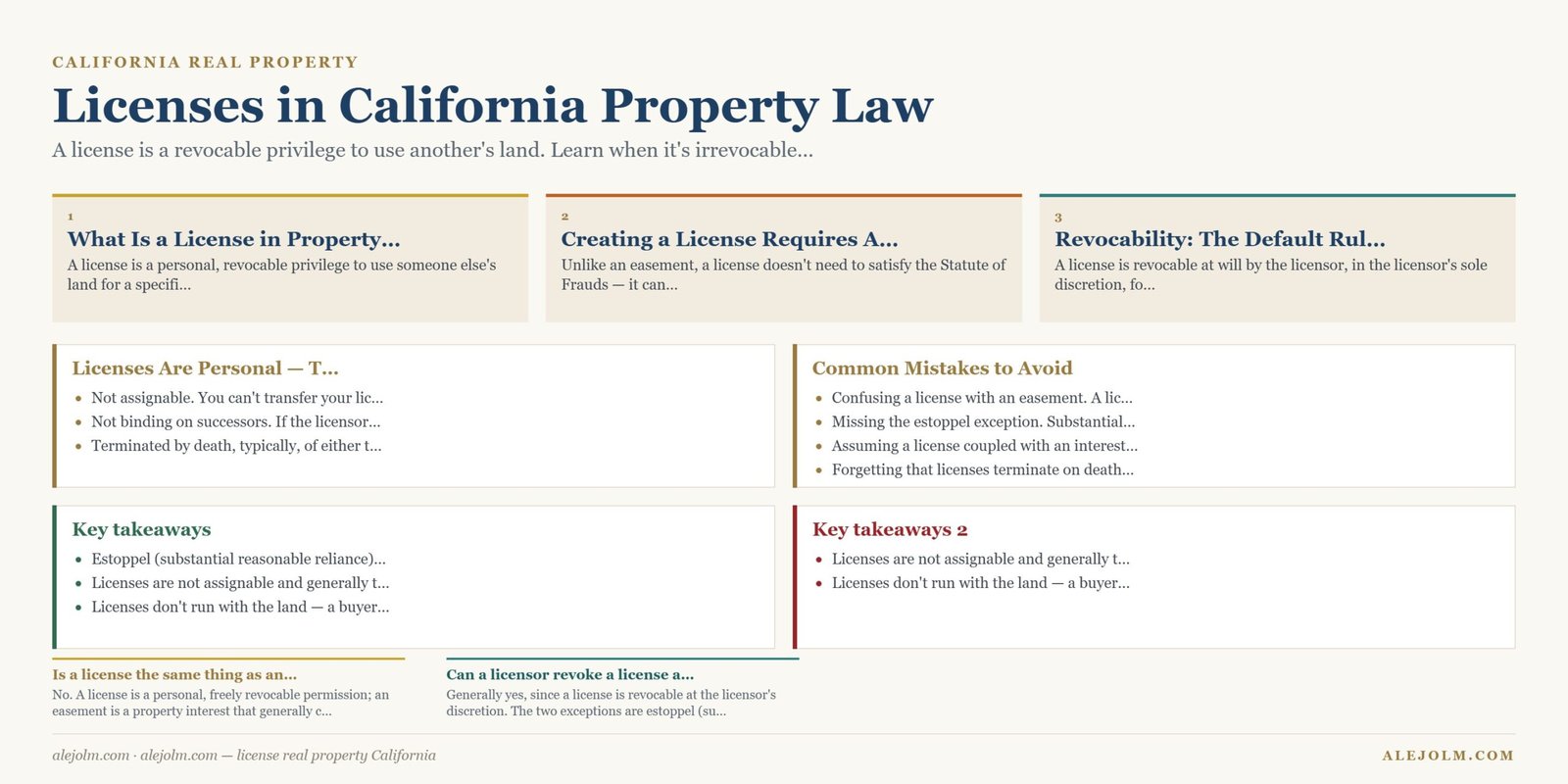
What Is a License in Property Law?
A license is a personal, revocable privilege to use someone else’s land for a specific purpose — the weakest non-possessory interest recognized in property law. It’s mere permission, not a property right, and that single fact drives every rule about it.
Understanding licenses matters beyond exam prep: a huge number of real-world neighbor disputes over driveways, shared paths, and informal arrangements turn on whether what exists is a license (revocable) or something stronger, like an easement (not revocable absent a termination event).
License, defined in one sentence: a license is an oral or written, personal, freely revocable permission to use another’s land, which does not run with the land and binds no one but the original licensor and licensee.
Creating a License Requires Almost Nothing
Unlike an easement, a license doesn’t need to satisfy the Statute of Frauds — it can be granted orally, with no writing at all. This has an important consequence: if someone tries to create an easement orally and it fails the Statute of Frauds (because it wasn’t in writing), the law doesn’t just void the arrangement. Instead, it’s treated as an automatic license — enforceable as permission, just revocable permission.
Revocability: The Default Rule and Two Exceptions
A license is revocable at will by the licensor, in the licensor’s sole discretion, for any reason or no reason. But two doctrines can make a license irrevocable:
- Estoppel. If the licensee reasonably relies on the license and makes a substantial investment of labor or money, the licensor is estopped from revoking. The license ripens into an irrevocable easement by estoppel.
- License coupled with an interest. If the licensee holds a genuine property interest tied to the license — like the right to retrieve chattels left on the licensor’s land — the license to enter and retrieve is irrevocable for as long as that underlying interest exists.
| Feature | License | Easement |
|---|---|---|
| Writing required | No | Yes, if over one year (Statute of Frauds) |
| Assignable | No — personal only | Yes, especially if appurtenant |
| Revocable | Yes, at will (subject to two exceptions) | No, absent a recognized termination method |
| Runs with the land | No | Yes, if appurtenant |
Worked Example
Your neighbor orally tells you that you can cross her driveway daily to reach your landlocked backyard shed. No writing, no payment. Relying on that permission, you spend $12,000 grading and paving a section of her driveway to make the route usable year-round. Two years later, she tells you to stop using it.
Analysis: The original arrangement was a license — oral, informal, no Statute of Frauds compliance. Ordinarily, she could revoke it at will. But your substantial, reasonable reliance — the $12,000 in improvements made in reliance on her permission — triggers estoppel. Equity will treat the license as having ripened into an irrevocable easement by estoppel, and she can no longer simply revoke it on a whim.
Now change the facts: instead of a driveway, imagine you left your bicycle at her garage temporarily, and she granted you a license to come retrieve it later. That license is coupled with an interest (your ownership of the bicycle) and is irrevocable for as long as your interest in the bicycle persists — she can’t lock you out and keep your bike.
Licenses Are Personal — They Don’t Run With the Land
A license binds only the original licensor and licensee. It is:
- Not assignable. You can’t transfer your license to a buyer of your own property.
- Not binding on successors. If the licensor sells the burdened land, the buyer isn’t bound by the license and can revoke it immediately.
- Terminated by death, typically, of either the licensor or licensee — unless coupled with an interest or expressly made assignable.
This is exactly why recording a license is pointless: since it doesn’t run with the land, there’s nothing for a recorded document to bind against future owners. Compare that to an easement by estoppel, which, once it ripens, should generally be recorded to protect it against later purchasers.
How Licenses Interact With Co-Ownership and Mortgages
If property is co-owned and one co-owner grants a license, that license binds only that co-owner’s interest — a second co-owner isn’t bound and can independently revoke the license as to their own share. This creates real friction in shared-ownership situations, where a more durable arrangement (an appurtenant easement) would clearly bind both co-owners and their successors, while a mere license remains fragile and revocable piecemeal.
Mortgage lenders generally don’t worry about ordinary licenses granted by a borrower, since they’re personal and revocable and don’t burden the land itself. But if a license has ripened into an easement by estoppel, a lender may object, since that easement does burden the collateral — which is why careful lenders sometimes require assurances that no such easement has been created.
Common Mistakes to Avoid
- Confusing a license with an easement. A license is revocable at will; an easement isn’t (absent a termination event).
- Missing the estoppel exception. Substantial reasonable reliance can make a license irrevocable — this is heavily tested.
- Assuming a license coupled with an interest is exotic. It shows up in ordinary fact patterns, like retrieving personal property left on someone’s land.
- Forgetting that licenses terminate on death and can’t be assigned to a new owner of the licensee’s land.
FAQ
Is a license the same thing as an easement?
No. A license is a personal, freely revocable permission; an easement is a property interest that generally cannot be revoked once validly created and, if appurtenant, runs with the land to successors.
Can a licensor revoke a license at any time, for any reason?
Generally yes, since a license is revocable at the licensor’s discretion. The two exceptions are estoppel (substantial reasonable reliance by the licensee) and a license coupled with a genuine property interest.
What happens if an oral easement fails the Statute of Frauds?
It isn’t simply void. Courts treat it as an automatic license — valid as revocable permission, even though it can’t operate as a binding, non-revocable easement.
Key Takeaways
- A license is a personal, revocable privilege to use another’s land, requiring no writing.
- An oral easement that fails the Statute of Frauds becomes an automatic license, not a nullity.
- Estoppel (substantial reasonable reliance) and a license coupled with an interest are the two paths to irrevocability.
- Licenses are not assignable and generally terminate on death.
- Licenses don’t run with the land — a buyer of the burdened property isn’t bound by a prior owner’s license grant.
This article is educational and is not legal advice. Consult a licensed California attorney about your situation.
Related guides
- equitable servitudes and CC&Rs in California
- profits à prendre explained
- tenancy in common ownership rules